
Introduction
The desire to learn a musical instrument is exciting, but choosing which one to start with can feel overwhelming. Thousands of people abandon their musical aspirations each year not because they lack musical talent, but because they chose an instrument that was too difficult for their situation or learning style.
The good news? Some instruments are genuinely easier to learn than others, especially in the crucial early stages. Picking an instrument with a gentler learning curve dramatically increases your chances of sticking with music long enough to experience real progress and joy.
“Easiest” is relative—it depends on your age, physical abilities, musical goals, budget, and learning style. An instrument that’s easy for one person might be challenging for another. However, certain instruments consistently produce faster initial results, require less complex finger coordination, and have gentler learning curves for beginners.
This comprehensive guide explores the easiest instruments to learn, explains what makes them beginner-friendly, compares difficulty levels, and helps you choose the perfect instrument for your situation. Whether you’re an adult returning to music, a parent choosing an instrument for your child, or simply seeking a new hobby, you’ll find the information needed to make a confident choice.
What Makes an Instrument Easy to Learn?
Before examining specific instruments, understanding what creates an “easy” learning experience helps guide your choice.
Quick Initial Results
The best beginner instruments produce recognizable sounds and simple melodies within days or weeks, not months. This early gratification keeps motivation high and makes practice feel rewarding rather than frustrating.
Instruments producing only noise or silence for weeks wear down motivation quickly. Early success is psychologically crucial for persistence.
Simple Finger Coordination Requirements
Beginner-friendly instruments don’t require complex finger dexterity or simultaneous coordination of multiple hands/feet. As you progress, coordination demands naturally increase, but beginners need accessible entry points.
Minimal Physical Prerequisites
The best beginner instruments don’t require unusual physical strength, lung capacity, or body type. They should be playable by people of various ages and physical abilities.
Clear Cause-and-Effect
When pressing a key or plucking a string produces exactly the intended note, learning accelerates. Instruments with less direct feedback (like brass, where precise embouchure produces correct pitch) have steeper learning curves.
Affordable Entry Cost
You’re less likely to abandon an instrument if you haven’t invested thousands of dollars. Many excellent beginner instruments cost under $100-200, allowing experimentation without massive financial commitment.
Extensive Teaching Resources
Popular beginner instruments have abundant free and affordable lessons, songbooks, online tutorials, and communities. Obscure instruments might be beautiful but offer limited learning support.
Reasonable Practice Time Requirements
Instruments that progress with 15-30 minutes daily practice are more sustainable than those requiring 1-2 hours minimum. Realistic practice times fit into busy lives.
Pleasant Sound Early On
Even if initial playing isn’t “good,” the instrument should sound at least pleasant, not grating. Hearing tolerable sounds encourages continued practice.
The Easiest Instruments to Learn: Ranked
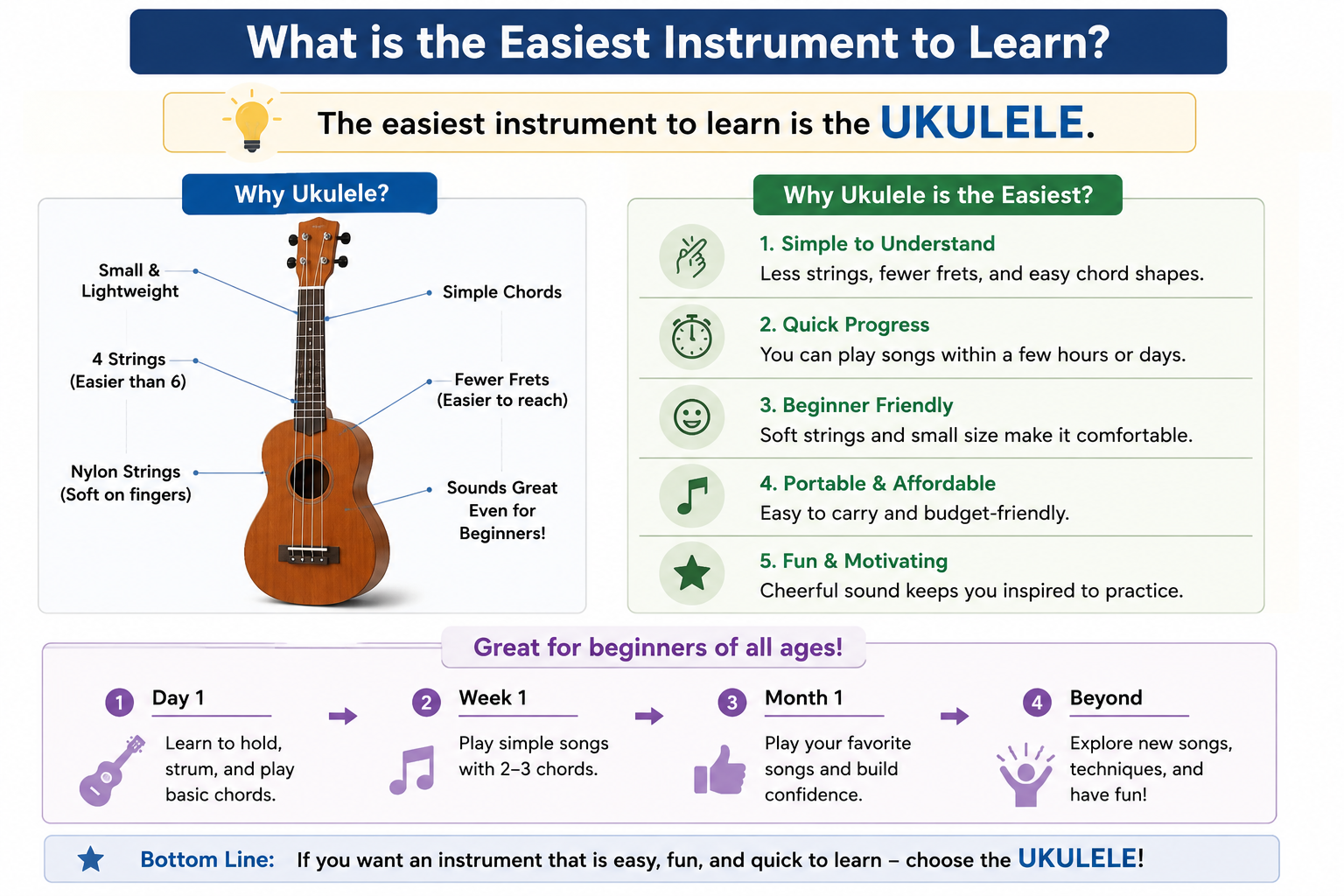
1. Ukulele: The Easiest Overall
Difficulty Level: Easiest
Time to First Songs: 1-2 weeks
Startup Cost: $50-150
The ukulele consistently ranks as the easiest instrument for beginners, and for excellent reasons.
Why Ukuleles Are So Beginner-Friendly
Gentle on fingers: Nylon strings are soft and forgiving. Your fingers won’t hurt as much as with guitar, and blisters develop slowly.
Minimal hand strength required: Young children to seniors play ukuleles successfully. No hand-crushing grip is necessary.
Simple chords: Basic songs use just 2-3 chords. Many popular songs become playable within weeks.
Quick results: You can play recognizable melodies within days.
Affordable: Quality beginner ukuleles cost $60-150. You can start without significant investment.
Small size: Easier to hold, less awkward for small hands or those with limited reach.
Intuitive fretboard: Only 4 strings (vs. 6 on guitar) makes learning simplified.
Cheerful sound: Even beginner playing sounds pleasant, not screechy.
Learning Timeline
- Week 1: Basic holding position, simple strumming patterns, first chords
- Week 2-3: Play simple songs (Wonderwall, Horse with No Name, Island in the Sun)
- Month 2-3: Stronger chord transitions, finger-picking basics, more complex songs
- Month 4-6: Reasonable proficiency, capable of playing in front of others
Best For
- Adults seeking casual hobbies
- Children ages 4+
- Anyone intimidated by guitar
- Those wanting fast initial progress
- Budget-conscious learners
Sample Learning Path
- Learn 3 basic chords: G, C, F
- Practice chord transitions until smooth
- Master simple strumming pattern
- Play 5-10 songs using these chords
- Gradually expand chord vocabulary
- Explore finger-picking and advanced techniques
2. Piano/Keyboard: The Most Intuitive
Difficulty Level: Very Easy (Beginner)
Time to First Songs: 1-2 weeks
Startup Cost: $100-300 (keyboard) to $2,000+ (acoustic piano)
Piano is often considered the easiest instrument theoretically because it’s so visually logical.
Why Piano Is Beginner-Friendly
Visual clarity: Each note is in a fixed location. You can see exactly where to press. No guessing or ear-training required initially.
Immediate, guaranteed results: Press a key, hear that note. Perfect cause-and-effect with no technique barrier.
Intuitive layout: White and black key patterns repeat, creating logic students grasp quickly.
No hand pain: Unlike guitar strings cutting fingers or ukulele blisters, piano playing is physically comfortable.
One sound per key: Each key produces one note at one pitch. Mastering pitch production takes years on other instruments but is immediate on piano.
Chord playing: Both hands can play together, expanding harmonic possibilities quickly.
Transferable knowledge: Piano skills transfer beautifully to music theory and other instruments.
Learning Timeline
- Week 1: Note names, hand position, simple single-note melodies
- Week 2-3: Basic melodies in one hand (Mary Had a Little Lamb, Twinkle Twinkle)
- Month 2: Simple two-hand pieces, basic chord concepts
- Month 3-4: More complex melodies, basic accompaniment patterns
- Month 6+: Simple classical pieces, chord progressions, music theory foundations
Best For
- Visual learners
- Those pursuing music theory
- People wanting to understand music fundamentally
- Older children and adults
- Those with limited hand strength
- Anyone seeking to transition to other instruments later
Considerations
Initial cost: Keyboards are affordable ($100-300), but acoustic pianos are expensive ($2,000-$5,000+)
Space: Full pianos require significant space; keyboards are portable
Touch differences: Digital keyboards feel different from acoustic pianos; this affects technique development
Practice space: Piano playing isn’t easily portable or silent
3. Recorder: Accessible for All Ages
Difficulty Level: Very Easy
Time to First Songs: 1-2 weeks
Startup Cost: $15-50
The recorder is famously taught in elementary schools for good reason—it’s genuinely accessible for young children.
Why Recorders Are Beginner-Friendly
Extremely affordable: Quality beginner recorders cost $15-30
Instant sound production: Blow and get a note (unlike brass instruments requiring embouchure development)
Simple finger patterns: Holes are covered sequentially; logic is straightforward
Small and portable: Fits in a backpack; can practice anywhere
Brief learning curve for basics: Play simple melodies within days
Clear fingering charts: Visual guides show exactly which holes to cover
Learning Timeline
- Day 1-3: Proper grip, breath control, producing clear notes
- Week 1: Learning first 5-8 notes, simple melodies
- Week 2-3: Playing recognizable songs (Hot Cross Buns, Mary Had a Lamb)
- Month 2-3: More complex melodies, multiple octaves
Best For
- Children ages 5+
- Those wanting to start very young
- Budget-conscious learners
- People seeking portable instruments
- Classroom or group learning settings
Considerations
Limited advanced potential: Recorders are beginner-oriented; fewer advanced songs exist than for guitar or piano
Sound limitations: Extended range and complex techniques require significant practice
Social perception: Recorders are associated with elementary school, affecting perceptions among older learners
Breath support: Requires developing diaphragm breathing, which takes practice
4. Ukulele Variants: Kalimba and Lyre
Difficulty Level: Very Easy
Time to First Songs: 1-3 weeks
Startup Cost: $30-100
Percussion-based melodic instruments offer unique advantages for certain learners.
Kalimba (Thumb Piano)
Why it’s easy:
- Arranged by pitch; each tine (metal tongue) plays one note
- Simple plucking motion
- Impossible to play “wrong”—any combination sounds pleasant
- Meditative, stress-relieving
- Beautiful sound immediately
Best for: Relaxation, meditative practice, those without music theory background
Limitations: Limited song variety; more of a relaxation tool than full instrument
Lyre
Why it’s easy:
- Ancient instrument with clear, intuitive design
- Plucking strings produces pleasant sounds
- Small number of strings (5-10)
- Quick learning for simple melodies
- Beautiful sound quality
Best for: Mythology enthusiasts, those wanting unique instruments, gentle learners
Limitations: Limited teaching resources; fewer modern songs available
5. Percussion Instruments: Drums and Ukulele
Difficulty Level: Easy to Moderate
Time to First Songs: 2-4 weeks
Startup Cost: $50-200 (beginner sets)
Percussion instruments offer different learning curves depending on the specific instrument.
Hand Drums (Djembe, Cajon, Bongos)
Why they’re accessible:
- Play immediately with pleasant sounds
- No strings or keys to tune
- Hand technique develops gradually
- Satisfying physical experience
- Rhythm focus (often easier than pitch)
Best for: Those with rhythmic focus, tactile learners, rhythm-game players
Drum Set: More Complex
Drums have a steeper learning curve than drums alone—coordinating hands and feet simultaneously is challenging.
Best for: Those with strong rhythm sense, people wanting ensemble experience
Comparison: Difficulty by Instrument
Very Easy (Playable within days)
- Ukulele
- Kalimba
- Lyre
- Hand drums
- Recorder
- Keyboard/Piano
Easy (Playable within weeks)
- Acoustic guitar (with nylon strings)
- Harmonica
- Melodica
- Glockenspiel
- Djembe
Moderate (Playable within months)
- Acoustic guitar (steel strings)
- Violin
- Clarinet
- Flute
- Trumpet
- Saxophone
- Drum set
- Banjo
More Challenging (Playable within 6-12 months)
- Oboe
- French horn
- Trombone
- Cello
- Mandolin
- Bagpipes
Most Challenging (Playable within 1-2+ years)
- Classical guitar
- Violin (advanced)
- Organ
- Double bass
- Orchestral instruments
Choosing the Right Easy Instrument for You
Consider Your Goals
Want quick results? Choose ukulele or piano
Love music theory? Piano provides best foundation
Want portable instrument? Ukulele, recorder, or kalimba
Prefer ensemble playing? Instrument depends on interests (drums for rhythm section, wind instruments for bands)
Seeking relaxation/meditation? Kalimba or hand drums
Want to play popular music? Ukulele, guitar (easier nylon version), or keyboard
Consider Your Age
Young children (ages 4-6): Recorder, small ukulele, hand drums
Older children (ages 7-12): Ukulele, piano, recorder, guitar
Teens: Any instrument; depends on interest and goals
Adults: Ukulele, piano, or instruments matching personal music taste
Consider Your Physical Abilities
Limited hand strength: Piano, recorder, kalimba, hand drums
Smaller hands: Ukulele (smaller neck), recorder, piano, hand drums
Hearing difficulties: Vibration-based instruments like vibraphone might work better; some percussion instruments
Limited lung capacity: Non-wind instruments (guitar, ukulele, piano, drums)
Limited mobility: Keyboard, hand drums (stationary options)
Consider Your Learning Style
Visual learners: Piano (see exact notes and hand positions)
Auditory learners: Ear training instruments; wind instruments providing immediate tone feedback
Kinesthetic learners: Guitar, percussion, hand drums (physical engagement)
Theory-oriented: Piano (clearly shows relationships)
Practical/application-oriented: Ukulele (play songs immediately)
Consider Your Budget
Under $50: Recorder, kalimba, hand drums, basic ukulele
$50-200: Decent ukulele, beginner keyboard, basic guitar
$200-500: Better ukulele, intermediate keyboard, decent acoustic guitar
$500+: Quality acoustic guitar, entry-level acoustic piano, decent electric keyboard with weighted keys
Consider Your Living Situation
Apartment/quiet needed: Keyboard, guitar, ukulele (relatively quiet)
Soundproofing available: Any instrument
Outdoor/mobile: Ukulele, recorder, portable drums
Shared housing: Headphone-friendly keyboard, quieter instruments
Common Mistakes When Choosing Easy Instruments
Mistake 1: Choosing Based Solely on Difficulty
Easy instrument + no interest = abandoned instrument. Choose something you genuinely want to play.
Solution: Pick an easy instrument you love rather than difficult instrument you’re indifferent about.
Mistake 2: Buying Cheap Instruments
An extremely cheap instrument sounds terrible, feels awful, and discourages practice.
Solution: Spend $100-200 on a decent beginner instrument. Quality dramatically affects learning experience.
Mistake 3: Starting Too Advanced
Jumping to acoustic guitar (steel strings, wider neck) when ukulele exists is setting yourself up for frustration.
Solution: Start with genuinely easiest version (nylon-string guitar, small ukulele for small hands, beginner keyboard).
Mistake 4: Ignoring Accessibility
Choosing an instrument you physically struggle with defeats the purpose of “easy.”
Solution: Honestly assess your physical abilities and choose accordingly.
Mistake 5: Neglecting Teaching Resources
An easy instrument with no lessons available becomes hard quickly.
Solution: Choose instruments with abundant online tutorials, books, and community support.
Mistake 6: Not Committing Properly
Expecting instant mastery without consistent practice frustrates learners.
Solution: Plan 15-30 minutes daily practice. Even “easy” instruments require some effort.
From Easy to Fluent: Building Progress
First Month: Fundamentals
Focus areas:
- Proper hand/mouth position
- Basic technique
- 3-5 simple songs
- Consistent daily practice
Expected results:
- Play recognizable melodies
- Understand basic music reading
- Feel progress
Months 2-3: Building Repertoire
Focus areas:
- Expand song library
- Smoother technique
- Faster transitions
- Music theory basics
Expected results:
- Play 10-20 songs
- Perform for friends/family
- Recognize patterns
- Growing confidence
Months 4-6: Developing Style
Focus areas:
- Personal interpretation
- More complex pieces
- Genre exploration
- Developing “voice”
Expected results:
- Play with expression
- Create personal arrangements
- Impress listeners
- Genuine enjoyment
Beyond 6 Months: The Musician
Focus areas:
- Advanced techniques
- Music theory depth
- Ensemble playing
- Creative expression
Expected results:
- Competent musician
- Play numerous styles
- Teach others
- Lifelong music engagement
The Psychology of “Easy”: Why It Matters
Initial Motivation
Easy instruments provide the quick wins that build motivation. Struggling for months without hearing yourself play discourages continuation.
Confidence Building
Early success builds confidence for later challenges. You’re more willing to tackle difficult techniques when you’ve experienced success.
Habit Formation
It’s easier to establish daily practice habits when practice feels rewarding rather than frustrating.
Long-Term Engagement
People who stick with music long-term often started with easy instruments. The journey from easy to advanced creates deeper musicianship than starting with difficulty.
FAQ: Common Questions About Easy Instruments
Q1: Is ukulele “too easy”? Will I outgrow it?
A: No. Ukulele has vast depth—from beginner strumming to complex fingerpicking, Hawaiian music, classical arrangements, and jazz. Many lifelong musicians play ukulele. It’s easy to start but deep to master.
Q2: If I learn ukulele, can I transition to guitar?
A: Yes, easily. Ukulele teaches finger dexterity, chord understanding, and music basics that transfer directly. Ukulele players transition to guitar smoothly.
Q3: What if I start with piano but want to play guitar later?
A: Piano teaches music theory and rhythm beautifully but doesn’t develop guitar-specific finger strength or techniques. You’d restart technique training but keep theory knowledge.
Q4: Is recorder too childish for adults?
A: Recorder is taught in schools, but many adult recorder players play serious classical and early music. However, social perception exists. If this concerns you, ukulele might feel more age-appropriate.
Q5: How much should I spend on a beginner instrument?
A: $75-200 is ideal. Cheaper instruments sound terrible and discourage practice. Expensive instruments are wasted if you abandon the hobby. Mid-range provides quality that lasts years.
Q6: Should I get lessons or teach myself?
A: Lessons (especially first 4-8 weeks) prevent developing bad habits that become hard to break. Group lessons or online instruction work well for easy instruments.
Q7: Can I learn an “easy” instrument at any age?
A: Yes. Age-appropriate considerations exist (young children with recorder, etc.), but adults successfully learn ukulele, piano, and other “easy” instruments.
Q8: What if I’m not musical? Can I still learn?
A: Yes. “Musicality” develops through practice. Everyone can learn music; some just need longer. Start with easy instruments and give yourself grace.
Conclusion
The easiest instrument to learn is undoubtedly the ukulele—it combines quick results, minimal pain, affordability, and gentle learning curves. Close seconds include piano (for visual learners and theory focus) and recorder (for young children and portability).
However, “easiest” is personal. The best instrument for you is:
- Easy enough to avoid frustration
- Interesting enough to maintain motivation
- Accessible to your physical abilities
- Aligned with your musical interests
- Supported by available teaching resources
Start with an easy instrument. This isn’t settling—it’s wisdom. Easy instruments build confidence, establish habits, and prove you can learn music. From this foundation, you can transition to more challenging instruments or deepen your chosen instrument’s mastery.
The biggest mistake isn’t choosing an “easy” instrument—it’s choosing an instrument and not practicing. Consistency beats difficulty every time. Fifteen minutes daily of ukulele practice far outpaces sporadic guitar heroics.
Your musical journey matters. Choose the instrument that excites you while forgiving your beginner mistakes. In months, you’ll be playing recognizable songs. In a year, playing around campfires or in front of friends. In years, contributing something beautiful to the world.
Don’t overthink it. Pick an easy instrument that calls to you, invest in decent quality, commit to practice, and begin. Your musical life awaits.