
How to Prepare for the ALEKS Chemistry Initial Knowledge Check
Introduction
If you are a college or university student enrolled in a chemistry course, chances are you have heard about the ALEKS Chemistry Initial Knowledge Check. This assessment is one of the first steps in your chemistry learning journey through the ALEKS platform — a powerful AI-driven educational tool used by thousands of institutions worldwide.
The ALEKS Initial Knowledge Check is designed to evaluate what you already know about chemistry before your course officially begins. It helps the system understand your current level of knowledge and creates a personalized learning path tailored specifically to your strengths and weaknesses. Think of it as a starting point — not a pass or fail test — but a smart diagnostic tool that sets you up for academic success.
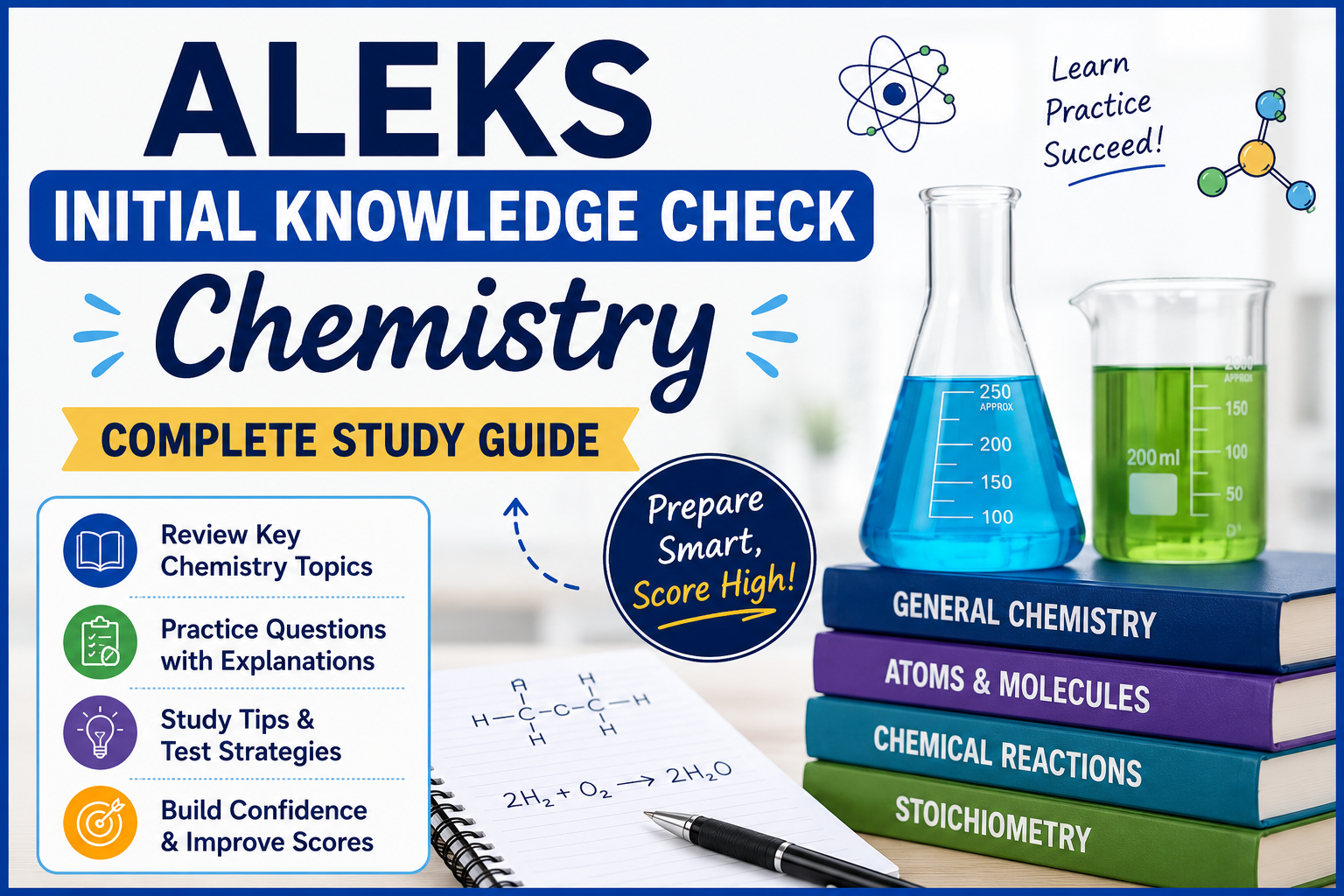
This complete study guide for 2026 will walk you through everything you need to know about the ALEKS Chemistry Initial Knowledge Check — from understanding its purpose and format, to the topics it covers, effective preparation strategies, common mistakes to avoid, and original practice questions with detailed explanations. Whether you are preparing days or weeks in advance, this guide will help you feel confident and ready.
What Is the ALEKS Chemistry Initial Knowledge Check?
Assessment Overview
The ALEKS Chemistry Initial Knowledge Check is an adaptive online assessment offered through the ALEKS (Assessment and LEarning in Knowledge Spaces) platform. ALEKS is widely used in colleges and universities as both a placement and learning tool for subjects like mathematics, chemistry, statistics, and other STEM disciplines.
The Initial Knowledge Check is typically the very first activity students complete when they begin using ALEKS for a chemistry course. It consists of a series of open-ended questions — not multiple choice — where students must type in their answers. This format ensures that students cannot simply guess and eliminates the possibility of getting lucky with random answers.
The assessment generally contains around 20 to 35 questions and covers a broad range of chemistry topics. The number of questions may vary depending on your responses, since the system adapts based on how you answer each question.
Placement Purpose
The primary purpose of the ALEKS Chemistry Initial Knowledge Check is placement and personalization. After completing the assessment, ALEKS generates a detailed report of what topics you already understand and which ones still need work. Based on these results, the system creates your personal ALEKS Pie — a visual representation of all the chemistry topics in your course, divided into mastered and unmastered areas.
This placement data helps both students and instructors in several important ways:
- Students know exactly where to focus their study efforts
- Instructors can identify class-wide knowledge gaps and adjust their teaching accordingly
- The ALEKS system builds a customized learning path so students are not wasting time on topics they already know
Adaptive Testing: Basic Concept
ALEKS uses a concept called adaptive testing, which means the assessment adjusts itself based on your performance. If you answer a question correctly, the system may present a slightly more advanced question. If you struggle with a question, the system adjusts accordingly.
This adaptive approach gives ALEKS a more accurate picture of your knowledge compared to traditional fixed tests. It is important to understand that the goal of the Initial Knowledge Check is not to trick you — it is simply trying to map out what you know. Honesty and genuine effort during the assessment will result in a more accurate and helpful learning path for you.
Topics Commonly Covered in the ALEKS Chemistry Initial Knowledge Check
The ALEKS Chemistry Initial Knowledge Check covers a wide range of foundational and intermediate chemistry topics. Here is an overview of the most commonly tested subject areas:
1. Atomic Structure
This topic covers the basic building blocks of matter. You may be asked about protons, neutrons, and electrons, atomic numbers, mass numbers, isotopes, and electron configuration. Understanding how atoms are structured is fundamental to all other areas of chemistry.
2. Periodic Table
Questions related to the periodic table test your ability to identify elements, understand periodic trends such as electronegativity, atomic radius, and ionization energy, and recognize groups and periods. Knowing how to read and interpret the periodic table is an essential skill.
3. Chemical Bonding
This section explores how atoms connect with each other. Topics include ionic bonds, covalent bonds, metallic bonds, Lewis structures, VSEPR theory, and molecular geometry. Understanding chemical bonding helps explain the properties of different substances.
4. Chemical Reactions
You may encounter questions about different types of chemical reactions — synthesis, decomposition, single replacement, double replacement, and combustion. Balancing chemical equations is also a key skill tested in this area.
5. Stoichiometry
Stoichiometry involves quantitative calculations related to chemical reactions. This includes mole calculations, molar mass, limiting reagents, percent yield, and conversion between grams and moles. This is one of the most calculation-heavy topics in the assessment.
6. Acids and Bases
Questions in this category cover pH scale, strong and weak acids and bases, neutralization reactions, and buffer solutions. You should be familiar with common acids and bases and their properties.
7. Gases
The behavior of gases is an important chemistry topic. This includes the Ideal Gas Law (PV = nRT), Boyle’s Law, Charles’s Law, Gay-Lussac’s Law, and Dalton’s Law of Partial Pressures. Understanding how pressure, volume, and temperature relate to each other is critical.
8. Solutions and Concentration
This topic covers how substances dissolve in solvents and how to calculate concentration. Key concepts include molarity, molality, dilution calculations, solubility rules, and colligative properties such as boiling point elevation and freezing point depression.
How to Prepare Before the Assessment
Proper preparation before taking the ALEKS Chemistry Initial Knowledge Check can make a significant difference in your results. Here is a step-by-step preparation plan:
Review Chemistry Fundamentals
Start by going back to basics. Review your high school or introductory college chemistry notes and textbooks. Make sure you have a solid understanding of core concepts like atomic structure, the periodic table, and basic chemical reactions before moving on to more advanced topics.
Practice Calculations
Many chemistry questions involve mathematical calculations. Practice performing calculations manually without relying on shortcuts. Work through problems involving molar mass, stoichiometry, molarity, and gas law equations. The more you practice, the faster and more accurate you will become.
Memorize Important Formulas
Create a formula sheet that includes all the key equations you need to know. Some essential formulas include:
- Molarity: M = moles of solute / liters of solution
- Ideal Gas Law: PV = nRT
- Percent Yield: (Actual Yield / Theoretical Yield) × 100
- Dilution Formula: M₁V₁ = M₂V₂
- pH Formula: pH = -log[H⁺]
Review this formula sheet daily until the formulas become second nature.
Solve Sample Questions
Practice is the most effective form of preparation. Work through as many sample chemistry questions as possible. Focus on open-ended questions that require you to calculate, explain, or analyze — since this mirrors the ALEKS format more closely than multiple-choice questions.
Revise Weak Topics
After reviewing all topics, identify the areas where you feel least confident. Dedicate extra study time to those weak areas. Use online resources, textbooks, and educational videos to strengthen your understanding before the assessment.
Common Mistakes Students Make
Being aware of common mistakes can help you avoid them during the assessment:
1. Guessing Answers
Unlike multiple-choice tests, guessing on ALEKS is not effective because you must type in your answers. Random guessing will quickly reveal knowledge gaps to the system and result in an inaccurate knowledge map. Always attempt to work through the problem logically.
2. Ignoring Units
In chemistry, units matter enormously. A common mistake is performing calculations correctly but entering the wrong unit or forgetting to include units altogether. Always double-check that your answer includes the correct unit of measurement.
3. Skipping Calculations
Some students try to mentally estimate calculations instead of working them out properly. Even simple-looking stoichiometry or gas law problems can have non-obvious answers. Always show your work and solve calculations step by step.
4. Poor Time Management
While the ALEKS Initial Knowledge Check does not have a strict time limit in most cases, students should still practice working efficiently. Spending too long on a single question can cause mental fatigue and reduce your overall performance. If you are stuck, move on and come back if possible.
5. Not Taking It Seriously
Because the Initial Knowledge Check is not a graded exam, some students do not take it seriously. This is a mistake. The more accurately the assessment captures your knowledge, the more effective your personalized learning path will be. Treat it as a genuine opportunity to showcase what you know.
Sample Chemistry Practice Questions
Here are 10 original chemistry practice questions with detailed explanations to help you prepare for the ALEKS Chemistry Initial Knowledge Check:
Question 1: What is the atomic number of oxygen?
Answer: 8
Explanation: The atomic number of an element equals the number of protons in its nucleus. Oxygen has 8 protons, so its atomic number is 8. It is located in Period 2, Group 16 of the periodic table.
Question 2: Calculate the molarity of a solution containing 2 moles of NaCl dissolved in 1 liter of water.
Answer: 2 M (2 mol/L)
Explanation: Molarity (M) = moles of solute ÷ liters of solution = 2 mol ÷ 1 L = 2 M. Molarity is the most common unit of concentration used in chemistry.
Question 3: What type of chemical bond forms between sodium (Na) and chlorine (Cl)?
Answer: Ionic Bond
Explanation: Sodium is a metal and chlorine is a nonmetal. When they react, sodium loses one electron to form Na⁺ and chlorine gains one electron to form Cl⁻. The electrostatic attraction between these oppositely charged ions forms an ionic bond, resulting in sodium chloride (NaCl).
Question 4: Balance the following chemical equation: H₂ + O₂ → H₂O
Answer: 2H₂ + O₂ → 2H₂O
Explanation: To balance this equation, count atoms on both sides. The balanced equation has 4 hydrogen atoms and 2 oxygen atoms on both sides, satisfying the Law of Conservation of Mass.
Question 5: What is the pH of a solution with a hydrogen ion concentration of 0.001 M?
Answer: pH = 3
Explanation: Using the formula pH = -log[H⁺]: pH = -log(0.001) = -log(10⁻³) = 3. A pH of 3 indicates an acidic solution.
Question 6: A gas occupies 4 liters at 2 atm pressure. What volume will it occupy at 1 atm? (Temperature constant)
Answer: 8 liters
Explanation: Using Boyle’s Law: P₁V₁ = P₂V₂ → (2 atm)(4 L) = (1 atm)(V₂) → V₂ = 8 L. When pressure decreases, volume increases proportionally.
Question 7: How many moles are in 44 grams of carbon dioxide (CO₂)?
Answer: 1 mole
Explanation: Molar mass of CO₂ = 12 (C) + 16×2 (O) = 44 g/mol. Moles = mass ÷ molar mass = 44 g ÷ 44 g/mol = 1 mole.
Question 8: What is the electron configuration of calcium (Ca, atomic number 20)?
Answer: 1s² 2s² 2p⁶ 3s² 3p⁶ 4s²
Explanation: Calcium has 20 electrons. Following the Aufbau principle, electrons fill orbitals in order of increasing energy. Calcium belongs to Group 2 (alkaline earth metals) and has 2 valence electrons in the 4s orbital.
Question 9: Identify the limiting reagent when 3 moles of H₂ reacts with 1 mole of N₂ to produce ammonia (N₂ + 3H₂ → 2NH₃).
Answer: Neither — they are in exact stoichiometric ratio
Explanation: The balanced equation requires 1 mole of N₂ for every 3 moles of H₂. Since we have exactly 1 mole N₂ and 3 moles H₂, both reactants are completely consumed. There is no limiting reagent in this case.
Question 10: What is the difference between a strong acid and a weak acid?
Answer: A strong acid completely dissociates in water; a weak acid only partially dissociates.
Explanation: Strong acids like HCl and H₂SO₄ release all their hydrogen ions in solution. Weak acids like acetic acid (CH₃COOH) only partially ionize, reaching an equilibrium state. This difference significantly affects pH and reactivity.
Study Tips for Better Performance
Daily Revision
Set aside 30 to 60 minutes each day for chemistry revision. Consistent daily review is far more effective than cramming the night before an assessment. Focus on one or two topics per session to avoid feeling overwhelmed.
Practice Quizzes
Take as many practice quizzes as possible before your assessment. Use online platforms, textbooks, and educational apps to find chemistry practice questions. The more variety in your practice, the better prepared you will be.
Build a Formula Sheet
Compile all essential chemistry formulas on a single reference sheet. Review this sheet daily. Writing formulas by hand repeatedly also helps commit them to memory more effectively than simply reading them.
Time Management
During your preparation period, practice solving questions within a set time frame. This builds your ability to work efficiently and reduces anxiety during the actual assessment.
Review Incorrect Answers
After every practice session, carefully review every question you answered incorrectly. Understand why your answer was wrong and what the correct approach should have been. This review process is where the most learning happens.
Frequently Asked Questions
What is the ALEKS Chemistry Initial Knowledge Check?
The ALEKS Chemistry Initial Knowledge Check is an adaptive diagnostic assessment used by the ALEKS platform to evaluate a student’s existing chemistry knowledge at the beginning of a course. It helps create a personalized learning path based on the student’s current understanding of chemistry concepts.
How can I prepare effectively?
Effective preparation involves reviewing chemistry fundamentals, practicing calculations regularly, memorizing key formulas, solving sample questions, and focusing extra attention on weak topic areas. Using this study guide as a roadmap is an excellent starting point.
What chemistry topics should I study?
Focus on the eight core areas: atomic structure, the periodic table, chemical bonding, chemical reactions, stoichiometry, acids and bases, gases, and solutions and concentration. These topics form the foundation of most introductory college chemistry courses.
How long does the assessment usually take?
The ALEKS Initial Knowledge Check typically takes between 45 minutes to 2 hours, depending on the number of questions generated by the adaptive system and how quickly you work through them. The exact duration varies by individual.
Can I improve my chemistry skills before taking the assessment?
Absolutely! Dedicating even one to two weeks of focused study before the assessment can significantly improve your performance. Use online resources, textbooks, video tutorials, and practice questions to strengthen your understanding before you begin.
Conclusion
The ALEKS Chemistry Initial Knowledge Check is an important and valuable tool that sets the foundation for your entire chemistry learning experience. Rather than viewing it as a stressful examination, approach it as an opportunity to honestly assess your current knowledge and receive a personalized learning plan designed specifically for you.
The key takeaway from this guide is simple: focus on understanding concepts rather than memorizing answers. Chemistry is a subject built on logic, patterns, and principles. When you truly understand why a chemical reaction occurs or how gas laws work, you will be able to apply that knowledge to any question — regardless of how it is worded.
Use the study strategies outlined in this guide — daily revision, formula memorization, practice questions, and error review — to build genuine chemistry competence. The more effort you put into preparation, the more accurately the ALEKS system will map your knowledge, and the more efficient your learning journey will be.
Start your preparation today, stay consistent, and trust the process. With the right mindset and the right study habits, you will walk into your ALEKS Chemistry Initial Knowledge Check feeling confident, prepared, and ready to succeed.