
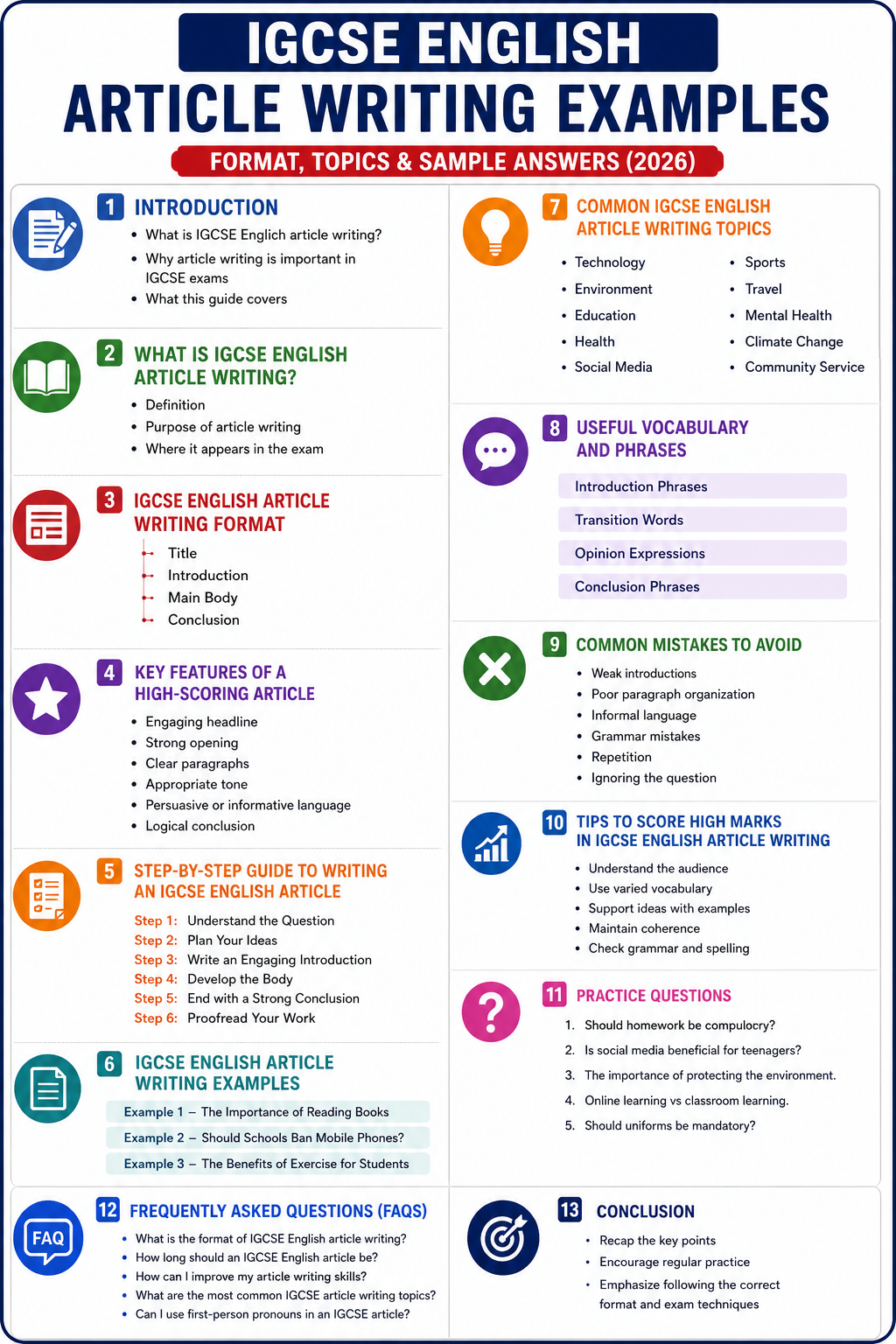
Introduction
Article writing is one of the most important writing skills tested in IGCSE English examinations. Whether you’re writing for a school magazine, newspaper, or blog, knowing how to write IGCSE English articles can significantly boost your exam score.
IGCSE English article writing requires you to present ideas clearly, engage readers, and maintain proper format. Unlike essays, articles have a more journalistic tone and must grab attention immediately.
This comprehensive guide covers everything you need to know about IGCSE article writing: format, structure, examples, topics, tips, and practice questions to help you excel.
Let’s master the art of article writing for IGCSE exams.
What Is IGCSE English Article Writing?
Definition
Article writing in IGCSE English is a form of extended writing where students compose pieces for publication-style formats like newspapers, magazines, websites, or blogs.
Key characteristics:
- Presents information or opinions to a specific audience
- Written in journalistic or magazine style
- Includes engaging headline
- Uses clear paragraphing
- Maintains appropriate tone
- Typically 250-400 words
Purpose of Article Writing
Why articles matter in IGCSE:
✓ Tests your ability to communicate effectively
✓ Assesses your understanding of audience
✓ Evaluates tone and style management
✓ Examines persuasive and informative writing skills
✓ Challenges your vocabulary and grammar
✓ Develops real-world writing skills
Where It Appears in the Exam
IGCSE English (0500 and 0511):
- Usually appears in Paper 1 (Reading and Writing)
- May be Task 1 or Task 2
- Worth significant marks (around 25 marks)
- Contributes to overall writing grade
- Time allocation: 45-60 minutes typical
IGCSE English Article Writing Format
Title/Headline
Purpose: Grab reader’s attention immediately
Characteristics:
- Catchy and engaging
- Relevant to topic
- Not too long (usually 5-10 words)
- Can be question, statement, or creative
- Sets tone for article
Examples:
- “Why Your Smartphone Might Be Your Worst Enemy”
- “Should Schools Ban Mobile Phones? Here’s Why”
- “The Hidden Truth About Social Media”
- “Why Reading Could Change Your Life”
Introduction
Purpose: Hook readers and introduce topic
What to include:
- Attention-grabbing opening sentence
- Context about the topic
- Your main point or question
- Main idea in 3-4 sentences
- Sets up body paragraphs
Techniques:
- Ask a question
- Make a surprising statement
- Tell a brief anecdote
- Use statistics
- Start with a quote
Main Body
Structure:
- 2-4 paragraphs typically
- Each paragraph one main idea
- Use topic sentences
- Support with examples
- Use transition words between paragraphs
Each body paragraph should:
- Start with topic sentence
- Develop one main point
- Include examples or evidence
- Connect back to main idea
- Lead to next paragraph
Conclusion
Purpose: Summarize and wrap up article
What to include:
- Summarize main points
- Final thought or recommendation
- Call to action (sometimes)
- Memorable ending
- Leave reader thinking
Should be:
- 2-3 sentences typically
- Strong and definitive
- Connected to introduction
- Forward-looking
Key Features of a High-Scoring IGCSE English Article
Engaging Headline
High-scoring headlines:
- Creative and interesting
- Relevant to topic
- Appropriate tone
- Makes reader want to read
- Not too long
Weak headlines: “Article About Reading” / “My Opinion on Technology”
Strong headlines: “Why Reading Books Beats Scrolling on Screens” / “The Tech Trap: How Your Phone is Stealing Your Life”
Strong Opening
Excellent openings:
- Start with hook (question, statement, statistic)
- Establish relevance
- Clear and engaging
- Natural and conversational
- Make purpose clear
Example: “Imagine a world without books. Impossible, right? Yet today’s teenagers are spending less time reading than ever before. But what are we really losing?”
Clear Paragraphing
Well-organized articles:
- Logical flow between paragraphs
- Clear topic sentences
- Supporting details in each paragraph
- Transition words connecting ideas
- Easy to follow
Appropriate Tone
Matching tone to purpose:
- Informative articles: factual, objective
- Persuasive articles: convincing, engaging
- Humorous articles: witty, light
- Serious articles: thoughtful, respectful
- Consistent throughout
Persuasive or Informative Language
Persuasive techniques:
- Rhetorical questions
- Personal pronouns (we, you)
- Strong adjectives
- Examples and evidence
- Emotional appeals (when appropriate)
Informative language:
- Clear explanations
- Facts and statistics
- Examples that illustrate
- Definition of terms
- Objective presentation
Logical Conclusion
Excellent conclusions:
- Summarize main points without repetition
- Leave reader with final thought
- May include call to action
- Return to opening idea (sometimes)
- Memorable and strong
Step-by-Step Guide to Writing IGCSE English Article
Step 1: Understand the Question
Before writing:
- Read the question carefully
- Identify what type of article needed
- Understand the audience
- Note any specific requirements
- Clarify topic and angle
Ask yourself:
- Who will read this? (Audience)
- What is the purpose? (Inform? Persuade? Entertain?)
- What angle should I take?
- How formal should it be?
- How long should it be?
Step 2: Plan Your Ideas
Brainstorm:
- Write down all ideas related to topic
- Don’t judge ideas yet
- Think of examples and evidence
- Consider different perspectives
- List questions to address
Organize ideas:
- Group related ideas
- Decide main point
- Choose strongest supporting ideas
- Arrange in logical order
- Create rough outline
Outline example:
- Introduction: Hook + topic
- Body paragraph 1: Point A + examples
- Body paragraph 2: Point B + examples
- Body paragraph 3: Point C + examples
- Conclusion: Summary + final thought
Step 3: Write an Engaging Introduction
First sentence (the hook):
- Ask a question
- Make shocking statement
- Use interesting statistic
- Tell brief story
- Use vivid description
Then establish:
- Why topic matters
- What you’ll discuss
- Your angle or position
Example:
“Would you give up your phone for a week? If the thought terrifies you, you’re not alone. Smartphone addiction has become a serious problem for teenagers today. But can we fix this without giving up technology entirely? Let’s explore.”
Step 4: Develop the Body
Each paragraph:
- Starts with clear topic sentence
- Develops one main idea
- Includes 1-2 supporting examples
- Uses facts, statistics, or evidence
- Ends with transition to next idea
Sample paragraph structure:
“Topic sentence states main point. Example one explains and illustrates. Example two provides further evidence. This connects to why it matters. Transition sentence leads to next paragraph.”
Step 5: End with a Strong Conclusion
Final paragraph:
- Briefly summarize main points
- Offer final thought or recommendation
- Perhaps suggest action
- Return to opening theme (optional)
- End memorably
Example:
“In conclusion, while smartphones aren’t going away, we must teach young people healthier relationships with technology. The solution isn’t banning devices but educating users. Start today by challenging yourself: can you go one hour without checking your phone?”
Step 6: Proofread Your Work
Check for:
- Spelling errors
- Grammar mistakes
- Punctuation problems
- Clarity of ideas
- Flow between paragraphs
- Correct format
- Word count
Read aloud: Helps catch awkward phrasing.
IGCSE English Article Writing Examples
Example 1: The Importance of Reading Books
Title: Why Teenagers Should Put Down Their Phones and Pick Up a Book
Article:
In our digital age, reading books seems like an outdated activity. Yet nothing could be further from the truth. Reading books offers teenagers benefits that no app or website can provide.
First, books develop imagination and creativity. When you read, your mind creates vivid pictures of characters and worlds. Video games and movies hand you finished images. Books let your imagination do the work. This exercise strengthens your brain’s creative abilities, skills you’ll use throughout life.
Second, reading improves your vocabulary and writing. Every book introduces new words in context. You absorb proper grammar naturally. Better vocabulary helps in exams, job applications, and every conversation. Reading good literature also teaches you how writing should sound, improving your own expression.
Finally, books provide real escape from stress. Unlike scrolling through social media, which increases anxiety, reading creates a calm, focused space. You enter a different world, forgetting worries temporarily. This mental break reduces stress more effectively than most other activities.
Some argue that audiobooks and e-readers serve the same purpose. While these formats are useful, physical reading engages your brain differently, creating stronger memory and deeper understanding.
The evidence is clear. Making time for books isn’t returning to the past—it’s investing in your future. Start with one book this month. You might be surprised how quickly you become hooked.
Example 2: Should Schools Ban Mobile Phones?
Title: Why Banning Phones in Schools Makes Perfect Sense
Article:
Picture a classroom where every student is focused, where teachers have everyone’s attention, where learning actually happens. This ideal seems impossible in today’s schools. But the solution might be simpler than you think: ban mobile phones.
Critics argue that phones are essential for safety and communication. This misses the point. Students can access phones during lunch, recess, and emergencies. The problem isn’t access but constant distraction.
Research proves this. A study by the University of Chicago found that having phones nearby reduced test performance by 10-15%, even when phones were off. The mere presence of phones distracts students. When phones are banned, classroom behavior improves, grades increase, and students report better focus.
Beyond academic benefits, phone bans teach discipline. Young people need to learn that some places require undivided attention. Workplaces will demand this. Universities will expect it. Schools should prepare students for this reality.
Some students claim they need phones for organizational apps. Fair point—but many schools could allow educational apps while banning social media. Schools might distribute simple devices for learning only.
The evidence supports phone bans. Countries implementing strict policies report dramatic improvements in student behavior and achievement. Students initially resist but quickly adapt and appreciate focused learning environments.
Schools exist to educate. When phones undermine this purpose, removing them becomes not restriction but protection of education itself. Students can survive a few hours without phones. Their education deserves this investment.
Example 3: The Benefits of Exercise for Students
Title: Why Every Student Needs to Exercise: More Than Just Physical Health
Article:
Exercise is universally recognized as healthy. But many students skip it, viewing sports as optional extras. This overlooks exercise’s profound benefits for student success.
Academic performance improves with exercise. Physical activity increases blood flow to the brain, enhancing concentration and memory. Students who exercise regularly score higher on tests. They focus better in class. They retain information more effectively. One study found that regular exercise improved exam performance by an average of 5 grades.
Mental health benefits are equally important. Students face enormous pressure today. Anxiety and depression plague teenagers. Exercise is a natural antidepressant. Physical activity releases endorphins, natural mood-improving chemicals. Just 30 minutes of exercise can lift mood for hours.
Sleep improves dramatically with exercise. Regular physical activity deepens sleep quality. Students sleep better, waking refreshed. Better sleep means better focus, better mood, better overall function.
Some claim exercise takes time from studying. Actually, the opposite is true. Exercise improves study efficiency. Exercising students achieve more in less time. They’re more focused, more energized, more productive.
Finally, exercise builds resilience and confidence. Achieving fitness goals creates self-esteem. Meeting physical challenges builds mental toughness. These qualities transfer to academic and personal challenges.
The message is clear. Exercise isn’t optional for students. It’s essential for academic success, mental health, and overall well-being. Schools should prioritize physical education. Students should commit to regular activity. Your body and mind will thank you.
Common IGCSE English Article Writing Topics
Technology
- The impact of social media on teenagers
- Are smartphones making us less intelligent?
- The benefits and dangers of artificial intelligence
- Online safety and privacy concerns
- Video games: education or waste of time?
Environment
- Climate change and what young people can do
- Plastic pollution: solutions and action
- Renewable energy: is it the future?
- Protecting endangered species
- Sustainable living for teenagers
Education
- Traditional schooling vs. online learning
- The importance of reading books
- Should homework be compulsory?
- Exam pressure on students
- Are school uniforms necessary?
Health and Fitness
- Mental health awareness in schools
- Why exercise is essential for students
- Healthy eating habits for teenagers
- Sleep deprivation and its effects
- Obesity in young people: causes and solutions
Social Issues
- Cyberbullying and how to prevent it
- Equality and discrimination
- Charity and volunteering
- Homelessness in our communities
- Young people’s rights and responsibilities
Sports and Recreation
- The importance of sports in schools
- Professional athletes as role models
- Extreme sports: are they worth the risk?
- Sports and teamwork lessons
- Fitness trends for young people
Travel and Culture
- The benefits of traveling
- Cultural exchange and understanding
- Tourism’s impact on local communities
- Preserving historical sites
- Adventure travel: exciting or dangerous?
Mental Health
- Anxiety in young people
- Building resilience and confidence
- Social media and self-esteem
- Stress management techniques
- Seeking help: breaking the stigma
Climate and Environment
- What young people can do about climate change
- Protecting rainforests
- Ocean pollution
- Sustainable fashion
- Renewable energy sources
Community Service
- Why volunteering matters
- Community projects that make a difference
- Young people helping elderly people
- Environmental clean-up initiatives
- Charity work and social responsibility
Useful Vocabulary and Phrases for IGCSE Articles
Introduction Phrases
Opening hooks:
- “Imagine a world where…”
- “Have you ever wondered why…?”
- “Did you know that…?”
- “It’s easy to overlook, but…”
- “In today’s world, nothing is more important than…”
- “The truth might surprise you…”
- “Statistics show that…”
- “Consider this…”
Introducing topic:
- “This article explores…”
- “The question we must ask is…”
- “Many people don’t realize…”
- “It’s time we discussed…”
- “Understanding this is crucial because…”
Transition Words
Adding information:
- Furthermore
- Additionally
- Moreover
- In addition
- What’s more
- Besides
Showing contrast:
- However
- Nevertheless
- On the other hand
- In contrast
- Yet
- Although
Showing cause and effect:
- Because
- As a result
- Consequently
- Therefore
- This leads to
- Due to
Introducing examples:
- For example
- For instance
- Such as
- In particular
- Specifically
- To illustrate
Opinion Expressions
Stating opinions persuasively:
- “It’s clear that…”
- “There’s no doubt that…”
- “The evidence suggests…”
- “Without a doubt…”
- “It’s vital that…”
- “We must recognize…”
- “The reality is…”
- “It’s undeniable that…”
Acknowledging different views:
- “Some argue that…”
- “While critics claim…”
- “It might be said that…”
- “Admittedly…”
- “One could argue…”
- “Others believe…”
Conclusion Phrases
Summarizing:
- “In conclusion…”
- “To summarize…”
- “In short…”
- “The point is clear…”
- “It’s evident that…”
- “The evidence shows…”
Final recommendations:
- “We must act now…”
- “The time has come to…”
- “It’s time we…”
- “We should all…”
- “Consider taking action by…”
- “The choice is ours…”
Common Mistakes to Avoid in IGCSE Article Writing
Weak Introductions
Problem: Starting without engaging readers
Weak: “This article is about why reading is important.”
Strong: “Imagine never experiencing a good book. Impossible? Yet today’s teenagers spend more time scrolling than reading. But what are we losing?”
Poor Paragraph Organization
Problem: Ideas not flowing logically
Fix: Each paragraph one main idea, clear topic sentence, transition words connecting paragraphs
Informal Language
Problem: Being too casual for publication-style writing
Weak: “Lol, social media is totally crazy these days.”
Strong: “Social media presents unprecedented challenges for teenagers today.”
Grammar Mistakes
Problem: Errors that lower marks significantly
Focus on:
- Subject-verb agreement
- Correct tenses (consistent throughout)
- Proper punctuation
- Varied sentence structure
Repetition
Problem: Using same words and phrases repeatedly
Fix: Use synonyms and varied expressions. Proofread specifically for repetition.
Ignoring the Question
Problem: Writing generally instead of addressing specific question
Fix: Re-read question multiple times. Make sure your article directly addresses what’s asked.
Tips to Score High Marks in IGCSE English Article Writing
Understand Your Audience
Before writing, ask:
- Who will read this? (Age, background, interests?)
- What tone is appropriate? (Formal, casual, humorous?)
- What level of detail needed?
- What values and concerns do they have?
Tailor your article to this specific audience.
Use Varied Vocabulary
Avoid:
- Repeating same words
- Using basic vocabulary throughout
- Clichéd phrases
Instead:
- Use synonyms
- Include sophisticated vocabulary naturally
- Vary word choice
- Use subject-specific terminology
Support Ideas with Examples
Each main point needs:
- Clear example
- Statistics or research
- Real-world illustration
- Personal anecdote (if appropriate)
- Evidence that strengthens argument
Maintain Coherence
Make sure:
- Ideas connect logically
- Paragraphs flow smoothly
- Conclusion relates to introduction
- Argument builds throughout
- Reader can follow easily
Check Grammar and Spelling
Proofread for:
- Spelling errors
- Grammar mistakes
- Punctuation problems
- Capitalization
- Consistency (especially tenses)
Read twice: Once for content, once for technical errors.
Practice Questions for IGCSE Article Writing
Question 1: School Policies
Write an article for your school magazine about: “Should homework be compulsory?”
Required:
- Engaging headline
- 250-400 words
- Clear paragraphs
- Your position on issue
- Supporting examples
Question 2: Social Media
Write an article for a youth website about: “Is social media beneficial for teenagers?”
Required:
- Catchy title
- 250-400 words
- Address both benefits and drawbacks
- Clear introduction and conclusion
- Appropriate tone for audience
Question 3: Environmental Issue
Write an article for an environmental blog about: “The importance of protecting the environment.”
Required:
- Compelling headline
- 250-400 words
- Persuasive tone
- Examples of environmental problems
- Action steps readers can take
Question 4: Education
Write an article for an education magazine about: “Online learning vs. classroom learning: Which is better?”
Required:
- Interesting title
- 250-400 words
- Compare both methods
- Support with examples or research
- Your recommendation
Question 5: School Uniforms
Write an article for a school website about: “Should uniforms be mandatory in schools?”
Required:
- Engaging headline
- 250-400 words
- Present arguments for and against
- Clear position
- Persuasive language
Frequently Asked Questions About IGCSE Article Writing
What is the exact format for IGCSE English article writing?
Format requirements:
- Title/headline at top
- Introduction (3-4 sentences)
- Body (2-4 paragraphs, each with topic sentence)
- Conclusion (2-3 sentences)
- 250-400 words typical (check your specific exam)
Optional elements:
- Byline (author name)
- Date
- Subheading
Check your specific exam board (Cambridge, other) for exact requirements.
How long should an IGCSE English article be?
General guidelines:
- Minimum: 250 words
- Typical: 300-400 words
- Maximum: Varies by exam board
Tip: Check past papers for your specific exam board. Word count matters—too short loses marks, too long may be penalized. Aim for middle of acceptable range.
How can I improve my article writing skills?
Effective practice:
- Read published articles in magazines, newspapers, websites
- Analyze what makes good articles engaging
- Write articles on different topics weekly
- Get feedback from teachers or friends
- Study high-scoring sample articles
- Practice timed writing under exam conditions
- Rewrite articles, improving each version
Regular practice is key to improvement.
What are the most common IGCSE article writing topics?
Frequent topics:
- Social media and technology
- Education and learning
- Health and fitness
- Environmental issues
- Social responsibility
- Young people’s issues
- Modern life challenges
Tip: Learn to write about various topics. You won’t know exam topic until you see the paper.
Can I use first-person pronouns in an IGCSE article?
Yes, but carefully:
- First-person pronouns (I, we, us) appropriate sometimes
- Use sparingly, not throughout
- “We” often works better than “I”
- Depends on topic and audience
Example use: “We all face this problem” or “I discovered that…”
Avoid: Overusing personal pronouns or making article about yourself.
Conclusion
IGCSE English article writing is a valuable skill that goes beyond exams. The ability to write engaging, persuasive articles serves you in university, career, and life.
Key Points to Remember
✓ Follow the format: title, introduction, body, conclusion
✓ Write for your specific audience
✓ Use engaging language and varied vocabulary
✓ Support ideas with examples and evidence
✓ Maintain clear paragraph structure
✓ Proofread carefully for errors
✓ Practice writing regularly on different topics
Your Path to Success
Article writing improves through practice. Start with the examples and practice questions in this guide. Read published articles. Analyze what makes them effective. Write your own versions. Get feedback. Revise. Improve.
Each article you write makes the next one easier. You’ll develop your voice, refine your style, and strengthen your skills. By exam day, article writing will feel natural.
Remember: Every published writer once sat where you’re sitting. They learned through practice. You can too.
Begin practicing today. Choose a topic that interests you. Write your first article. Then write another. And another. The skills will develop naturally.
Your high marks in IGCSE English article writing are within reach. With the format, examples, and tips in this guide, combined with regular practice, you’ll approach exam day confident and prepared.
Now it’s time to write. Good luck.