
Introduction
Hydrates are fascinating compounds that contain water molecules trapped within their crystal structure. Understanding how to calculate the theoretical percentage of water in these compounds is fundamental to chemistry, particularly in analytical and general chemistry courses.
When you heat a hydrate, the water molecules escape, leaving behind an anhydrous (water-free) salt. By comparing the mass before and after heating, chemists can determine water content experimentally. The theoretical percentage of water represents what should be present based on the compound’s chemical formula—a crucial reference point for evaluating experimental results.
Whether you’re preparing for a chemistry exam, conducting a laboratory experiment, or simply seeking to understand hydrate chemistry more deeply, knowing how to calculate theoretical water percentage is essential. This calculation combines fundamental concepts: molar masses, stoichiometry, and mass percentage—skills applicable throughout chemistry.
This comprehensive guide walks you through the complete process of calculating theoretical water percentage in hydrates. You’ll learn the underlying concepts, follow step-by-step procedures, work through multiple examples, and understand how to apply this knowledge in laboratory and academic contexts.
What Is a Hydrate?
Before calculating water percentages, understanding hydrates is crucial.
Definition and Structure
A hydrate is a compound containing water molecules incorporated into its crystal lattice. The water isn’t loosely bound or simply mixed in—it’s an integral part of the crystal structure, held by intermolecular forces.
Hydrates are written with a dot between the salt and water molecule:
CuSO₄·5H₂O (copper sulfate pentahydrate)
The number after the dot indicates how many water molecules are associated with each formula unit of the salt.
Common Examples of Hydrates
CuSO₄·5H₂O: Copper sulfate pentahydrate (bright blue crystals)
Na₂CO₃·10H₂O: Sodium carbonate decahydrate (washing soda)
MgSO₄·7H₂O: Magnesium sulfate heptahydrate (Epsom salt)
Ca(OH)₂·½H₂O: Calcium hydroxide monohydrate
FeSO₄·7H₂O: Iron(II) sulfate heptahydrate (green vitriol)
Al₂(SO₄)₃·18H₂O: Aluminum sulfate octadecahydrate
Why Water Is Trapped in Hydrates
Water molecules become incorporated into crystals for several reasons:
Hydrogen bonding: Water’s hydrogen bonds interact with the polar regions of the salt ions, stabilizing the crystal structure.
Geometric fit: Water molecules fit into spaces within the crystal lattice, creating more stable structures than the anhydrous salt alone.
Entropy: Under certain conditions (particularly lower temperatures), having water incorporated into the lattice increases overall crystal stability.
Solvent equilibrium: Hydrates form when salt crystals grow from aqueous solutions—water becomes part of the solid structure rather than evaporating completely.
Anhydrous vs. Hydrated Forms
Anhydrous form: Contains no water molecules (CuSO₄ – white or pale blue)
Hydrated form: Contains incorporated water molecules (CuSO₄·5H₂O – bright blue)
These are essentially different compounds with different properties:
- Different colors
- Different crystal structures
- Different molar masses
- Different solubilities
- Different uses (anhydrous CuSO₄ is used as a desiccant)
Fundamental Concepts: Building Blocks for Calculation
Molar Mass
Molar mass is the mass in grams of one mole of a substance, expressed in g/mol. Calculating molar masses is the foundation of hydrate percentage calculations.
How to find molar mass:
- Look up atomic masses of each element (usually on periodic tables)
- Count how many atoms of each element are present
- Multiply atomic mass by number of atoms
- Add all contributions together
Example: Calculate molar mass of CuSO₄·5H₂O
Elements and quantities:
- Cu (copper): 1 atom × 63.55 g/mol = 63.55 g/mol
- S (sulfur): 1 atom × 32.06 g/mol = 32.06 g/mol
- O in SO₄: 4 atoms × 16.00 g/mol = 64.00 g/mol
- O in H₂O: 5 molecules × 1 O atom = 5 × 16.00 g/mol = 80.00 g/mol
- H in H₂O: 5 molecules × 2 H atoms = 10 × 1.008 g/mol = 10.08 g/mol
Total molar mass:
63.55 + 32.06 + 64.00 + 80.00 + 10.08 = 249.69 g/mol
Stoichiometry
Stoichiometry is the study of quantitative relationships in chemical reactions and compounds. For hydrates, stoichiometry tells us:
- How many water molecules are in the formula
- The ratio of water to salt
In CuSO₄·5H₂O, the stoichiometry indicates that each formula unit contains exactly 5 water molecules.
Mass Percentage
Mass percentage (or percent by mass) represents what fraction of the total mass is composed of a specific component.
Formula:
Mass % = (Mass of component / Total mass) × 100%For hydrates:
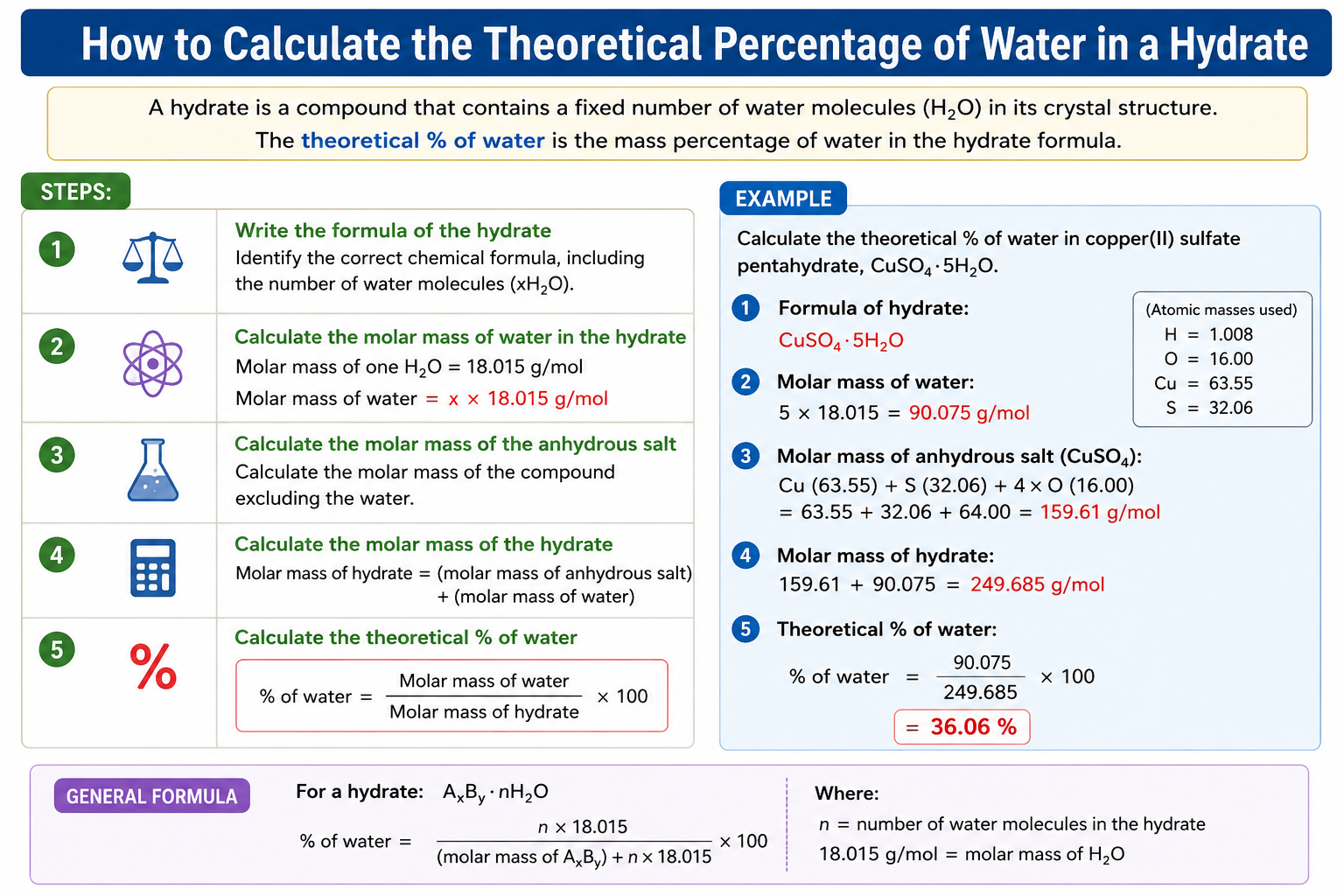
Water % = (Mass of water / Mass of hydrate) × 100%Step-by-Step Procedure for Calculating Theoretical Water Percentage
Step 1: Identify the Hydrate Formula
Write the complete chemical formula including the number of water molecules.
Example: MgSO₄·7H₂O (magnesium sulfate heptahydrate)
Step 2: Find Atomic Masses
Look up atomic masses from the periodic table. Standard values:
- H: 1.008 g/mol
- C: 12.01 g/mol
- N: 14.01 g/mol
- O: 16.00 g/mol
- Na: 22.99 g/mol
- Mg: 24.31 g/mol
- S: 32.06 g/mol
- Ca: 40.08 g/mol
- Cu: 63.55 g/mol
- Fe: 55.85 g/mol
- Al: 26.98 g/mol
Step 3: Calculate Molar Mass of the Anhydrous Salt
Ignore water molecules for now—calculate just the salt portion.
Example: MgSO₄
- Mg: 1 × 24.31 = 24.31
- S: 1 × 32.06 = 32.06
- O: 4 × 16.00 = 64.00
- Molar mass of MgSO₄ = 120.37 g/mol
Step 4: Calculate Molar Mass of Water in the Hydrate
Calculate the mass contribution from all water molecules in one formula unit.
Formula:
Mass of water = (Number of water molecules) × (Molar mass of H₂O)
Molar mass of H₂O = 18.016 g/mol (or 18.02 g/mol with rounding)
Example: MgSO₄·7H₂O
- Mass of water = 7 × 18.02 = 126.14 g/mol
Step 5: Calculate Total Molar Mass of Hydrate
Add the molar mass of the salt and the mass of water.
Formula:
Molar mass of hydrate = Molar mass of salt + Mass of water in hydrateExample: MgSO₄·7H₂O
- Molar mass = 120.37 + 126.14 = 246.51 g/mol
Step 6: Calculate Theoretical Water Percentage
Apply the mass percentage formula.
Formula:
Theoretical water % = (Mass of water / Molar mass of hydrate) × 100%Example: MgSO₄·7H₂O
Theoretical water % = (126.14 / 246.51) × 100% = 51.18%Summary of Calculation Procedure
- Write hydrate formula
- Look up atomic masses
- Calculate molar mass of salt
- Calculate mass of water molecules (number of H₂O × 18.02)
- Add for total molar mass
- Divide water mass by total mass
- Multiply by 100% for percentage
Detailed Examples With Solutions
Example 1: CuSO₄·5H₂O (Copper Sulfate Pentahydrate)
Step 1: Formula identified
CuSO₄·5H₂O
Step 2: Atomic masses
Cu = 63.55, S = 32.06, O = 16.00, H = 1.008
Step 3: Molar mass of CuSO₄
- Cu: 1 × 63.55 = 63.55
- S: 1 × 32.06 = 32.06
- O: 4 × 16.00 = 64.00
- Total: 159.61 g/mol
Step 4: Mass of water in hydrate
- 5 H₂O × 18.02 g/mol = 90.10 g/mol
Step 5: Total molar mass
- 159.61 + 90.10 = 249.71 g/mol
Step 6: Theoretical water percentage
- (90.10 / 249.71) × 100% = 36.06%
Example 2: Na₂CO₃·10H₂O (Sodium Carbonate Decahydrate)
Step 1: Formula identified
Na₂CO₃·10H₂O
Step 2: Atomic masses
Na = 22.99, C = 12.01, O = 16.00, H = 1.008
Step 3: Molar mass of Na₂CO₃
- Na: 2 × 22.99 = 45.98
- C: 1 × 12.01 = 12.01
- O: 3 × 16.00 = 48.00
- Total: 105.99 g/mol
Step 4: Mass of water in hydrate
- 10 H₂O × 18.02 g/mol = 180.20 g/mol
Step 5: Total molar mass
- 105.99 + 180.20 = 286.19 g/mol
Step 6: Theoretical water percentage
- (180.20 / 286.19) × 100% = 62.96%
Example 3: FeSO₄·7H₂O (Iron(II) Sulfate Heptahydrate)
Step 1: Formula identified
FeSO₄·7H₂O
Step 2: Atomic masses
Fe = 55.85, S = 32.06, O = 16.00, H = 1.008
Step 3: Molar mass of FeSO₄
- Fe: 1 × 55.85 = 55.85
- S: 1 × 32.06 = 32.06
- O: 4 × 16.00 = 64.00
- Total: 151.91 g/mol
Step 4: Mass of water in hydrate
- 7 H₂O × 18.02 g/mol = 126.14 g/mol
Step 5: Total molar mass
- 151.91 + 126.14 = 278.05 g/mol
Step 6: Theoretical water percentage
- (126.14 / 278.05) × 100% = 45.34%
Example 4: Al₂(SO₄)₃·18H₂O (Aluminum Sulfate Octadecahydrate)
Step 1: Formula identified
Al₂(SO₄)₃·18H₂O
Step 2: Atomic masses
Al = 26.98, S = 32.06, O = 16.00, H = 1.008
Step 3: Molar mass of Al₂(SO₄)₃
- Al: 2 × 26.98 = 53.96
- S: 3 × 32.06 = 96.18
- O: 12 × 16.00 = 192.00
- Total: 342.14 g/mol
Step 4: Mass of water in hydrate
- 18 H₂O × 18.02 g/mol = 324.36 g/mol
Step 5: Total molar mass
- 342.14 + 324.36 = 666.50 g/mol
Step 6: Theoretical water percentage
- (324.36 / 666.50) × 100% = 48.68%
Example 5: Ca(OH)₂·½H₂O (Calcium Hydroxide Hemihydrate)
Step 1: Formula identified
Ca(OH)₂·½H₂O
Step 2: Atomic masses
Ca = 40.08, O = 16.00, H = 1.008
Step 3: Molar mass of Ca(OH)₂
- Ca: 1 × 40.08 = 40.08
- O: 2 × 16.00 = 32.00
- H: 2 × 1.008 = 2.016
- Total: 74.096 g/mol (or 74.10)
Step 4: Mass of water in hydrate
- 0.5 H₂O × 18.02 g/mol = 9.01 g/mol
Step 5: Total molar mass
- 74.10 + 9.01 = 83.11 g/mol
Step 6: Theoretical water percentage
- (9.01 / 83.11) × 100% = 10.84%
Laboratory Application: Determining Hydrate Formula
The theoretical water percentage calculation is crucial for experimental work where you determine the unknown number of water molecules in a hydrate.
The Experimental Process
1. Measure initial mass of hydrate
- Weigh hydrated crystal on analytical balance
- Record mass (e.g., 4.974 g)
2. Heat the hydrate
- Place in crucible
- Heat strongly until mass becomes constant
- Water evaporates, leaving anhydrous salt
3. Measure final mass
- Cool in desiccator (prevents reabsorption of water)
- Weigh cooled residue
- Record mass (e.g., 3.209 g)
4. Calculate water lost
- Mass of water = Initial mass – Final mass
- 4.974 – 3.209 = 1.765 g water
5. Calculate molar masses
- Determine or identify the anhydrous salt
- Calculate its molar mass
- Calculate molar mass of water lost
6. Determine empirical formula
- Use mole ratios to find n in X·nH₂O
7. Verify with theoretical percentage
- Calculate theoretical water % for determined formula
- Compare to experimental percentage
- Good agreement indicates correct formula
Example: Determining CuSO₄·nH₂O
Experimental data:
- Initial mass (hydrate): 4.974 g
- Final mass (anhydrous): 3.209 g
- Mass of water: 1.765 g
Finding the molar mass of water lost:
- Moles of H₂O = 1.765 g ÷ 18.02 g/mol = 0.0980 mol
Finding moles of anhydrous salt:
- Molar mass of CuSO₄ = 159.61 g/mol
- Moles of CuSO₄ = 3.209 g ÷ 159.61 g/mol = 0.0201 mol
Finding the ratio (n):
- n = 0.0980 mol H₂O ÷ 0.0201 mol CuSO₄ = 4.88 ≈ 5
Conclusion: The hydrate is CuSO₄·5H₂O
Verification with theoretical percentage:
- We calculated earlier that CuSO₄·5H₂O should be 36.06% water
- Experimental percentage: (1.765 / 4.974) × 100% = 35.49%
- Difference: 36.06% – 35.49% = 0.57% (excellent agreement)
Common Mistakes and How to Avoid Them
Mistake 1: Forgetting to Include Water Oxygen in Salt Calculation
When calculating the molar mass of the salt, some students forget that oxygens in SO₄²⁻ need to be counted.
Incorrect: CuSO₄·5H₂O
- Cu: 63.55, S: 32.06, H₂O contribution only
Correct: CuSO₄·5H₂O
- Cu: 63.55
- S: 32.06
- O in SO₄: 4 × 16.00
- Then add H₂O contribution separately
Mistake 2: Miscounting Atoms in Complex Formulas
With formulas like Al₂(SO₄)₃, it’s easy to miscount atoms.
Incorrect: Counting 1 S instead of 3 S
Correct: The 3 outside the parentheses multiplies everything inside:
- Al: 2
- S: 1 × 3 = 3
- O: 4 × 3 = 12
Use a systematic approach, marking each atom as you count.
Mistake 3: Using Wrong Molar Mass for Water
Water’s molar mass is approximately 18.02 g/mol (or 18.016 g/mol exactly).
Incorrect: Using 18 exactly or other wrong values
Correct: Use 18.02 or 18.016 g/mol consistently
This small difference matters with multiple water molecules.
Mistake 4: Forgetting to Multiply by 100% for Percentage
The mass percentage formula gives a decimal that must be converted to percentage.
Incorrect: 0.3606 reported as answer
Correct: 0.3606 × 100% = 36.06%
Mistake 5: Rounding Prematurely
Rounding too early in multi-step calculations can cause error accumulation.
Incorrect: Round molar masses to whole numbers at start
Correct: Keep at least 2-3 decimal places throughout, round only final answer
Mistake 6: Decimal Point Errors in Water Molecules
When the coefficient is a fraction (like ½ H₂O), students often misplace decimals.
Incorrect: Ca(OH)₂·0.5H₂O → calculating as 5 H₂O
Correct: 0.5 H₂O × 18.02 = 9.01 g/mol
Mistake 7: Confusing Theoretical and Experimental Percentages
- Theoretical percentage: What should be there based on formula (calculated)
- Experimental percentage: What’s actually there (determined by heating)
- They should be close but rarely identical due to experimental error
Tips for Accurate Calculations
Using Systematic Approach
Template for every hydrate calculation:
- Write formula: ___________
- Identify all elements and count atoms
- Look up atomic masses: H ___, O ___, etc.
- Calculate salt molar mass:
- Element 1: ___ atoms × ___ g/mol = ___ g/mol
- Element 2: ___ atoms × ___ g/mol = ___ g/mol
- (etc.)
- Subtotal: ___ g/mol
- Calculate water contribution: ___ H₂O × 18.02 = ___ g/mol
- Total molar mass: ___ + ___ = ___ g/mol
- Water percentage: (___ / ___) × 100% = ___%
Checking Your Work
Reasonableness check:
- Is percentage between 0-100%? (Should be)
- Does it make sense given number of water molecules?
- Few water molecules → lower percentage
- Many water molecules → higher percentage
- Is it in the expected range for similar hydrates?
Recalculation check:
- Redo calculation independently
- Use different rounding approach
- See if you get same answer
Dimensional analysis check:
- Do units cancel correctly?
- g/mol ÷ g/mol = dimensionless ✓
- Multiply by 100% for percentage ✓
FAQ: Common Questions About Hydrate Calculations
Q1: Why is the molar mass of water always 18.02 g/mol?
A: Water is H₂O, always consisting of 2 hydrogen atoms (1.008 g/mol each) and 1 oxygen atom (16.00 g/mol). So H₂O = 2(1.008) + 16.00 = 18.016 ≈ 18.02 g/mol. This is constant regardless of the hydrate.
Q2: What if the hydrate formula has a fractional number of water molecules like 2.5H₂O?
A: Treat fractions the same as whole numbers. Multiply 2.5 × 18.02 = 45.05 g/mol for the water contribution. This isn’t uncommon in real hydrates.
Q3: Does the theoretical percentage change with temperature or pressure?
A: No. The theoretical percentage is based purely on the chemical formula, which is fixed. Temperature and pressure affect whether the hydrate is stable or decomposes, but don’t change what percentage should be water.
Q4: How accurate should my calculated percentage be?
A: Typically, report to 2 decimal places (e.g., 36.06%). More decimal places are unnecessary given uncertainties in atomic mass values; fewer decimal places loses important information.
Q5: What if experimental percentage differs significantly from theoretical?
A: Possible causes:
- Incomplete heating (water not fully removed)
- Reabsorption of water (not cooled properly)
- Decomposition of salt (heating too high)
- Wrong hydrate assumed
- Experimental errors in weighing
Repeat the experiment if discrepancy is large (>1-2%).
Q6: Can a hydrate have zero theoretical water percentage?
A: No. By definition, a hydrate contains water. A compound with zero water is anhydrous, not a hydrate.
Q7: Are theoretical water percentages ever 100%?
A: No. Even hydrates with many water molecules (like Al₂(SO₄)₃·18H₂O at 48.68%) never reach 100% because the salt portion always contributes to the total mass. Only pure water would be 100% water.
Q8: Is there a difference between “percent water” and “percentage of water”?
A: Not really—these phrases mean the same thing. Both refer to the mass percentage of water in the hydrate.
Advanced Applications
Using Percent Water to Identify Unknown Hydrates
If you have a hydrate and don’t know its formula, the percent water can help identify it:
Procedure:
- Heat to constant mass
- Calculate experimental water percentage
- Look up known hydrates of that salt
- Compare percentages until you find a match
- Confirm by other methods if needed
Determining Purity of Hydrate Samples
Commercial hydrate samples might contain impurities. Water percentage helps assess purity:
Logic:
- Pure CuSO₄·5H₂O should be 36.06% water
- If sample is only 30% water, it’s not pure
Calculation of purity:
% purity = (Observed water % / Theoretical water %) × 100%Quantifying Water Loss During Storage
Hydrates can lose water upon exposure to air (efflorescence) or absorb water (hygroscopic). Changes in water percentage indicate this:
Example:
- Fresh CuSO₄·5H₂O: 36.06% water
- After storage: 35.12% water
- Water lost: Indicates some conversion to CuSO₄·4H₂O or less
Conclusion
Calculating the theoretical percentage of water in hydrates is a fundamental chemistry skill combining atomic masses, stoichiometry, and mass percentages. While the calculation itself is straightforward when broken into steps, understanding the concepts behind it—what hydrates are, why they form, and how to manipulate chemical formulas—is equally important.
The process follows a logical sequence: identify the formula, find atomic masses, calculate salt molar mass, add water contribution, and divide water mass by total mass. With practice using the examples provided, this becomes routine.
More importantly, understanding this calculation connects to broader chemistry concepts. It demonstrates how chemical formulas represent actual mass relationships, how stoichiometry works quantitatively, and how experimental results can be compared to theoretical predictions. These skills extend far beyond hydrates to countless other chemistry calculations.
Whether you’re preparing for exams, conducting laboratory experiments, or simply deepening your chemistry understanding, mastering hydrate calculations builds confidence and competence. Start with simpler hydrates (few water molecules), build to more complex ones, and don’t hesitate to check your work using the strategies provided.
The next time you encounter CuSO₄·5H₂O or any other hydrate, you can confidently calculate that it should contain 36.06% water—and explain exactly why that’s the case. That’s the power of understanding chemistry at a deeper level.