
Understanding the relationship between milligrams and grams is essential for anyone working with measurements in daily life, whether you’re cooking, taking medication, working in a laboratory, or simply trying to understand product labels. This comprehensive guide will break down everything you need to know about converting between these two common metric units.
Quick Info: Milligrams to Grams at a Glance
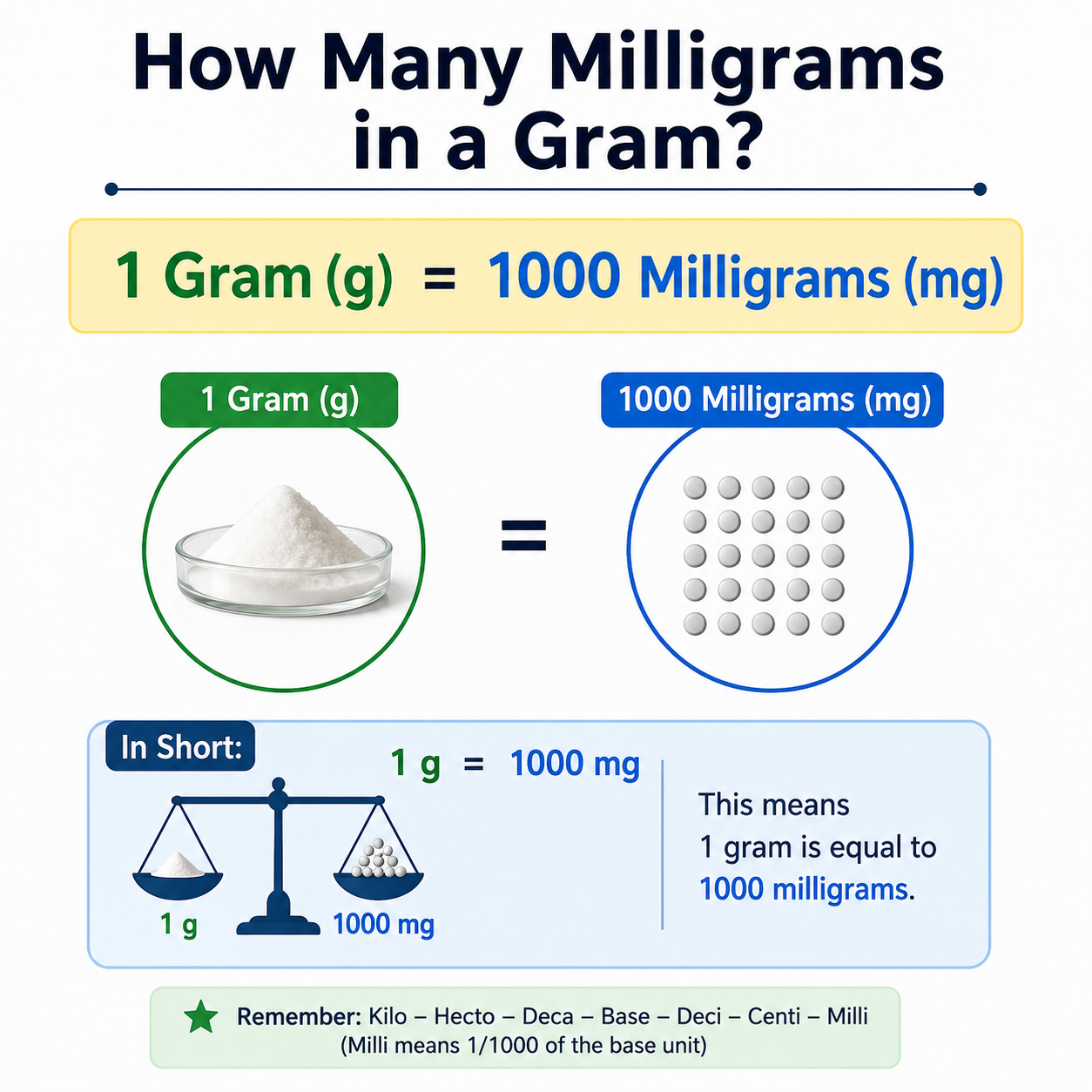
The Simple Answer: There are 1,000 milligrams (mg) in 1 gram (g).
This fundamental conversion is one of the most frequently used in the metric system and forms the basis for understanding weight and mass measurements in countless applications. Whether you’re measuring ingredients for a recipe, calculating medication dosages, or working on a science project, this conversion factor remains constant and reliable.
Understanding the Metric System
The metric system is an internationally recognized decimal system of measurement that makes conversions remarkably straightforward. Unlike imperial measurements that require memorizing seemingly random conversion factors, the metric system operates on multiples of ten, making calculations intuitive and less prone to error.
The word “gram” comes from the Late Latin “gramma,” meaning a small weight, while “milligram” combines the prefix “milli-” (meaning one-thousandth) with gram. This naming convention immediately tells us that a milligram is one-thousandth of a gram, or conversely, that one gram contains one thousand milligrams.
The Metric Prefix System
Understanding metric prefixes helps you quickly grasp the relationships between different units of measurement. The prefix “milli-” always means one-thousandth (1/1000) of the base unit. This same prefix appears throughout the metric system in measurements like milliliters (1/1000 of a liter) and millimeters (1/1000 of a meter).
Other common metric prefixes include “kilo-” (1,000 times the base unit), “centi-” (1/100 of the base unit), and “deci-” (1/10 of the base unit). Once you understand this prefix system, converting between metric units becomes second nature.
Converting Milligrams to Grams
Converting milligrams to grams requires dividing the number of milligrams by 1,000. This is because you’re moving from a smaller unit to a larger unit, so you’ll end up with a smaller number.
Formula: Grams = Milligrams ÷ 1,000
For example, if you have 5,000 milligrams and want to know how many grams that equals, you would calculate: 5,000 mg ÷ 1,000 = 5 g.
Practical Examples of Milligram to Gram Conversions
Let’s look at some real-world examples to make this conversion clearer. If a medication bottle contains 500 milligrams of active ingredient per tablet, that equals 0.5 grams (500 ÷ 1,000 = 0.5). If a recipe calls for 2,500 milligrams of salt, you would measure out 2.5 grams (2,500 ÷ 1,000 = 2.5).
Understanding these conversions helps you make sense of product labels, follow medical instructions accurately, and communicate measurements effectively across different contexts. Many digital scales allow you to switch between grams and milligrams, but knowing how to convert manually ensures you can always verify accuracy.
Converting Grams to Milligrams
Converting grams to milligrams is the opposite process and requires multiplication by 1,000. Since you’re moving from a larger unit to a smaller unit, you’ll end up with a larger number.
Formula: Milligrams = Grams × 1,000
If you have 3 grams of a substance and need to express this in milligrams, you would calculate: 3 g × 1,000 = 3,000 mg.
Why This Conversion Matters in Daily Life
This conversion appears more frequently in everyday life than you might realize. When reading nutritional labels, vitamins and minerals are often listed in milligrams, while the serving size might be in grams. A serving of cereal might be 40 grams, while it contains 250 milligrams of sodium. Understanding both measurements helps you make informed decisions about nutrition and health.
In baking and cooking, precision matters, especially when working with potent ingredients like yeast, baking powder, or spices. A recipe might call for 7 grams of yeast, but your measuring spoon might be marked in milligrams. Knowing that 7 grams equals 7,000 milligrams helps you measure accurately.
Common Applications and Use Cases
Understanding the milligram-to-gram relationship is crucial across numerous fields and everyday situations. From healthcare to cooking, from scientific research to jewelry making, these measurements play a vital role in ensuring precision and safety.
Medical and Pharmaceutical Applications
Perhaps nowhere is the accuracy of milligram and gram measurements more critical than in medicine. Medication dosages are frequently prescribed in milligrams, and understanding their gram equivalent helps prevent dangerous dosing errors. A typical adult aspirin tablet contains 325 milligrams (0.325 grams) of acetylsalicylic acid, while a children’s dose might be just 81 milligrams (0.081 grams).
Healthcare professionals must convert between these units regularly when preparing medications, especially in hospital settings where drugs might be supplied in gram quantities but need to be administered in precise milligram doses. This conversion knowledge can literally save lives by preventing medication errors.
Culinary and Nutritional Contexts
In the kitchen, both amateur cooks and professional chefs work with grams and milligrams regularly. While most ingredients are measured in grams or larger units, certain potent substances like saffron, vanilla extract, or food additives might be measured in milligrams. Understanding the conversion helps you scale recipes up or down accurately.
Nutritional information on food packaging typically lists macronutrients (proteins, carbohydrates, fats) in grams while micronutrients (vitamins and minerals) appear in milligrams. A protein bar might contain 20 grams of protein but only 400 milligrams of calcium. Being able to contextualize these measurements helps you make healthier food choices.
Scientific and Laboratory Work
Scientists, researchers, and students working in laboratories must have a solid grasp of metric conversions. Experiments often require extremely precise measurements where the difference between milligrams and grams could completely change the outcome. Chemical reactions, biological samples, and research materials are frequently measured in these units.
In chemistry, for instance, you might need to measure out 2.5 grams of a compound, which your analytical balance displays as 2,500 milligrams. Understanding this equivalence ensures your experiments are reproducible and your data is reliable.
Tips for Accurate Conversion
While the mathematical conversion between milligrams and grams is straightforward, implementing it accurately in practical situations requires attention to detail and the right tools. Here are some essential tips to ensure you’re converting and measuring correctly every time.
Using Digital Tools and Calculators
While mental math works well for simple conversions, using a calculator eliminates the risk of mathematical errors, especially when working with decimal points. Many smartphones have built-in calculator apps, and numerous free online converters are specifically designed for metric conversions. These tools are particularly helpful when you’re working with awkward numbers or need to convert multiple measurements quickly.
However, don’t become overly dependent on technology. Understanding the underlying conversion principle means you can perform basic conversions in your head and quickly spot when a digital tool has given you an incorrect result due to input error.
Double-Checking Your Work
When precision matters—particularly in medical or scientific contexts—always double-check your conversions. A simple trick is to work backward: if you converted 3,500 milligrams to 3.5 grams, convert 3.5 grams back to milligrams to verify you get 3,500. This reverse calculation takes only seconds but can catch potentially serious errors.
Another verification method is to ask yourself whether your answer makes logical sense. When converting milligrams to grams, your answer should always be a smaller number (since grams are larger units). When converting grams to milligrams, your answer should always be a larger number. If this isn’t the case, you’ve likely divided when you should have multiplied, or vice versa.
Investing in Quality Measuring Tools
For practical applications involving actual weighing of substances, the quality of your scale matters tremendously. Digital kitchen scales typically measure down to 1 gram, which is suitable for most cooking applications. However, if you need to measure milligrams accurately, you’ll need a more precise scale, such as a jewelry scale or laboratory balance.
When purchasing a scale, check its accuracy range and smallest measurement increment. A scale that measures to 0.01 grams (10 milligrams) offers significantly more precision than one that only measures to whole grams. Choose your tools based on your specific needs and the level of precision your applications require.
Common Mistakes to Avoid
Even when you understand the basic conversion, certain pitfalls can lead to errors. Being aware of these common mistakes helps you avoid them and develop good measurement habits.
Decimal Point Errors
The most frequent mistake in milligram-to-gram conversions involves misplacing the decimal point. When converting 2,500 milligrams to grams, the correct answer is 2.5 grams, not 25 grams or 0.25 grams. This type of error often occurs when people are rushing or not paying careful attention to their calculations.
To avoid decimal point errors, write out your calculation clearly, showing the division or multiplication explicitly. For example, write “2,500 mg ÷ 1,000 = 2.5 g” rather than trying to move the decimal point in your head. This written record also creates a trail you can review if you need to verify your work later.
Confusing Similar-Looking Abbreviations
The abbreviations for milligrams (mg) and grams (g) are similar enough that they’re sometimes confused, especially in handwritten notes. This confusion is compounded by other metric units like micrograms (mcg or μg) and kilograms (kg). Always write these abbreviations clearly and double-check which unit is being referenced in any source material you’re working from.
In medical contexts, this confusion can be particularly dangerous. A medication order for 5 mg that’s misread as 5 g represents a thousand-fold dosing error. Healthcare settings have specific protocols to prevent such errors, including always writing out “micrograms” instead of using abbreviations, but individual vigilance remains essential.
Rounding Inappropriately
While rounding numbers can make calculations easier, inappropriate rounding can introduce significant errors, especially when you’re working with small quantities. If you’re converting 1,247 milligrams to grams, the precise answer is 1.247 grams. Rounding this to 1 gram represents a nearly 20% error, which could be critical depending on your application.
Only round your final answer, and only after considering how much precision your specific situation requires. Medical and scientific applications typically require more decimal places than cooking or everyday measurements. When in doubt, maintain more precision rather than less—you can always round later if needed.
Frequently Asked Questions
How many milligrams are in a gram?
There are exactly 1,000 milligrams in one gram. This conversion is constant and never changes, making it a reliable foundation for all metric weight conversions. Whether you’re measuring gold, flour, medication, or any other substance, this relationship remains the same. The metric system’s consistency is one of its greatest strengths, eliminating the confusion that often accompanies imperial conversions.
How do I convert 500 mg to grams?
To convert 500 milligrams to grams, divide 500 by 1,000. The calculation is: 500 mg ÷ 1,000 = 0.5 g. Therefore, 500 milligrams equals 0.5 grams, which can also be expressed as half a gram. This particular conversion appears frequently in medication dosages, where 500 mg tablets are common for many over-the-counter and prescription drugs.
Is 1000 mg the same as 1 gram?
Yes, 1,000 mg is exactly the same as 1 gram. These two measurements represent identical amounts of mass or weight. When you see these measurements on product labels, prescriptions, or recipes, you can use them interchangeably. Some contexts prefer one unit over the other—medical prescriptions often use milligrams for precision, while cooking recipes typically use grams for convenience.
How many grams is 250 mg?
To find how many grams are in 250 milligrams, divide 250 by 1,000: 250 mg ÷ 1,000 = 0.25 g. Therefore, 250 milligrams equals 0.25 grams, or one-quarter of a gram. This measurement is common in nutritional supplements, where vitamins and minerals are frequently available in 250 mg doses.
What is bigger, a milligram or a gram?
A gram is significantly bigger than a milligram. Specifically, one gram is 1,000 times larger than one milligram. Think of it this way: just as a dollar is made up of 100 pennies, a gram is made up of 1,000 milligrams. When you need to measure very small amounts of a substance, milligrams provide more precision and result in whole numbers that are easier to work with than tiny decimal fractions of a gram.
How do you measure milligrams without a scale?
Measuring milligrams accurately without a scale is extremely difficult and generally not recommended, especially for critical applications like medication. However, for approximate measurements in cooking, you can use the fact that certain common substances have known weights. For example, one level teaspoon of table salt weighs approximately 6,000 milligrams (6 grams), so you could estimate smaller amounts as fractions of a teaspoon. That said, if precision matters, investing in an inexpensive digital scale that measures milligrams is always the better choice.
Why does the medical field use milligrams instead of grams?
The medical field frequently uses milligrams because medication doses often involve amounts less than one gram. Writing “500 mg” is clearer and less error-prone than writing “0.5 g,” especially in handwritten prescriptions where decimal points might be missed or misread. Using milligrams eliminates decimal points for most common drug doses, reducing the risk of dangerous dosing errors. This practice prioritizes patient safety by making dosages as clear and unambiguous as possible.
Can I use a kitchen scale to measure milligrams?
Most standard kitchen scales measure only down to 1 gram and are not suitable for measuring milligrams. If you need to measure milligrams accurately, you’ll need a more precise instrument, such as a jewelry scale, laboratory balance, or a specialized milligram scale. These devices typically cost more than kitchen scales but provide the precision necessary for measuring very small quantities. Before purchasing any scale, check its specifications to ensure it measures to the level of precision you need.
How many milligrams are in 2.5 grams?
To convert 2.5 grams to milligrams, multiply 2.5 by 1,000: 2.5 g × 1,000 = 2,500 mg. Therefore, 2.5 grams equals 2,500 milligrams. This type of conversion is common when you’re working with a digital scale that displays measurements in grams but need to communicate or record the measurement in milligrams, or when following a recipe that uses different units than your available measuring tools.
What household items weigh about 1 gram?
Understanding what 1 gram feels like can help you develop intuition for these measurements. Common household items that weigh approximately 1 gram include a single paper clip, a typical raisin, a dollar bill, or a single small feather. A packet of artificial sweetener typically contains about 1 gram of product. While these comparisons aren’t precise enough for scientific or medical purposes, they can help you develop a sense of scale and catch obvious measurement errors—if your calculation suggests that a vitamin tablet weighs the same as 100 paper clips, something has clearly gone wrong.
Conclusion
Understanding that there are 1,000 milligrams in a gram is more than just memorizing a simple conversion factor—it’s about developing a practical skill that applies across numerous aspects of daily life, from cooking and nutrition to health and science. The metric system’s logical, base-10 structure makes these conversions straightforward once you grasp the underlying principles.
Whether you’re measuring ingredients for a recipe, calculating medication doses, reading nutritional labels, or conducting scientific experiments, the ability to convert confidently between milligrams and grams empowers you to work with precision and accuracy. By understanding the relationship between these units, avoiding common mistakes, and using appropriate tools, you can ensure that your measurements are always correct.
Remember that while the mathematical conversion is simple, its real-world applications require attention to detail and an understanding of context. Always double-check your work when precision matters, use quality measuring instruments appropriate to your needs, and don’t hesitate to write out your calculations to avoid errors. With practice, converting between milligrams and grams will become second nature, giving you confidence in any situation that requires these essential measurements.