
Introduction
Choosing a career path is one of the most significant decisions you’ll make—one affecting decades of your life, income, satisfaction, and overall wellbeing. Yet many students approach this decision with minimal guidance, hoping somehow the “right” path will become obvious. It rarely does.
The stakes are high. The average person spends approximately 90,000 hours working over their lifetime—about one-third of their adult life. Choosing poorly leads to years of dissatisfaction, financial struggle, and regret. Choosing thoughtfully creates a fulfilling career aligned with your values, strengths, and interests.
The challenge: you’re making a major decision often with incomplete information about yourself and available career options. Many students change majors, switch careers, or struggle with decisions made without adequate reflection. Others succeed brilliantly because they invested time in genuine self-discovery and exploration.
This comprehensive guide provides a structured, evidence-based approach to career selection. You’ll learn self-assessment strategies, exploration methods, decision-making frameworks, and practical steps to identify and pursue the right career for you. Whether you’re in high school selecting college majors, in college choosing a career direction, or already working but questioning your path, this guide illuminates the decision-making process.
Why Career Selection Matters
The Long-Term Impact
Your career choice affects:
Financial security: Income varies dramatically by field (software engineer median $120K vs. retail associate $25K). Career earnings differences compound to millions over a lifetime.
Time allocation: Your career determines how you spend most of your waking hours. This time allocation affects health, relationships, and life satisfaction.
Personal identity: We partially define ourselves through our work. “I’m an engineer” or “I’m a teacher” becomes part of your identity.
Skill development: Your career determines which skills you develop, knowledge you acquire, and expertise you build.
Lifestyle and relationships: Some careers demand 80-hour weeks; others allow flexibility. Some require frequent moves; others allow stability. These profoundly affect personal relationships and life quality.
Social impact: Your work contributes (positively or negatively) to society. Some find deep meaning in their career’s social contribution.
Mental health and wellbeing: Career satisfaction strongly predicts overall life satisfaction, stress levels, and mental health.
The Cost of Poor Decisions
Changing majors: Average cost of one major change during college is $10,000+ plus 1-2 years extra time.
Career changes: Switching fields mid-career requires retraining, often involves starting over in salary and status, and creates stress and uncertainty.
Dissatisfaction costs: Unhappy employees show higher healthcare costs ($1,685+ more annually), lower productivity, higher turnover (costing employers 50-200% of salary per replacement), and increased personal stress.
Opportunity costs: Time spent in wrong career is time not spent in right career, delaying fulfillment and potentially lifetime earnings.
The Benefit of Good Decisions
Career satisfaction compounds over time:
- Higher engagement and performance
- Better relationships with colleagues
- Continuous skill development
- Increasing compensation and responsibility
- Growing sense of purpose
- Positive life trajectory
- Resilience through challenges
The investment in careful career selection pays dividends throughout your working life.
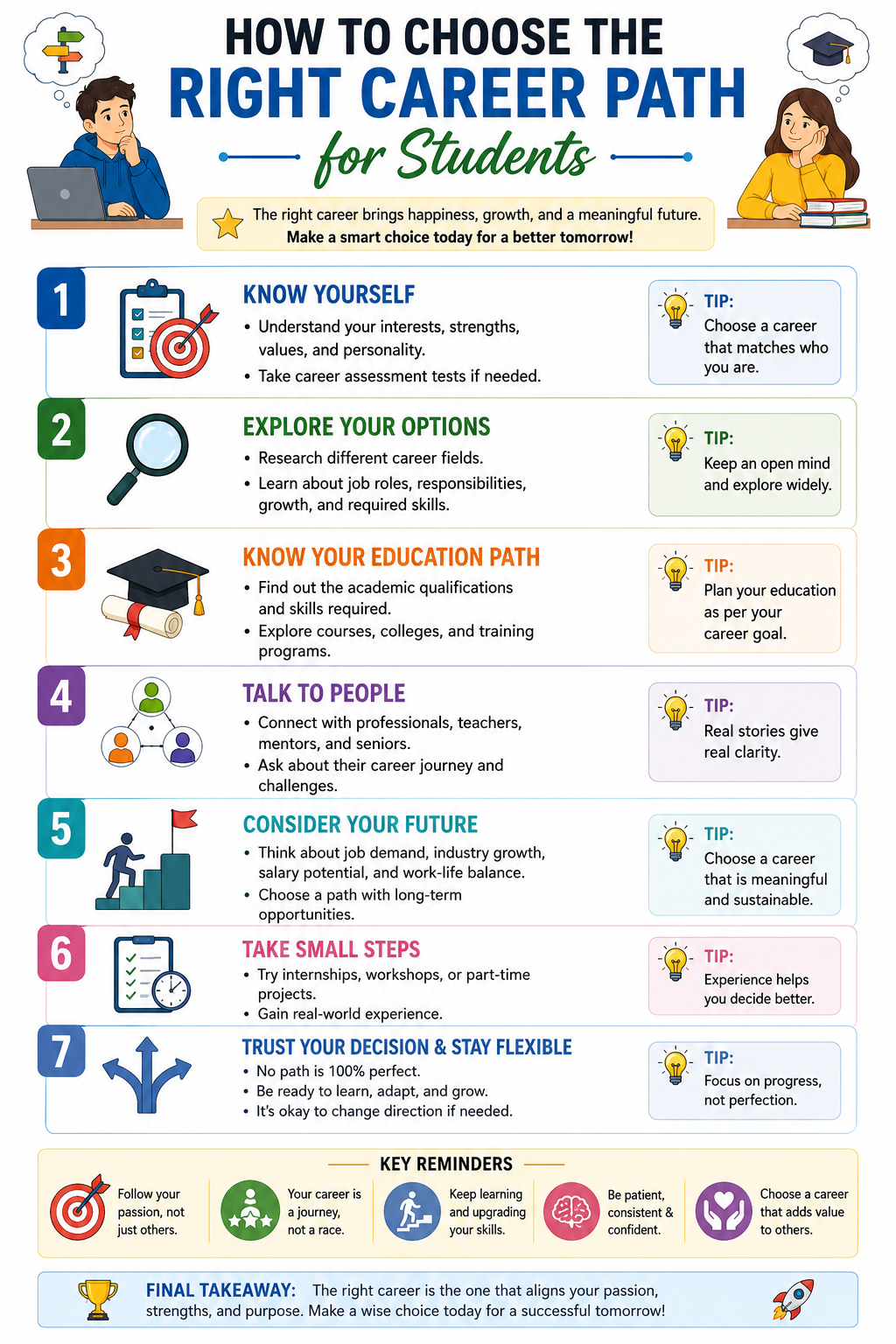
Step 1: Comprehensive Self-Assessment
Before exploring careers, deeply understand yourself. Self-awareness is foundational to good career decisions.
Personality Assessment
Understanding your personality helps identify compatible careers and work environments.
Myers-Briggs Type Indicator (MBTI):
Assesses personality along four dimensions: Introversion/Extraversion, Sensing/Intuition, Thinking/Feeling, Judging/Perceiving.
Each combination (16 types total) has career correlations:
- ISTJ (“Logistician”): Structured, organized, responsible. Careers: accounting, law, management
- ENFP (“Campaigner”): Creative, enthusiastic, people-oriented. Careers: marketing, entertainment, counseling
- INTJ (“Architect”): Strategic, analytical, independent. Careers: engineering, research, strategy
CliftonStrengths (StrengthsFinder):
Identifies your top talent themes rather than weaknesses. Understanding strengths helps find careers leveraging them.
Big Five Personality Traits:
Measures Openness, Conscientiousness, Extraversion, Agreeableness, Neuroticism. Research shows correlations with career satisfaction in different fields.
The Enneagram:
Nine-type personality system showing how you view the world and interact with others. Helps identify compatible work environments and colleagues.
Values Clarification
Values are what matter most to you—guiding principles for decision-making.
Common career values:
- Financial security: High income, stable employment, benefits
- Helping others: Direct impact on people’s lives
- Independence: Autonomy, self-direction, minimal supervision
- Creativity: Innovation, artistic expression, originality
- Stability: Predictable routine, minimal change, security
- Status/Recognition: Achievement, advancement, prestige
- Work-life balance: Reasonable hours, time for personal life
- Learning: Continuous growth, intellectual challenge
- Social impact: Contributing to society, making a difference
- Variety: Diverse tasks and environments, change
- Leadership: Guiding others, influence, decision-making
- Nature/Environment: Working outdoors, environmental focus
Exercise: Values Ranking
- Review common values (listed above and others)
- Rate importance (essential, important, somewhat important, not important)
- Identify your top 5-7 values
- Consider conflicts (e.g., very high income often requires sacrificing work-life balance)
- Recognize which values are non-negotiable
Careers aligned with your core values produce higher satisfaction. Misaligned careers create persistent dissatisfaction.
Skills Inventory
What can you do well? Understanding your abilities helps identify viable careers.
Hard skills (teachable technical abilities):
- Software programming
- Foreign languages
- Mathematical modeling
- Laboratory techniques
- Financial analysis
- Design skills
- Writing and editing
List hard skills you’ve developed through education, work, hobbies, and volunteer experience.
Soft skills (transferable interpersonal abilities):
- Communication
- Leadership
- Problem-solving
- Teamwork
- Time management
- Adaptability
- Critical thinking
These are valuable across industries.
Strengths vs. Skills:
Distinguish between things you’re good at and things you enjoy. Some people excel at accounting but hate it; others struggle with writing but love it. Identify skills you enjoy using.
Identifying your skills:
- Review performance reviews and feedback
- List accomplishments you’re proud of
- Notice what others regularly ask you to help with
- Complete skills assessments (online tools, career counselors)
- Reflect on work/school tasks you excel at
Interests and Passions
What fascinates you? What could you do for hours without getting bored?
Holland Code (RIASEC):
Categorizes interests into six types:
- Realistic: Hands-on, practical work with tools/objects. Careers: mechanic, carpenter, electrician, farmer
- Investigative: Research, analysis, problem-solving. Careers: scientist, engineer, analyst, doctor
- Artistic: Creative, expressive, original work. Careers: artist, designer, musician, writer
- Social: Working with people, helping, teaching. Careers: counselor, teacher, social worker, nurse
- Enterprising: Business, leadership, persuasion. Careers: manager, entrepreneur, sales, lawyer
- Conventional: Order, detail, organization. Careers: accountant, administrator, data analyst, librarian
Most people are combinations of types. Your top 2-3 types suggest compatible career families.
Interest Identification:
Ask yourself:
- What subjects fascinate me? What do I read/watch about voluntarily?
- What activities make me lose track of time?
- What would I do if I didn’t need the money?
- What problems do I want to solve?
- What kind of people do I enjoy working with?
- What kind of work environment appeals to me?
- What causes do I care about?
Work Style and Preferences
Different work environments suit different people.
Environment preferences:
- Office vs. outdoor vs. hybrid
- Team vs. independent work
- Quiet vs. collaborative vs. fast-paced
- Structured routine vs. variety
- Predictable vs. dynamic/changing
Working style preferences:
- Detail-oriented vs. big-picture thinking
- Following procedures vs. creating new approaches
- Working alone vs. collaborating
- Stable employment vs. entrepreneurship
- Specialization vs. variety
Lifestyle preferences:
- 9-to-5 vs. flexible hours
- Local vs. traveling
- Minimal vs. significant responsibility
- High stakes vs. lower pressure
- Fast-paced advancement vs. stability
Identify which environment characteristics are essential, important, or preferences. Pursuing careers misaligned with your work preferences creates stress even if the work itself interests you.
Life Goals and Vision
Where do you want to be in 5, 10, 20 years?
Questions to consider:
- What accomplishments would make you proud?
- What kind of lifestyle do you envision?
- How much income do you need/want?
- What role does family play in your plans?
- What do you want to be known for?
- What problems do you want to solve?
- What legacy do you want to leave?
Some people’s career vision is building a family and having flexibility; others envision leadership in their field; others want independence through entrepreneurship. All are valid—clarity helps guide career selection.
Step 2: Research and Career Exploration
Self-knowledge is necessary but insufficient. You must understand actual career options to make informed decisions.
Identify Career Possibilities
Start broadly:
Use self-assessment results to identify career families:
- “I’m an ENFP with strong communication skills interested in helping people” → Psychology, counseling, social work, human resources, nonprofit work, teaching
- “I’m analytical, creative, interested in technology and problem-solving” → Software engineering, UX design, product management, data science
- “I value independence, entrepreneurship, and financial success” → Starting your own business, consulting, investment management, sales
Don’t narrow prematurely. Identify 5-10 career possibilities to explore.
Expand your thinking:
Consider:
- Emerging careers in growing fields (data science, renewable energy, UX design)
- Industries experiencing growth vs. decline
- Careers you’ve never heard of (Bureau of Labor Statistics lists 900+ careers)
- Combination careers (teacher + entrepreneur, engineer + artist)
- Evolution of careers as technology changes
Many careers don’t exist in the form students learn about in school. Remaining open to new possibilities is crucial.
Research Specific Careers
For each career possibility, investigate thoroughly:
Typical responsibilities and tasks:
- What does a typical day involve?
- What percentage of time is spent on different tasks?
- What’s the real work like (not the glamorized version)?
- What problems do you solve?
- What projects are typical?
Education and training requirements:
- Degree needed (bachelor’s, master’s, trade certificate)?
- Certifications or licenses required?
- Years of education required?
- How expensive is education?
- Can you start without the degree and add education later?
Salary and compensation:
- Entry-level, mid-career, and experienced salaries
- Geographic salary variations (Silicon Valley engineers earn more than rural engineers)
- Benefits packages
- Growth potential
- Job security
Work environment and lifestyle:
- Typical work hours
- Travel requirements
- Physical demands
- Remote work possibilities
- Team size and collaboration level
- Stress level
- Seasonal variations
Growth prospects:
- Is the field growing, stable, or declining?
- Job availability in your geographic area
- Competition for positions
- Career path (where can this career lead)?
Lifestyle implications:
- Geographic flexibility (can you work anywhere?)
- Family considerations
- Work-life balance
- Relocation requirements
- Physical or mental demands
Research Resources
Bureau of Labor Statistics Occupational Outlook Handbook:
Comprehensive, government-provided information on hundreds of careers including pay, growth, requirements.
Career websites:
- Glassdoor (salary, company reviews, interview questions)
- LinkedIn (see career paths of professionals)
- Indeed (job descriptions showing actual responsibilities)
- CareerOneStop (government resource)
- Professional association websites
Online tests and tools:
- O*NET Interest Profiler
- CareerExplorer
- MyNextMove
- Khan Academy Career Videos
Informational interviews:
Talk with people actually doing the work (below).
Job postings:
Reading actual job descriptions reveals what employers truly want and what the work entails.
Educational institution websites:
Review what schools teach in specific programs. Curriculum often reveals what the field involves.
Informational Interviews
Talking directly with professionals provides invaluable insight no amount of research can replace.
Benefits of informational interviews:
- Understand real day-to-day work
- Learn career paths and advancement
- Hear honest assessment of field (including downsides)
- Build professional network
- Gain inside knowledge about industries
- Find mentors and advocates
How to conduct informational interviews:
1. Identify people:
- Alumni in your desired field
- LinkedIn connections
- Professional associations
- Professors’ professional networks
- Friends’ and family’s contacts
- Company websites and employee lists
2. Make the request:
Email template:
“Hi [Name], I’m exploring careers in [field] and greatly respect your work at [company]. Would you have 15-20 minutes in the next few weeks for a brief informational conversation? I’d love to learn about your career path and experiences. Thank you!”
Keep it short, specific, and respectful of their time.
3. Prepare questions:
- How did you enter this field?
- What does your typical day look like?
- What skills are most important?
- What surprised you about this career?
- What do you love about this work?
- What challenges do you face?
- What preparation would you recommend?
- How has this field changed?
- What advice would you give someone entering now?
4. Conduct the interview:
- Thank them for their time
- Show genuine interest
- Take notes
- Listen more than you talk
- Ask follow-up questions
- Ask who else you might speak with
5. Follow up:
- Send thank you note within 24 hours
- Keep them updated on your progress
- Let them know how their advice helped
- Maintain the relationship (these become your network)
Aim to conduct 3-5 informational interviews per career you’re seriously considering. These conversations provide perspective no research can replace.
Job Shadowing and Internships
Experiencing work firsthand beats theoretical knowledge.
Job shadowing:
Spend a day (or days) observing someone doing the actual work.
Benefits:
- See real tasks and environment
- Understand daily reality
- Meet people in the field
- Evaluate fit
- Make informed decisions
Many professionals will allow job shadowing if asked respectfully.
Internships:
Work in the field for a summer or semester.
Benefits:
- Gain actual work experience
- Determine fit
- Build resume and network
- Earn credentials
- Sometimes leading to job offers
Seek internships actively during high school and college. Multiple internships in different roles/companies provide better career understanding than one internship.
Part-time work and volunteering:
Even if not in your ideal field, work experience develops professional skills and clarifies preferences.
Step 3: Narrow Your Options
After exploration, you likely have deeper understanding of possibilities. Now narrow your focus.
Use Decision-Making Frameworks
Pros and Cons Analysis:
Create a table for each career:
| Aspect | Career A | Career B | Career C |
|---|---|---|---|
| Alignment with values | Excellent | Good | Fair |
| Interest level | Very high | High | Moderate |
| Skill match | Strong | Good | Developing |
| Education time/cost | 4 yrs/$100K | 2 yrs/$20K | 6 yrs/$150K |
| Salary potential | High | Moderate | High |
| Work-life balance | Fair | Excellent | Poor |
| Growth prospects | Excellent | Good | Declining |
| Availability | Many jobs | Moderate | Few jobs |
Rate each factor and note important considerations.
Weighted Decision Matrix:
Assign importance weights to factors:
| Factor | Weight | Career A | Career B | Career C |
|---|---|---|---|---|
| Values alignment | 25% | 9/10 | 7/10 | 5/10 |
| Interest level | 25% | 9/10 | 8/10 | 6/10 |
| Salary potential | 20% | 9/10 | 5/10 | 9/10 |
| Work-life balance | 15% | 4/10 | 9/10 | 2/10 |
| Job availability | 15% | 8/10 | 6/10 | 3/10 |
| Weighted score | 100% | 8.1 | 7.1 | 5.9 |
Calculate weighted scores. Higher scores suggest better fit for your specific priorities.
Elimination Framework:
- Identify absolute requirements (must-haves)
- Eliminate careers not meeting requirements
- For remaining careers, identify important preferences
- Compare remaining options on preferences
- Select top 2-3 for deeper exploration
Example: If work-life balance is essential and you eliminate all careers averaging 60+ hour weeks, this narrows options significantly and focuses remaining exploration.
Regret Minimization:
Imagine yourself at 80 years old reflecting on your career choice. Which option would you least regret? This framework helps distinguish between head and heart preferences.
Consider Timing and Sequencing
You don’t have to make one final decision. Consider sequencing:
Sample sequencing:
- Year 1-2: General education while exploring multiple fields
- Year 3: Choose major/focus area based on exploration
- Summer internships: Test specific paths
- Post-college: First job tests career viability
- Years 1-5 post-college: Solidify specialization or pivot if needed
Most people don’t stay in their first career. Viewing career development as a series of decisions reduces pressure and allows course corrections.
Step 4: Test Your Decisions
Before fully committing, test decisions through real experience.
Educational Testing
Enroll in relevant courses:
- Take classes in fields you’re considering
- Actually enjoy the subject matter or recognize it’s not for you?
- Perform well or struggle despite effort?
- Find the work interesting or tedious?
Example: Considering engineering? Take difficult math and physics courses. Hate them? Engineering may not be right even if salary is attractive.
Professional Testing
Gain professional experience:
- Summer jobs in the field
- Internships
- Part-time work
- Volunteer positions
- Projects or competitions
Experience often contradicts assumptions:
- “I thought I’d love graphic design” → Discover you love technology but dislike design’s subjective feedback
- “I assumed I’d hate accounting” → Discover satisfaction in careful analysis and problem-solving
Micro-commitments
Test before major commitments:
- Take one course in a subject (not committing to major)
- Do internship (not committing to field)
- Join clubs or societies (not committing to career)
- Volunteer (not committing to nonprofit work)
Small commitments provide information for larger decisions.
Feedback Integration
Continuously integrate feedback:
Seek feedback from:
- Professors and instructors
- Supervisors and colleagues
- Mentors and advisors
- Friends and family
- Your own experience
Ask specifically:
- Do you think I’m well-suited for this?
- What are my strengths and development areas in this context?
- Do I seem engaged and satisfied?
- What would you advise based on what you know about me?
Integrate feedback but remember—only you can decide your career. Others’ input informs but doesn’t determine your decision.
Step 5: Make the Decision
Eventually, decision time arrives. How do you choose with incomplete information?
Accept Uncertainty
No career decision is perfect. Every path has tradeoffs:
- High-paying career may have long hours
- Helping-focused career may have modest income
- Prestigious career may not align with interests
Perfect careers don’t exist. The goal is finding careers where benefits outweigh drawbacks for your unique situation.
Use Your Values
Ultimately, decide based on what matters most to you:
- If family is your priority, choose work allowing family time
- If financial security matters most, prioritize stable, well-paying careers
- If helping others is central, choose people-focused work
- If learning drives you, choose fields with growth opportunity
Decisions aligned with your core values prove more satisfying long-term than decisions based on others’ expectations.
Commit with Flexibility
Commit fully to your chosen path—this commitment drives effort and improvement. However, remain open to course corrections.
“I’m becoming an engineer” is good. “I’m becoming an engineer, but I’ll reassess after my first year of study and revisit if it’s not right” shows wisdom. Most successful people have made career pivots.
Consider First Steps
Clarify immediate next steps:
Career: Software Engineer
- Immediate (next 3 months): Enroll in computer science program, complete programming fundamentals course, build first app
- Next 6-12 months: Complete CS degree coursework, seek summer internship at tech company
- Next 1-2 years: Continue degree, test specialization (web, mobile, data, security)
- Post-degree: First job in software development, continued learning and specialization
Clear next steps transform abstract career choice into concrete actions.
Common Career Decision Mistakes and How to Avoid Them
Mistake 1: Following Others’ Expectations
Parents, teachers, peers, and society pressure toward certain careers. But their priorities aren’t yours.
Example: Parents expect law school; you want engineering. Following their expectations leads to years in wrong career.
Solution: Acknowledge input but decide based on your values, interests, and strengths. It’s your career and life.
Mistake 2: Chasing Prestige or Money Alone
High-prestige or high-paying careers that misalign with your interests/values create persistent dissatisfaction.
Example: Becoming investment banker for prestige and money despite hating financial work and craving creativity.
Solution: Include prestige and compensation but ensure alignment with interests and values too.
Mistake 3: Choosing Too Narrowly Too Early
Narrowing prematurely prevents discovering better fits.
Example: Declaring major freshman year based on high school assumptions without real exploration.
Solution: Keep options open through first year or two. Take diverse courses. Explore multiple possibilities before narrowing.
Mistake 4: Overweighting Single Factors
No single factor determines career satisfaction—it’s multifaceted.
Example: Choosing career for salary alone, ignoring work environment or tasks. Years later: “I make great money but hate the work.”
Solution: Consider multiple factors: interest, values, skills, salary, environment, growth, impact.
Mistake 5: Not Seeking Information
Making major decisions based on assumptions instead of research.
Example: Assuming what a career is like without talking to practitioners or researching.
Solution: Research thoroughly. Conduct informational interviews. Gain experience. Base decisions on knowledge.
Mistake 6: Ignoring Red Flags
Noticing misalignment but ignoring it, hoping things improve.
Example: Struggling in major coursework but continuing because you’re “invested.” Better to pivot early.
Solution: When significant misalignment appears, investigate seriously. Small concerns often grow into major problems.
Mistake 7: Viewing Career Decisions as Permanent
Believing you must choose one career forever paralyzes decision-making.
Example: Refusing to choose because “what if it’s wrong?” and staying in indecision longer than making a decision then changing.
Solution: View career choices as important but changeable. You can pivot if needed. Starting and changing is better than indefinite indecision.
Mistake 8: Not Considering Your Whole Life
Viewing career in isolation from family, health, relationships, and personal growth.
Example: Pursuing ambitious career requiring constant travel, destroying relationships and health.
Solution: Consider career in context of life goals. Ensure career supports overall wellbeing and life satisfaction.
Special Situations
Changing Careers Mid-Life
Career decisions aren’t permanent. Many successful people change careers mid-life.
Reasons for career changes:
- Realized initial choice wasn’t right
- Life circumstances changed
- Field declined or evolved
- New interests developed
- Seeking greater fulfillment
Strategies for career change:
- Assess transferable skills from previous career
- Gain necessary education/credentials
- Network in new field
- Accept possible salary reduction starting over
- Consider part-time transition if possible
- Seek mentors in new field
- Test new career before fully committing (side projects, internships)
The same decision-making framework applies: self-assessment, research, exploration, testing, decision.
Following Passion vs. Practical Concerns
“Follow your passion” is common advice, but it’s incomplete. Passion without practical viability creates problems.
Better framework:
Find intersection of:
- Passion/Interest: What you love
- Skill/Aptitude: What you’re good at
- Practical Viability: Career with reasonable job market and income
Pursue careers at the intersection of all three.
Example intersections:
- Love music + excellent ear training + viable music education career = teach music
- Love helping people + strong science background + viable medicine career = become doctor
- Love writing + excellent communication + viable marketing career = work in marketing
Passions without viability often crash. Pure practicality without passion creates dissatisfaction. The intersection works best.
Uncertain or Undecided
Some students feel genuinely uncertain even after exploration. This is normal and manageable.
Strategies:
- Take general education requirements while exploring
- Try multiple majors/fields through coursework
- Seek additional informational interviews
- Do more internships/job shadowing
- Work with a career counselor
- Give yourself permission to decide later
- Remember: first job doesn’t determine your entire career
Indecision becomes problematic only when you avoid deciding. Some uncertainty is healthy; indefinite avoidance is problematic.
Tools and Resources for Career Decision Making
Formal Assessments
Personality and Interest Assessments:
- Myers-Briggs Type Indicator (MBTI)
- CliftonStrengths (StrengthsFinder)
- Strong Interest Inventory
- Holland Code/Self-Directed Search
- Big Five Personality Test
- Enneagram
Most are available through school counselors or online.
Skill Assessments:
- LinkedIn Skills Assessment
- O*NET Skills Assessment
- Various online skill quizzes
Career Information Websites
- Bureau of Labor Statistics: Comprehensive career information, outlook, salary
- LinkedIn: Professional profiles showing career paths
- Glassdoor: Company reviews, salary data, interview questions
- Indeed: Job postings showing actual work
- CareerOneStop: Government career resource
- MyNextMove.org: Career exploration tool
Professional Organizations
Most fields have professional associations offering:
- Career information
- Networking opportunities
- Job boards
- Mentoring
- Student membership options
Examples: American Medical Association, American Bar Association, IEEE (engineering), SXSW (technology/media).
Career Counselors and Advisors
Most schools provide free career counseling. Professional career coaches available for fee. Benefits:
- Objective guidance
- Assessment administration
- Career planning
- Interview preparation
- Resume review
- Accountability and support
Investment in career counseling often pays dividends through better decisions.
Books and Podcasts
Books:
- “Designing Your Life” by Burnett & Evans
- “So Good They Can’t Ignore You” by Cal Newport
- “The First 90 Days” by Michael Watkins (career success)
- “Range” by David Epstein (benefits of diverse experience)
Podcasts:
- The Tim Ferriss Show (career interviews)
- How I Built This (entrepreneurship and career)
- CareerCurve (career advice)
- Your Life Calling (career exploration)
FAQ: Career Decision Making
Q1: When should I start thinking about my career?
A: Early exposure to careers is valuable at any age. Serious career planning typically starts in high school, intensifies in college, and continues throughout life. Even elementary school exposure to diverse careers helps. Don’t delay career thinking, but also don’t pressure young children into premature decisions.
Q2: What if I’m interested in multiple different careers?
A: This is normal. Explore all interests genuinely. Look for overlap or connections. Consider whether you can combine interests (engineer + sustainability, business + social impact). Many successful people draw on multiple interests. Some eventually specialize; others build careers drawing on multiple interests.
Q3: Is it too late to change careers?
A: No. People successfully change careers at any age. Challenges increase with age and dependents, but change remains possible. The earlier you change the better (fewer sunk costs, more years in new career), but don’t accept decades in wrong career because of this.
Q4: What if my ideal career isn’t hiring?
A: First, verify this is true through research (not just assumptions). If a career has limited opportunities, consider:
- Geographic relocation where jobs exist
- Adjacent careers with similar work
- Freelance or entrepreneurial versions
- Creating your own opportunity
- Timing—some careers experience cyclical hiring
Q5: Should I choose a college based on career outcomes?
A: College matters, but less than often assumed. Research shows employer reputation, your skills/experiences, and networking matter more than college name for many fields. However, some fields (law, medicine) have clearer educational pathways. Choose college based on available programs in your area of interest, affordability, and culture fit.
Q6: How do I know if a career is right for me?
A: Signs of good fit:
- Alignment with values and interests
- Energized by the work (not drained)
- Engaged in learning the field
- Perform well and receive positive feedback
- Can envision yourself doing this long-term
- Lifestyle aligns with your needs
Red flags for poor fit:
- Persistent disengagement
- Work against your values
- Struggle despite significant effort
- Dread going to work
- Envy others in different fields
- Can’t imagine doing this long-term
Q7: What if my preferred career doesn’t pay enough?
A: Acknowledge the financial constraint honestly. Options:
- Pursue the career with financial sacrifices elsewhere
- Develop side income (freelance, side business)
- Seek higher-paying variations of the career
- Negotiate for better compensation
- Choose adjacent career that pays better
- Delay pursuing the career until you’re financially secure enough
- Reconsider what “enough” means (perhaps more than initially assumed)
Q8: How often do people change careers?
A: Frequently. Bureau of Labor Statistics shows average person holds 12+ jobs in lifetime, often spanning multiple careers. Major career changes happen for 40%+ of workers. Career shifts are normal, not failures.
Conclusion
Choosing a career path is one of your most consequential decisions, deserving thoughtful attention and substantial effort. Yet it’s a skill rarely formally taught, leaving many students unprepared for the decision.
The framework in this guide—comprehensive self-assessment, thorough research and exploration, narrowing options thoughtfully, testing decisions, and making committed choices—dramatically improves career decision quality.
Remember: You’re not choosing a permanent, unchangeable path. You’re choosing a direction for this phase of your life. Most people adjust and evolve their careers as they grow and change. The goal isn’t finding the one “perfect” career but choosing a solid direction aligned with your values, interests, and circumstances.
Key takeaways:
- Invest in self-knowledge: Understand your personality, values, skills, interests, and preferences. This foundation matters more than external pressures.
- Research thoroughly: Study careers actively. Read, research, conduct informational interviews, shadow professionals, and gain experience. Base decisions on knowledge, not assumptions.
- Explore before narrowing: Keep options open through genuine exploration. Many students discover unexpected fit through exploration they almost skipped.
- Test before fully committing: Internships, part-time work, and coursework let you test decisions with low stakes. Use these tests wisely.
- Align with your values: Career satisfaction ultimately depends on alignment with what matters most to you. Prestige and salary matter, but not as much as doing work that feels meaningful.
- Seek guidance: Career counselors, mentors, and trusted advisors provide valuable perspective. Use available resources.
- Accept uncertainty and imperfection: You’ll never have complete information. Make the best decision possible with available information, commit fully, and remain open to course corrections.
- View career development as ongoing: You’re not making one final decision. You’re making a series of decisions throughout your working life, each informed by previous experience.
Your career deserves careful attention and genuine reflection. Invest the effort now, make thoughtful decisions, and commit to your chosen path. You’ll spend decades working—make it count.
Your ideal career awaits. Begin the journey of discovery today.