
Third grade is a critical year in mathematics education. Students transition from foundational arithmetic to more complex concepts including multiplication, division, and fractions. Finding quality 3rd grade math worksheets that engage students while building essential skills can be challenging for teachers and parents alike. The good news? Free, printable resources are readily available and can significantly support learning at home or in the classroom.
This comprehensive guide provides access to free 3rd grade math worksheets covering all major topics taught at this grade level. Whether you need worksheets for multiplication practice, division problems, fraction introduction, measurement activities, or word problems, you’ll find printable PDFs organized by topic and difficulty level. These worksheets are designed by educators to align with Common Core standards and address the specific learning objectives of third-grade mathematics. Use these resources to supplement classroom instruction, provide homework practice, assess student understanding, or support struggling learners with targeted skill practice.
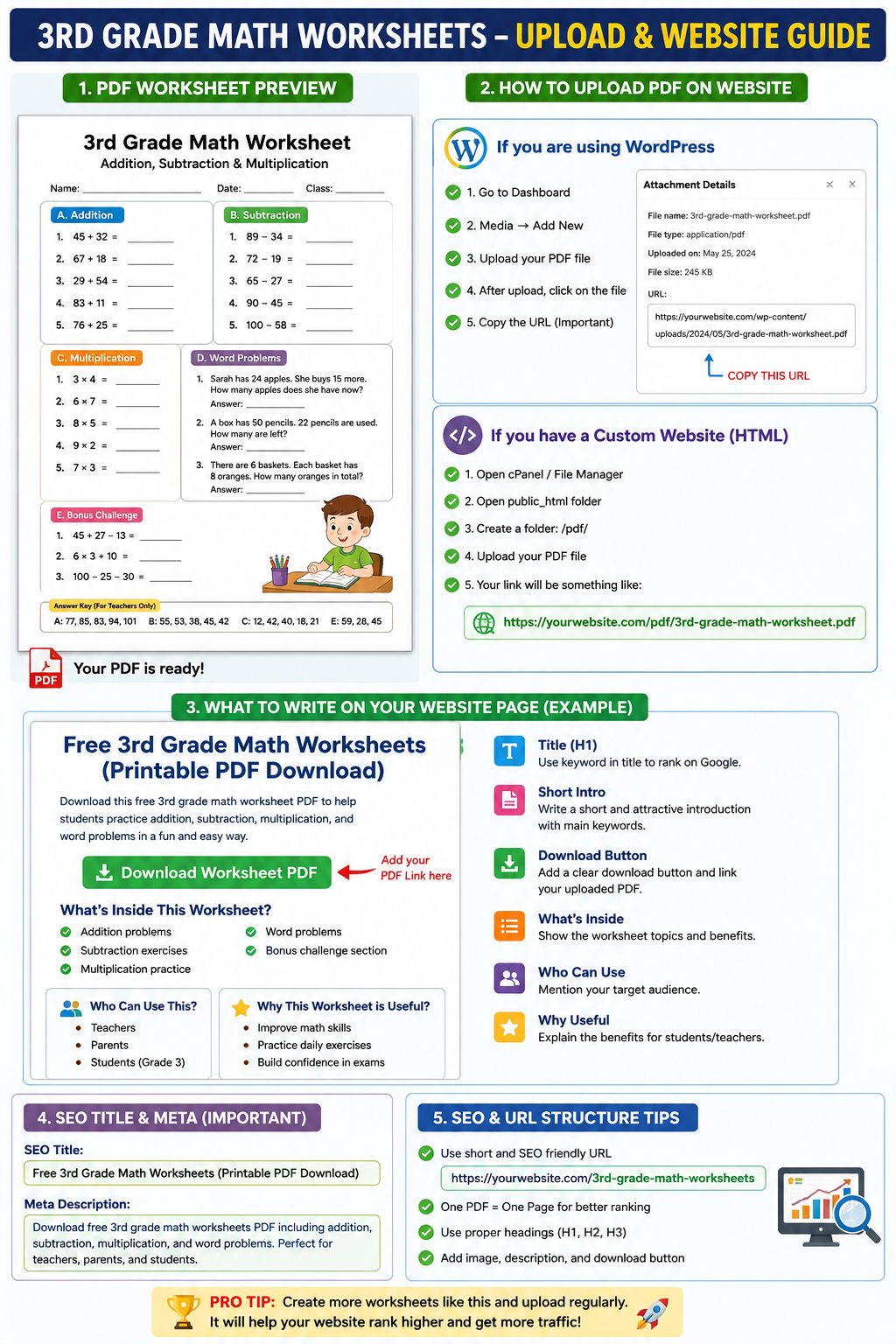
Download this free 3rd grade math worksheet PDF to help students practice addition, subtraction, multiplication, and word problems in a fun and easy way.
Why Math Worksheets Matter for 3rd Grade Learning
Before diving into specific worksheet resources, understanding why worksheets remain valuable educational tools is important.
Building Fluency and Automaticity
What it means:
Fluency refers to the ability to perform calculations quickly and accurately without excessive cognitive effort. Automaticity means recalling facts (like multiplication tables) without deliberate thinking.
Why it matters:
- Students must master basic facts to tackle more complex problems
- Fluency frees up mental capacity for problem-solving and reasoning
- Automatic recall of facts improves overall mathematics performance
- Students who struggle with fact fluency fall behind in higher grades
How worksheets help:
- Repeated practice builds fluency through spaced repetition
- Timed practice develops speed and accuracy
- Regular worksheet practice targets specific skill gaps
- Progress tracking through worksheets shows improvement over time
Reinforcing Classroom Learning
The classroom-to-home connection:
Teachers introduce concepts during lessons, but practice consolidates understanding. Worksheets extend learning beyond the classroom.
How worksheets help:
- Practice immediately after instruction strengthens learning
- Repeated exposure across multiple sessions improves retention
- Worksheets address concepts from multiple angles
- Home practice extends classroom time on task
- Parents can identify specific areas needing additional support
Identifying Learning Gaps
Diagnostic value:
Worksheets reveal which specific skills students have mastered and which need more work.
How worksheets help:
- Mistake patterns reveal conceptual misunderstandings
- Completion speed indicates fluency levels
- Difficulty progression helps identify the exact point where students struggle
- Teachers can provide targeted intervention based on worksheet results
- Parents understand what their children need to practice
Accommodating Different Learning Styles
Differentiation:
Students learn at different paces and through different modalities. Worksheets provide flexibility.
How worksheets help:
- Worksheets can be modified for different difficulty levels
- Visual, written, and concrete representations accommodate different learners
- Self-paced practice reduces anxiety for struggling learners
- Advanced worksheets challenge gifted students
- Additional practice helps struggling learners catch up
Building Confidence and Independence
The psychological component:
Successfully completing worksheets builds confidence. Confidence increases motivation and effort.
How worksheets help:
- Visible progress motivates continued effort
- Mastery of worksheet problems builds confidence
- Independent worksheet completion develops self-reliance
- Achievement reinforces positive attitudes toward mathematics
- Progress celebrations maintain engagement
3rd Grade Math Standards and Skills Covered
Understanding what skills 3rd graders should master helps you select appropriate worksheets.
Addition and Subtraction
Standards:
- Fluent addition and subtraction within 1,000
- Understanding place value
- Properties of addition and subtraction
- Adding and subtracting with regrouping
Skills covered:
- Two-digit addition and subtraction
- Three-digit addition and subtraction
- Adding and subtracting with regrouping (carrying and borrowing)
- Word problems involving addition and subtraction
- Fact families and number patterns
- Mental math strategies
Example worksheets in this category:
- Two-digit addition without regrouping
- Two-digit addition with regrouping
- Three-digit addition
- Subtraction within 1,000
- Mixed addition and subtraction problems
- Word problems involving addition and subtraction
Multiplication and Division
Standards:
- Understanding multiplication as repeated addition
- Multiplication facts (3×3 through 9×9)
- Division as inverse of multiplication
- Dividing with concrete models
Skills covered:
- Arrays and repeated addition
- Multiplication facts (times tables)
- Division with remainders
- Fact families (3×4=12, 4×3=12, 12÷3=4, 12÷4=3)
- Word problems involving multiplication and division
- Commutative property of multiplication
Example worksheets in this category:
- Multiplication as repeated addition
- Multiplication facts (3×3 table through 9×9 table)
- Timed multiplication facts
- Division concepts and facts
- Division with remainders
- Multiplication and division word problems
Fractions
Standards:
- Understanding unit fractions
- Comparing and ordering fractions
- Fractions of shapes and sets
- Equivalent fractions (introduction)
Skills covered:
- Identifying and naming fractions (1/2, 1/3, 1/4, etc.)
- Visual fraction models
- Comparing fractions with same denominators
- Ordering fractions
- Fractions of shapes
- Equivalent fractions
- Word problems with fractions
Example worksheets in this category:
- Identifying fractions from shapes
- Coloring fractional parts
- Comparing fractions
- Equivalent fractions
- Fractions of sets
- Ordering fractions
Measurement and Data
Standards:
- Measuring lengths using standard units
- Telling time
- Understanding area and perimeter
- Collecting, organizing, and interpreting data
Skills covered:
- Measuring length (inches, centimeters)
- Telling time to the nearest minute
- Understanding area and perimeter
- Reading thermometers
- Reading and creating bar graphs
- Reading and creating picture graphs
- Understanding data and statistics
Example worksheets in this category:
- Length measurement practice
- Telling time worksheets
- Area and perimeter problems
- Thermometer reading
- Bar graph creation and interpretation
- Picture graph practice
Geometry
Standards:
- Identifying and describing shapes
- Understanding attributes of shapes
- Partitioning shapes
Skills covered:
- Identifying 2D and 3D shapes
- Describing shape attributes
- Comparing shapes
- Partitioning shapes into equal parts
- Symmetry
- Rotating and flipping shapes
Example worksheets in this category:
- Shape identification
- Shape attributes and properties
- Symmetry activities
- Composing and decomposing shapes
- 2D and 3D shape comparison
Free 3rd Grade Math Worksheet Categories
Addition and Subtraction Worksheets
These worksheets build fluency with multi-digit addition and subtraction.
Two-Digit Addition Without Regrouping:
- Students add numbers without carrying
- Example: 23 + 14 = 37
- Purpose: Build foundational addition understanding
- Difficulty: Easier, best for beginning of year
- Recommended: 15-20 problems per worksheet
Two-Digit Addition With Regrouping:
- Students add numbers that require carrying
- Example: 27 + 15 = 42
- Purpose: Master carrying algorithm
- Difficulty: Intermediate, builds on earlier skill
- Recommended: 12-15 problems per worksheet
Three-Digit Addition:
- Students add numbers with hundreds place
- Example: 234 + 156 = 390
- Purpose: Extend to larger numbers
- Difficulty: Intermediate to advanced
- Recommended: 10-12 problems per worksheet
Two-Digit Subtraction Without Regrouping:
- Students subtract without borrowing
- Example: 36 – 12 = 24
- Purpose: Build foundational subtraction understanding
- Difficulty: Easier
- Recommended: 15-20 problems per worksheet
Two-Digit Subtraction With Regrouping:
- Students subtract with borrowing
- Example: 32 – 15 = 17
- Purpose: Master borrowing algorithm
- Difficulty: Intermediate
- Recommended: 12-15 problems per worksheet
Three-Digit Subtraction:
- Students subtract with hundreds place
- Example: 350 – 127 = 223
- Purpose: Extend to larger numbers
- Difficulty: Intermediate to advanced
- Recommended: 10-12 problems per worksheet
Mixed Addition and Subtraction:
- Problems combine addition and subtraction
- Challenges students to identify the operation
- Purpose: Develop operation sense
- Difficulty: Intermediate to advanced
- Recommended: 12-15 problems per worksheet
Word Problems – Addition and Subtraction:
- Story problems requiring addition or subtraction
- Example: “Maria has 24 crayons. She gives 8 to her friend. How many does she have left?”
- Purpose: Apply skills to real situations
- Difficulty: Intermediate to advanced
- Recommended: 5-8 problems per worksheet
Multiplication and Division Worksheets
These worksheets develop multiplication and division skills and fluency.
Multiplication as Repeated Addition:
- Visual introduction to multiplication concept
- Represents 3×4 as three groups of four
- Purpose: Build conceptual understanding
- Difficulty: Easier, introduction to multiplication
- Recommended: 8-10 problems per worksheet
Arrays and Multiplication:
- Students identify multiplication from array models
- Develops understanding of rows and columns
- Purpose: Visual representation of multiplication
- Difficulty: Intermediate
- Recommended: 10-12 problems per worksheet
Multiplication Facts (3s Table):
- Students practice 3×1 through 3×9
- Purpose: Build fluency with 3s facts
- Difficulty: Intermediate
- Recommended: 20-25 problems per worksheet for practice
Multiplication Facts (4s Table):
- Students practice 4×1 through 4×9
- Purpose: Build fluency with 4s facts
- Difficulty: Intermediate
- Recommended: 20-25 problems per worksheet
Multiplication Facts (5s Table):
- Students practice 5×1 through 5×9
- Purpose: Build fluency with 5s facts
- Difficulty: Intermediate (usually easier for students)
- Recommended: 20-25 problems per worksheet
Multiplication Facts (6s-9s Tables):
- Students practice facts for 6, 7, 8, and 9
- Purpose: Master all multiplication facts to 9×9
- Difficulty: Intermediate to advanced
- Recommended: 15-20 problems per worksheet
Mixed Multiplication Facts:
- Students practice all multiplication facts to 9×9
- Purpose: Maintain fluency across all facts
- Difficulty: Advanced
- Recommended: 20-30 problems per worksheet (timed practice)
Division Concepts:
- Students understand division as sharing and grouping
- Visual models and concrete representations
- Purpose: Build conceptual understanding of division
- Difficulty: Intermediate
- Recommended: 10-12 problems per worksheet
Division Facts:
- Students practice division as inverse of multiplication
- Example: 12÷3=4 (inverse of 3×4=12)
- Purpose: Build division fluency
- Difficulty: Intermediate to advanced
- Recommended: 15-20 problems per worksheet
Division With Remainders:
- Students divide and express remainders
- Example: 14÷3=4 R2
- Purpose: Understand remainders
- Difficulty: Advanced
- Recommended: 10-12 problems per worksheet
Multiplication and Division Word Problems:
- Story problems requiring multiplication or division
- Example: “Sarah has 24 cookies to share equally among 4 friends. How many cookies does each friend get?”
- Purpose: Apply skills to real situations
- Difficulty: Advanced
- Recommended: 5-8 problems per worksheet
Fraction Worksheets
These worksheets introduce and practice fundamental fraction concepts.
Identifying Fractions:
- Students identify and name fractions from shapes
- Example: Color one-half of the circle
- Purpose: Build understanding of fraction vocabulary
- Difficulty: Introductory
- Recommended: 12-15 problems per worksheet
Comparing Fractions (Same Denominator):
- Students compare fractions with same denominators
- Example: Is 2/4 greater than 1/4?
- Purpose: Understand fraction comparison
- Difficulty: Intermediate
- Recommended: 10-12 problems per worksheet
Ordering Fractions:
- Students arrange fractions from smallest to largest
- Example: Order 1/2, 1/4, 3/4 from smallest to largest
- Purpose: Build fraction sense
- Difficulty: Intermediate to advanced
- Recommended: 8-10 problems per worksheet
Unit Fractions:
- Students work with fractions with numerator of 1
- Example: 1/2, 1/3, 1/4
- Purpose: Build foundational fraction understanding
- Difficulty: Intermediate
- Recommended: 10-12 problems per worksheet
Fractions of Shapes:
- Students identify and color fractional parts of shapes
- Example: Shade 2/3 of the rectangle
- Purpose: Visual fraction understanding
- Difficulty: Intermediate
- Recommended: 10-12 problems per worksheet
Fractions of Sets:
- Students identify fractions of groups
- Example: What fraction of the group has circles?
- Purpose: Apply fractions to real situations
- Difficulty: Intermediate to advanced
- Recommended: 8-10 problems per worksheet
Equivalent Fractions (Introduction):
- Students recognize equivalent fractions
- Example: 1/2 = 2/4
- Purpose: Begin understanding equivalent fractions
- Difficulty: Advanced
- Recommended: 8-10 problems per worksheet
Measurement and Data Worksheets
These worksheets develop measurement skills and data interpretation.
Length Measurement (Inches):
- Students measure objects in inches
- Purpose: Practice standard measurement
- Difficulty: Intermediate
- Recommended: 8-10 measurement activities per worksheet
Length Measurement (Centimeters):
- Students measure objects in centimeters
- Purpose: Practice metric measurement
- Difficulty: Intermediate
- Recommended: 8-10 measurement activities per worksheet
Telling Time:
- Students read analog clock and write time
- Purpose: Build time-telling fluency
- Difficulty: Intermediate
- Recommended: 12-15 problems per worksheet
Elapsed Time:
- Students calculate time between two times
- Example: If you start at 2:00 and finish at 2:45, how much time passed?
- Purpose: Understand time intervals
- Difficulty: Advanced
- Recommended: 8-10 problems per worksheet
Area and Perimeter:
- Students calculate area (square units) and perimeter (distance around)
- Purpose: Build understanding of these concepts
- Difficulty: Intermediate to advanced
- Recommended: 8-10 problems per worksheet
Bar Graph Interpretation:
- Students read and answer questions about bar graphs
- Purpose: Extract and interpret data
- Difficulty: Intermediate
- Recommended: 4-6 questions per worksheet
Bar Graph Creation:
- Students create bar graphs from data sets
- Purpose: Organize and represent data
- Difficulty: Intermediate to advanced
- Recommended: 2-3 graph creations per worksheet
Picture Graph Interpretation:
- Students read picture graphs and answer questions
- Purpose: Interpret pictorial data representation
- Difficulty: Intermediate
- Recommended: 4-6 questions per worksheet
Geometry Worksheets
These worksheets develop shape identification and geometric thinking.
2D Shape Identification:
- Students identify circles, triangles, squares, rectangles, and other shapes
- Purpose: Build shape vocabulary
- Difficulty: Introductory
- Recommended: 15-20 problems per worksheet
3D Shape Identification:
- Students identify cubes, spheres, cones, cylinders
- Purpose: Build 3D shape awareness
- Difficulty: Introductory
- Recommended: 12-15 problems per worksheet
Shape Attributes:
- Students describe properties of shapes (sides, corners, angles)
- Purpose: Develop geometric vocabulary
- Difficulty: Intermediate
- Recommended: 10-12 problems per worksheet
Comparing Shapes:
- Students identify similarities and differences between shapes
- Purpose: Develop comparative thinking
- Difficulty: Intermediate
- Recommended: 8-10 problems per worksheet
Line Symmetry:
- Students identify lines of symmetry and create symmetric shapes
- Purpose: Understand symmetry
- Difficulty: Intermediate
- Recommended: 8-10 problems per worksheet
Composing Shapes:
- Students combine shapes to create new shapes
- Example: Two triangles make a square
- Purpose: Develop spatial reasoning
- Difficulty: Intermediate to advanced
- Recommended: 8-10 problems per worksheet
Partitioning Shapes:
- Students divide shapes into equal parts
- Purpose: Build foundation for fractions
- Difficulty: Intermediate
- Recommended: 8-10 problems per worksheet
How to Use 3rd Grade Math Worksheets Effectively
Having worksheets is valuable only if they’re used effectively. Here’s guidance on maximizing their impact.
Pre-Assessment: Identifying Skill Levels
Purpose:
Determine what students already know before teaching a concept.
How to use:
- Give a worksheet covering the topic before instruction
- Don’t grade for accuracy; use to identify knowledge gaps
- Note which skills students possess and which they lack
- Use results to inform instruction and group students
Benefits:
- Avoids teaching skills students already know
- Targets instruction to actual needs
- Saves time by focusing on new concepts
- Identifies students needing prerequisite review
During Instruction: Supporting Learning
Purpose:
Reinforce concepts being taught in class.
How to use:
- Introduce concept during lesson
- Provide worksheets that same day for practice
- Start with easier problems; progress to harder ones
- Do first few problems together; have students work independently
- Review answers and address common mistakes
Benefits:
- Immediate practice reinforces learning
- Identifies student confusion while you can help
- Builds fluency through repetition
- Shows students how to approach problems
For Homework: Extending Practice
Purpose:
Extend learning beyond the classroom.
How to use:
- Assign worksheets related to recent lessons
- Keep assignments reasonable (15-20 minutes)
- Provide answer key so students can self-check
- Follow up in class with student questions
- Adjust future assignments based on homework performance
Benefits:
- Home practice extends instructional time
- Parents see what their children are learning
- Reveals which students need additional support
- Builds independent practice habits
For Intervention: Targeted Support
Purpose:
Provide extra practice for students struggling with specific skills.
How to use:
- Use simpler worksheets targeting specific gaps
- Provide more frequent practice (3-4 times weekly)
- Provide manipulatives and concrete models
- Check frequently and provide immediate feedback
- Celebrate improvement and progress
Benefits:
- Targeted practice addresses specific needs
- More frequent feedback helps struggling learners
- Prevents gaps from widening
- Builds confidence through visible progress
For Enrichment: Challenging Advanced Students
Purpose:
Provide challenge for students who’ve mastered grade-level skills.
How to use:
- Use harder versions of worksheets
- Provide extension problems or word problems
- Assign multi-step problems
- Create mixed problems combining multiple skills
- Challenge students to explain their thinking
Benefits:
- Prevents boredom and behavior problems
- Develops deeper understanding
- Challenges gifted students appropriately
- Extends learning beyond grade level
For Assessment: Checking Understanding
Purpose:
Evaluate whether students have mastered skills.
How to use:
- Use worksheets as formative assessments
- Don’t grade all worksheets; use some for informal assessment
- Check for accuracy, but also look at reasoning
- Identify error patterns indicating misunderstandings
- Use results to adjust instruction
Benefits:
- Provides objective data on student learning
- Identifies misconceptions early
- Informs instructional decisions
- Documents progress for parents and administrators
Tips for Parents Using Math Worksheets at Home
Parents often use worksheets to support learning at home. These tips maximize effectiveness.
Create a Positive Learning Environment
Strategies:
- Choose a quiet, distraction-free space
- Make the environment comfortable and inviting
- Remove distractions (phones, TV, unnecessary items)
- Ensure good lighting and seating
- Set a regular time for math practice
Why it matters:
- Positive environment increases focus and effort
- Reduces anxiety and frustration
- Makes practice more effective and enjoyable
- Builds healthy study habits
Start Small and Build Gradually
Strategies:
- Begin with just a few problems (5-10)
- Gradually increase as stamina improves
- Start with easier versions of worksheets
- Progress to harder problems once easier ones are mastered
- Don’t overwhelm with too much at once
Why it matters:
- Prevents frustration and discouragement
- Builds confidence through success
- Develops math endurance gradually
- Makes practice sustainable
Focus on Understanding, Not Just Answers
Strategies:
- Ask your child to explain their thinking
- Ask “How did you get that answer?”
- Help them show their work
- Discuss different ways to solve problems
- Praise effort and problem-solving approach, not just correct answers
Why it matters:
- Develops deeper understanding
- Identifies misconceptions
- Builds problem-solving skills
- Prepares for more complex mathematics
Use Manipulatives and Concrete Materials
Strategies:
- Use blocks, counters, or coins for concrete practice
- Draw pictures or diagrams to represent problems
- Use number lines to visualize addition and subtraction
- Use arrays to visualize multiplication
- Connect abstract symbols to concrete representations
Why it matters:
- Many 3rd graders learn better with concrete materials
- Visual representations aid understanding
- Manipulatives make math tangible and less abstract
- Builds foundation for abstract thinking later
Check Your Child’s Work Together
Strategies:
- Look over worksheets together
- Celebrate correct answers
- Discuss incorrect answers without criticism
- Ask what went wrong and how to fix it
- Use mistakes as learning opportunities
Why it matters:
- Identifies understanding gaps quickly
- Provides immediate feedback
- Shows child you value their effort
- Builds positive attitudes toward math
Communicate With the Teacher
Strategies:
- Ask what specific skills are being taught
- Request guidance on how to help at home
- Share worksheet results with the teacher
- Ask about areas where your child needs support
- Coordinate practice at home with classroom instruction
Why it matters:
- Ensures home practice supports classroom instruction
- Prevents practicing wrong methods or isolated skills
- Allows teacher to provide specific guidance
- Builds strong home-school partnership
Keep It Short and Fun
Strategies:
- Limit sessions to 15-20 minutes
- Make practice games when possible
- Use humor and keep tone light
- Take breaks if frustration builds
- Celebrate progress and effort
Why it matters:
- Maintains focus and prevents mental fatigue
- Prevents practice from becoming punishment
- Builds positive attitudes toward math
- Keeps children engaged and willing
Frequently Asked Questions (FAQs)
Where can I find free 3rd grade math worksheets?
Free worksheets are available through many sources: education websites (Teachers Pay Teachers free section, Khan Academy), school district websites, educational blogs, and learning apps. Common sources include CommonCoreSheets.com, IXL Learning’s free worksheets, and Math-Drills.com. A simple Google search for “free 3rd grade math worksheets” provides numerous options.
How often should 3rd graders practice with worksheets?
Most experts recommend 15-20 minutes of daily math practice for 3rd graders. This might include worksheet practice 3-4 times weekly, with other days involving games, manipulative-based activities, or other practice formats. Daily practice is more effective than longer, less frequent sessions.
How do I know if a worksheet is appropriate for my child?
An appropriate worksheet should: include problems your child can solve with effort (not easily, not impossibly), address skills recently taught, align with your child’s learning level, and feel manageable in length. If a worksheet is too easy, it’s not building new skills. If it’s too hard, it causes frustration.
Should I make my child redo worksheets with errors?
Rather than forcing complete reworking, discuss errors together. Ask your child to explain their thinking. If they understand the concept but made careless mistakes, correction isn’t necessary. If they don’t understand, reworking after discussion or additional instruction is beneficial.
How should I grade my child’s worksheets?
For practice worksheets, avoid assigning grades. Instead, use worksheets to identify what your child understands and what needs more practice. Praise effort and improvement. For formal assessments or tests, grading is appropriate, but practice worksheets are better used as diagnostic tools.
What should I do if my child consistently gets problems wrong?
If problems are consistently incorrect, the issue may be: the skill isn’t truly mastered, the worksheet is too difficult, or there’s a conceptual misunderstanding. Slow down, go back to simpler problems, use concrete materials, or ask the teacher for clarification on how the skill is being taught.
Are timed worksheets appropriate for 3rd grade?
Timed practice can be appropriate for building fluency with basic facts (addition, subtraction, multiplication), but should be used sparingly and not in ways that cause anxiety. Untimed practice is more appropriate when learning new concepts. Some children work more slowly and benefit more from untimed practice.
How do I keep my child motivated to do worksheets?
Make worksheets part of varied practice (games, manipulatives, computer programs). Celebrate progress, not perfection. Connect math to real-world situations. Make it fun and low-pressure. Let your child choose from options. Involve them in tracking progress. Keep sessions short and manageable.
What if my child refuses to do worksheets?
First, identify the reason: anxiety, frustration, boredom, or reluctance to do schoolwork. Then, adjust accordingly: use easier worksheets, include more games, reduce quantity, or make practice social. Avoid power struggles. If resistance is significant, discuss with the teacher to identify whether there are underlying learning issues.
How do worksheets support different learning styles?
While some learners are very visual-spatial and benefit from worksheets with diagrams, others prefer linguistic approaches. Mix worksheet types: some with visual models, some with word problems, some with concrete representations. Combine worksheets with hands-on activities, games, and discussion to engage different learning styles.
Conclusion
Free 3rd grade math worksheets are valuable tools for supporting learning at home and in the classroom. These simple, printable resources help students build fluency with essential skills, practice concepts recently taught, and develop confidence in mathematics. Whether you’re a teacher looking to supplement instruction, a parent supporting learning at home, or a student needing extra practice, worksheets organized by topic and difficulty level provide targeted, focused practice.
The key to effective worksheet use is understanding that worksheets are best used as one component of comprehensive mathematics instruction—not as the entirety of practice. Combine worksheets with manipulative-based activities, games, real-world problem-solving, and discussion for the most effective learning. Regular, moderate-length practice sessions prove more effective than occasional marathon sessions.
As you use these printable 3rd grade math worksheets, remember to focus on building understanding alongside fluency, celebrate effort and improvement, and adjust difficulty based on your child’s or students’ needs. When used effectively, worksheets become powerful tools supporting students’ mathematical growth and building the strong foundation necessary for success in upper-grade mathematics.
Start with worksheets addressing the specific skills your child or students are currently learning. Progress gradually from easier to more difficult versions. Use results to identify strengths and areas needing more practice. Most importantly, keep the experience positive and supportive, helping young mathematicians develop both competence and confidence in mathematics.