
Introduction
Figurative language is one of the most important literary elements students learn in middle school English classes. It transforms ordinary writing into vivid, imaginative expression that engages readers emotionally and intellectually. If you’re working through figurative language identification worksheets, understanding not just the answers but the reasoning behind them is crucial for mastering this skill.
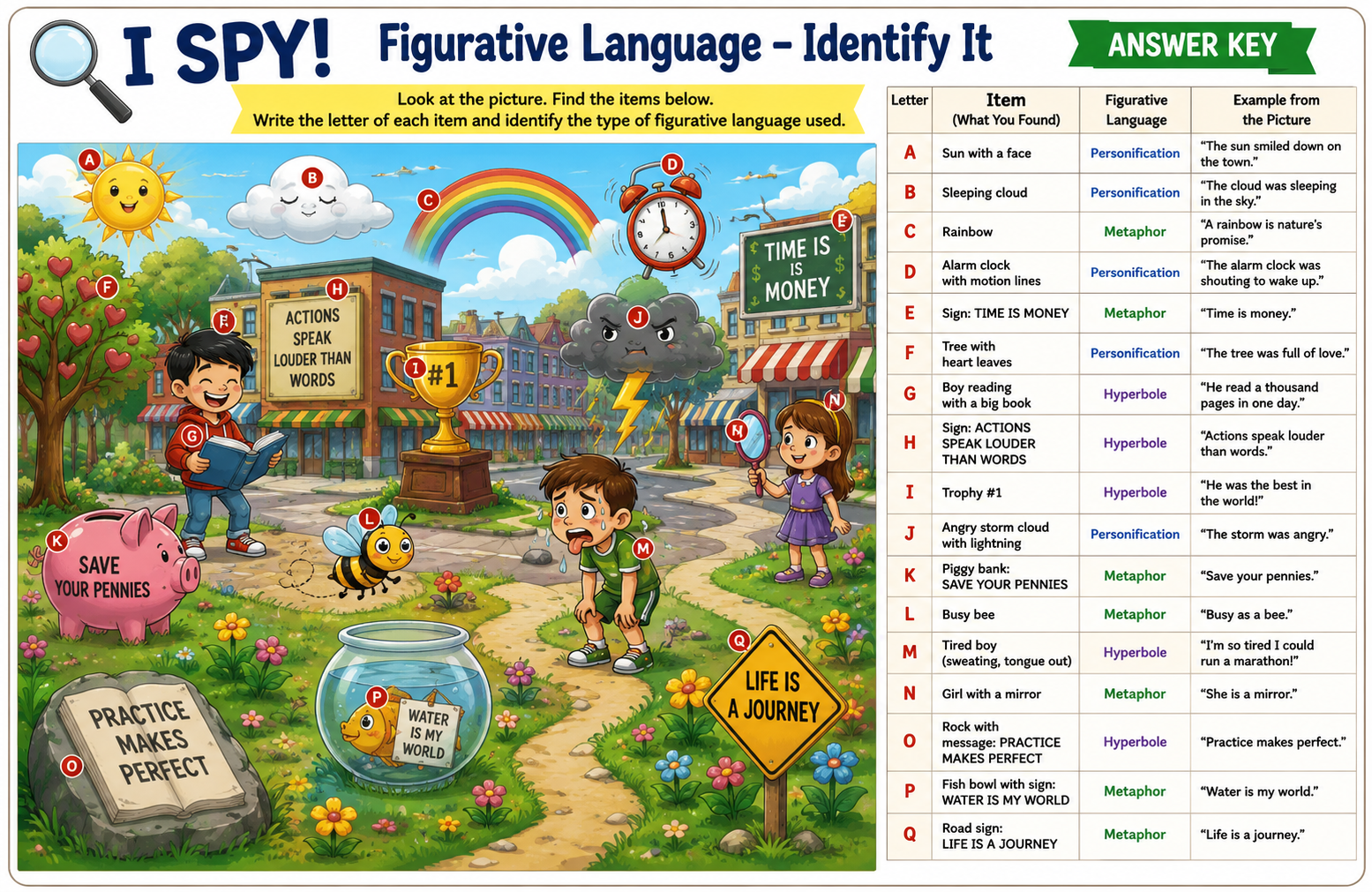
This comprehensive guide provides complete figurative language worksheet answers with detailed explanations for each type: similes, metaphors, personification, idioms, hyperbole, oxymoron, alliteration, onomatopoeia, and more. Rather than simply providing answer keys, this resource explains why each answer is correct, how to identify each figure of speech, and what makes them work effectively in writing. Whether you’re a student checking your work, a teacher looking for answer keys, or a parent helping with homework, this guide helps you understand the reasoning behind identification and use of figurative language devices.
What Is Figurative Language?
Before diving into specific worksheet answers, understanding what figurative language is and why writers use it is essential.
Definition
Figurative language refers to words, phrases, and expressions that deviate from literal meaning to create imagery, emotion, or emphasis. Rather than stating facts directly, figurative language uses creative language to communicate ideas in more imaginative and impactful ways.
Purpose and Function
Why writers use figurative language:
- Creates vivid imagery: Helps readers visualize scenes and situations
- Evokes emotion: Connects readers emotionally to the text
- Enhances meaning: Communicates complex ideas concisely
- Engages readers: Makes writing more interesting and memorable
- Develops voice: Reflects the writer’s unique perspective and style
- Emphasizes ideas: Highlights important concepts through comparison
- Creates humor: Generates entertainment and delight
- Builds connections: Helps readers relate to unfamiliar concepts through comparison
Literal vs. Figurative Meaning
Literal meaning: The actual, dictionary definition of words
- Example: “The sun is shining brightly in the sky.”
- This describes a factual weather condition
Figurative meaning: Implied or imaginative meaning beyond literal definition
- Example: “Her smile was the sunshine that brightened my day.”
- This doesn’t mean a literal smile is the sun; it compares the positive effect of her smile to sunlight’s brightness
Types of Figurative Language with Worksheet Examples
1. Simile
Definition:
A comparison between two different things using “like” or “as,” explicitly stating the comparison.
Key identifier: Contains “like” or “as”
Structure: “A is like B” or “A is as _____ as B”
Example Worksheet Problems and Answers
Problem 1: “Her voice was like a songbird singing in the morning.”
- Answer: Simile
- Explanation: The comparison uses “like” to compare her voice to a songbird singing. This is explicitly stated comparison.
- What’s being compared: Her voice and a songbird’s singing
- Purpose: Suggests her voice is beautiful, melodic, and pleasant
Problem 2: “The old car ran as smoothly as a new Mercedes.”
- Answer: Simile
- Explanation: Uses “as…as” to compare how the old car runs to a Mercedes. The “as…as” structure is a key simile marker.
- What’s being compared: How the old car runs and how a Mercedes runs
- Purpose: Emphasizes that despite being old, the car performs excellently
Problem 3: “She was happy like a child on Christmas morning.”
- Answer: Simile
- Explanation: “Like” indicates a comparison between her happiness and a child’s happiness on Christmas morning.
- What’s being compared: Her happiness and a child’s Christmas morning happiness
- Purpose: Conveys pure, unbridled joy
Problem 4: “The music was as loud as thunder.”
- Answer: Simile
- Explanation: “As…as” structure creates explicit comparison between music volume and thunder volume.
- What’s being compared: Music loudness and thunder loudness
- Purpose: Emphasizes extreme loudness
Problem 5: “The crowd moved like a river flowing downstream.”
- Answer: Simile
- Explanation: “Like” creates explicit comparison between crowd movement and river flow.
- What’s being compared: Crowd movement and river flow
- Purpose: Suggests continuous, unstoppable movement
How to Identify Similes
Key clues:
- Look for “like” or “as”
- The comparison is direct and obvious
- Two different things are being compared
- The comparison helps readers visualize or understand something better
Common simile structures:
- “_____ is like _____”
- “As _____ as _____”
- “_____ like _____”
2. Metaphor
Definition:
A comparison between two different things WITHOUT using “like” or “as.” It directly states that one thing IS another thing.
Key identifier: No “like” or “as”; uses “is” or other forms of “to be”
Structure: “A is B” (implies similarity)
Example Worksheet Problems and Answers
Problem 1: “Time is a thief that steals our youth.”
- Answer: Metaphor
- Explanation: Time is directly compared to a thief without “like” or “as.” It “IS” a thief, not “is like” a thief.
- What’s being compared: Time and a thief
- Purpose: Suggests time takes away our youth and vitality without our control
- Why it’s effective: Creates a more forceful statement than a simile; emphasizes the unavoidable nature of aging
Problem 2: “His words were daggers piercing her heart.”
- Answer: Metaphor
- Explanation: Words “are” daggers—direct comparison without “like.” States they ARE daggers, not that they’re “like” daggers.
- What’s being compared: His words and daggers
- Purpose: Emphasizes how deeply hurtful his words were
- Why it’s effective: Creates vivid imagery of emotional pain as physical pain
Problem 3: “The classroom was a zoo during lunch period.”
- Answer: Metaphor
- Explanation: The classroom “IS” a zoo—direct comparison without “like” or “as.”
- What’s being compared: The classroom and a zoo
- Purpose: Describes the chaotic, wild nature of the classroom
- Why it’s effective: Immediately conveys chaos and lack of order
Problem 4: “She is a shining star in our community.”
- Answer: Metaphor
- Explanation: She “IS” a star—direct comparison without “like.”
- What’s being compared: She and a star
- Purpose: Suggests she’s bright, admirable, and stands out
- Why it’s effective: Creates positive, uplifting imagery
Problem 5: “Life is a journey with many twists and turns.”
- Answer: Metaphor
- Explanation: Life “IS” a journey—direct comparison without “like.”
- What’s being compared: Life and a journey
- Purpose: Suggests life involves travel, discovery, and unexpected changes
- Why it’s effective: Helps readers understand life’s complexity through the familiar concept of journeying
How to Identify Metaphors
Key clues:
- NO “like” or “as”
- Uses forms of “to be” (is, was, are, were, be)
- One thing is directly stated to BE another thing
- The comparison is implied rather than explicit
Common metaphor structures:
- “_____ is _____”
- “_____ was _____”
- “_____ = _____” (in poetry, the verb might be implied)
Simile vs. Metaphor Quick Check:
- Simile: “Her eyes are like stars” (comparison with “like”)
- Metaphor: “Her eyes are stars” (direct statement without “like”)
3. Personification
Definition:
Giving human characteristics, qualities, or actions to non-human things (animals, objects, ideas, nature).
Key identifier: Non-human thing described with human qualities or actions
Structure: Non-human subject + human action/quality
Example Worksheet Problems and Answers
Problem 1: “The wind whispered through the trees.”
- Answer: Personification
- Explanation: Wind is given the human ability to “whisper.” Wind cannot actually whisper; this is a human action.
- What’s personified: The wind
- Human quality assigned: Ability to whisper/communicate softly
- Purpose: Creates a gentle, mysterious atmosphere
Problem 2: “The flowers danced in the breeze.”
- Answer: Personification
- Explanation: Flowers are given the human ability to “dance.” They’re described doing something only humans (or animals) do.
- What’s personified: The flowers
- Human quality assigned: Ability to dance
- Purpose: Creates movement and liveliness; suggests graceful motion
Problem 3: “The old house groaned under the weight of the snow.”
- Answer: Personification
- Explanation: A house is given the human ability to “groan,” something only humans and animals do.
- What’s personified: The house
- Human quality assigned: Ability to vocalize/complain
- Purpose: Suggests the house is struggling; creates sympathy for an inanimate object
Problem 4: “Time stood still as I waited for her response.”
- Answer: Personification
- Explanation: Time is given the human ability to “stand,” a physical human action.
- What’s personified: Time
- Human quality assigned: Ability to stand/stop moving
- Purpose: Emphasizes how slowly time seemed to pass during suspense
Problem 5: “The stars twinkled playfully above us.”
- Answer: Personification
- Explanation: Stars are given the human quality of “playfulness” and the ability to act playfully.
- What’s personified: The stars
- Human quality assigned: Playfulness
- Purpose: Creates a whimsical, joyful tone
Problem 6: “The river rushed eagerly toward the ocean.”
- Answer: Personification
- Explanation: The river is given the human emotion “eagerness” and the human motivation to move with purpose.
- What’s personified: The river
- Human quality assigned: Emotion and purposeful action
- Purpose: Makes the river seem alive and animated
How to Identify Personification
Key clues:
- Look for non-human things (animals, objects, nature, ideas) described with human qualities
- Ask: “Can this non-human thing actually do/feel this?”
- If the answer is “no,” it’s likely personification
- Human actions include: thinking, feeling, speaking, moving with purpose, showing emotion
Common personification examples:
- Nature: wind whispers, rain dances, sun smiles, trees reach
- Objects: clocks tick impatiently, cars groan, doors slam angrily
- Abstract ideas: justice is blind, death calls, hunger gnaws
4. Idiom
Definition:
A phrase or expression whose meaning cannot be understood from the literal meanings of the individual words. The meaning is figurative and specific to a culture or language.
Key identifier: Phrase that means something different from the literal combination of words
Structure: Multiple words with non-literal collective meaning
Example Worksheet Problems and Answers
Problem 1: “When she found out she won the lottery, she hit the roof.”
- Answer: Idiom
- Explanation: “Hit the roof” doesn’t literally mean she struck a roof. It means she became very angry or excited.
- Literal meaning: Strike or reach the roof
- Figurative meaning: Became very angry/excited
- Origin/Context: This idiom likely references an intense emotional reaction being so strong the person jumps up
Problem 2: “He was barking up the wrong tree when he blamed his brother.”
- Answer: Idiom
- Explanation: “Barking up the wrong tree” doesn’t mean literally barking at a tree. It means pursuing a wrong course of action or suspecting the wrong person.
- Literal meaning: A dog barking at the wrong tree
- Figurative meaning: Pursuing an incorrect direction or blaming the wrong person
- Origin: Hunting dogs would sometimes bark at the wrong tree, indicating the wrong location of the animal
Problem 3: “Don’t cry over spilled milk.”
- Answer: Idiom
- Explanation: About not worrying over something that has already happened and cannot be changed.
- Literal meaning: Crying about spilled milk
- Figurative meaning: Lamenting something that cannot be undone
- Purpose: Advises moving forward rather than dwelling on past mistakes
Problem 4: “She has a heart of gold.”
- Answer: Idiom
- Explanation: She doesn’t literally have a golden heart. It means she’s kind, generous, and compassionate.
- Literal meaning: A heart made of gold
- Figurative meaning: A kind and generous person
- Purpose: Expresses admiration for someone’s character
Problem 5: “That joke went over his head.”
- Answer: Idiom
- Explanation: Doesn’t literally mean something went above his head in space. Means he didn’t understand the joke or its point.
- Literal meaning: Something passing above his head physically
- Figurative meaning: He didn’t understand
- Purpose: Suggests the joke was too complex or subtle for him to grasp
Problem 6: “I’m dying of thirst.”
- Answer: Idiom (also could be Hyperbole, depending on the source material)
- Explanation: Doesn’t mean literally dying, but means extremely thirsty.
- Literal meaning: Actually dying from thirst
- Figurative meaning: Extremely thirsty
- Note: This could be categorized as hyperbole (extreme exaggeration) rather than idiom, depending on context and classification system
How to Identify Idioms
Key clues:
- The phrase’s meaning differs from the literal meaning of individual words
- You cannot understand the meaning by looking up individual words
- The meaning is specific to a language or culture
- Native speakers understand it immediately; non-native speakers often find it confusing
Common idioms:
- “Break a leg” (good luck)
- “Piece of cake” (very easy)
- “Raining cats and dogs” (raining heavily)
- “Bite the bullet” (face difficulty bravely)
- “Cost an arm and a leg” (very expensive)
- “Break the ice” (start a conversation)
5. Hyperbole
Definition:
Extreme exaggeration used for emphasis, humor, or effect. The statement is obviously not literally true.
Key identifier: Extreme, obvious exaggeration
Structure: Statement that’s intentionally much more extreme than reality
Example Worksheet Problems and Answers
Problem 1: “I’ve told you a million times not to do that!”
- Answer: Hyperbole
- Explanation: The speaker hasn’t literally told the person a million times—that would be impossible. The exaggeration emphasizes frustration.
- Literal meaning: Exactly one million tellings
- Figurative meaning: Many, many times
- Purpose: Expresses extreme frustration and repetition
Problem 2: “This backpack weighs a ton!”
- Answer: Hyperbole
- Explanation: The backpack doesn’t literally weigh 2,000 pounds (a ton). The exaggeration emphasizes how heavy it feels.
- Literal meaning: Weighs 2,000 pounds
- Figurative meaning: Very heavy
- Purpose: Expresses complaint about weight in an emphatic way
Problem 3: “I’m so hungry I could eat a horse.”
- Answer: Hyperbole
- Explanation: The person couldn’t literally eat an entire horse. The extreme exaggeration emphasizes hunger.
- Literal meaning: Would consume an entire horse
- Figurative meaning: Very hungry
- Purpose: Expresses extreme hunger humorously
Problem 4: “You’re the best student in the entire world!”
- Answer: Hyperbole
- Explanation: Literally not the best student of all 8 billion people on Earth. The extreme exaggeration is used to express praise.
- Literal meaning: Best of all humans globally
- Figurative meaning: Excellent student
- Purpose: Emphasizes praise and appreciation
Problem 5: “This test is impossible; I’ll never understand it.”
- Answer: Hyperbole
- Explanation: The test isn’t literally impossible, and the student likely could understand it with effort. The exaggeration expresses frustration and doubt.
- Literal meaning: Cannot be done; no understanding possible
- Figurative meaning: Very difficult
- Purpose: Expresses frustration and discouragement
Problem 6: “I’m dying of boredom.”
- Answer: Hyperbole
- Explanation: Not literally dying, but the exaggeration emphasizes how bored the person is.
- Literal meaning: Actually dying from boredom
- Figurative meaning: Extremely bored
- Purpose: Expresses extreme boredom
How to Identify Hyperbole
Key clues:
- The statement is obviously untrue or extreme
- The exaggeration emphasizes a point or emotion
- The statement would be impossible to literally true
- Context suggests the speaker isn’t being factual
- Look for absolute words: “never,” “always,” “million,” “ton,” “dying,” “killing”
Common hyperbole examples:
- “I’m so tired I could sleep for a week”
- “This pizza is the best thing I’ve ever eaten”
- “My room is a pigsty” (exaggerating messiness)
- “That movie scared me to death”
- “I’ve been waiting forever”
6. Oxymoron
Definition:
A combination of contradictory or opposite words placed together for effect or emphasis.
Key identifier: Two words/concepts that contradict each other
Structure: Contradictory adjective + noun or contradictory words together
Example Worksheet Problems and Answers
Problem 1: “This is a bittersweet moment.”
- Answer: Oxymoron
- Explanation: “Bitter” and “sweet” are opposite tastes/emotions, yet they’re combined to describe a single moment that’s both sad and happy.
- Contradictory elements: Bitter (bad, sad) and sweet (good, pleasant)
- Purpose: Captures complex emotions that can’t be described simply
- Example situation: Graduation is bittersweet—happy to move forward, sad to leave
Problem 2: “Deafening silence filled the room.”
- Answer: Oxymoron
- Explanation: “Deafening” means extremely loud, while “silence” means no sound. These are contradictory, yet combined to describe the loudness of silence.
- Contradictory elements: Deafening (very loud) and silence (no sound)
- Purpose: Emphasizes how notable or striking the silence is
- Effect: Creates paradoxical imagery
Problem 3: “This is a clearly confused explanation.”
- Answer: Oxymoron
- Explanation: “Clearly” suggests obviousness and clarity, while “confused” suggests lack of clarity. These contradict.
- Contradictory elements: Clearly (obvious, clear) and confused (unclear, muddled)
- Purpose: Emphasizes the paradox of confusing something intended to be clear
Problem 4: “She gave a serious joke during the presentation.”
- Answer: Oxymoron
- Explanation: “Serious” means not joking; “joke” means humorous. These contradict when combined.
- Contradictory elements: Serious (not funny) and joke (meant to be funny)
- Purpose: Suggests a joke that has serious undertones or isn’t meant to be funny
Problem 5: “The sweet poison of his words charmed everyone.”
- Answer: Oxymoron
- Explanation: “Sweet” is pleasant; “poison” is harmful. Combining them emphasizes dangerous attractiveness.
- Contradictory elements: Sweet (pleasant) and poison (harmful)
- Purpose: Suggests something attractive but ultimately harmful
Problem 6: “This is an awfully good movie.”
- Answer: Oxymoron
- Explanation: “Awfully” suggests badness; “good” suggests quality. These contradict.
- Contradictory elements: Awfully (badly) and good (well)
- Purpose: Emphasizes unexpectedly high quality
- Note: Could also be considered informal speech patterns rather than intentional literary device
How to Identify Oxymoron
Key clues:
- Look for contradictory words placed together
- Ask: “Do these words contradict each other?”
- The contradiction is usually intentional and meaningful
- Purpose is usually to create emphasis or express complexity
- Common in poetry and literature for artistic effect
Common oxymorons:
- “Jumbo shrimp”
- “Act naturally”
- “Deafening silence”
- “Bittersweet”
- “Dark light”
- “Loud whisper”
- “Living dead”
- “Honest liar”
7. Alliteration
Definition:
The repetition of beginning sounds in neighboring words. Creates rhythm, emphasis, or musicality.
Key identifier: Same beginning sound repeated in close proximity
Structure: Multiple words starting with the same sound/letter
Example Worksheet Problems and Answers
Problem 1: “The beautiful butterfly buzzed by the blue flowers.”
- Answer: Alliteration
- Explanation: Multiple words begin with “b” sound: beautiful, butterfly, buzzed, by, blue. The repetition creates rhythm.
- Repeated sound: /b/
- Purpose: Creates flowing, musical quality
- Effect: Emphasizes the graceful movement
Problem 2: “She sells seashells by the seashore.”
- Answer: Alliteration
- Explanation: Multiple words begin with /s/ sound: sells, seashells, seashore. This is a famous tongue twister.
- Repeated sound: /s/
- Purpose: Creates rhythm and memorability
- Effect: Difficult to say quickly, making it entertaining
Problem 3: “The wild wind whistled through the windows.”
- Answer: Alliteration
- Explanation: Multiple words begin with /w/: wild, wind, whistled, windows.
- Repeated sound: /w/
- Purpose: Emphasizes the wind’s presence
- Effect: Creates vivid auditory imagery
Problem 4: “Peter picked a peck of pickled peppers.”
- Answer: Alliteration
- Explanation: Multiple words begin with /p/: Peter, picked, peck, pickled, peppers.
- Repeated sound: /p/
- Purpose: Creates tongue-twister effect
- Effect: Emphasizes the abundance and repetition
Problem 5: “The curious cat crept carefully across the carpet.”
- Answer: Alliteration
- Explanation: Multiple words begin with /c/ or /k/ sound: curious, cat, crept, carefully, carpet.
- Repeated sound: /c/ (hard c)
- Purpose: Emphasizes stealth and caution
- Effect: Creates sense of careful movement
Problem 6: “The lonely lighthouse lit the dark, dangerous deep.”
- Answer: Alliteration
- Explanation: Multiple words begin with /l/: lonely, lighthouse, lit; multiple words begin with /d/: dark, dangerous, deep.
- Repeated sounds: /l/ and /d/
- Purpose: Creates dramatic atmosphere
- Effect: Emphasizes isolation and danger
How to Identify Alliteration
Key clues:
- Look for repeated beginning sounds (not letters—sounds matter)
- Words should be close together
- Usually 2-4 or more words with same sound
- Listen for musical or rhythm effect
- Purpose is usually emphasis or musicality
Important note: It’s the SOUND that matters, not the letter. “Call” and “king” both have /k/ sound, even though they’re different letters.
Common alliteration:
- “Tongue twisters” often use alliteration deliberately
- Poetry uses alliteration for musicality
- Advertising uses alliteration for memorability
- Children’s books use alliteration for fun
8. Onomatopoeia
Definition:
A word that imitates the sound it represents. The word sounds like what it means.
Key identifier: Word that sounds like its meaning
Structure: Single word (or phrase) that mimics a sound
Example Worksheet Problems and Answers
Problem 1: “The door creaked loudly.”
- Answer: Onomatopoeia
- Explanation: “Creaked” sounds like the actual sound a door makes when opening slowly.
- Sound represented: The squeaking/creaking sound of a door
- Purpose: Creates vivid auditory imagery
- Effect: Reader can almost hear the sound
Problem 2: “The bacon sizzled in the hot pan.”
- Answer: Onomatopoeia
- Explanation: “Sizzled” imitates the sound of bacon cooking in a pan.
- Sound represented: The hissing/sizzling sound of cooking
- Purpose: Creates sensory experience
- Effect: Reader can hear and smell the cooking
Problem 3: “Thunder crashed and boomed across the sky.”
- Answer: Onomatopoeia (two examples)
- Explanation: “Crashed” and “boomed” both imitate thunder sounds.
- Sounds represented: Loud explosive sounds of thunder
- Purpose: Emphasizes the power and intensity of the storm
- Effect: Creates dramatic atmosphere
Problem 4: “The leaves rustled in the wind.”
- Answer: Onomatopoeia
- Explanation: “Rustled” imitates the soft, whispering sound of leaves moving.
- Sound represented: The soft whispering sound of leaves
- Purpose: Creates peaceful atmosphere
- Effect: Reader can hear the gentle sound
Problem 5: “The clock ticked loudly in the quiet room.”
- Answer: Onomatopoeia
- Explanation: “Ticked” imitates the repetitive sound a clock makes.
- Sound represented: The regular ticking of a clock mechanism
- Purpose: Emphasizes the silence and the passage of time
- Effect: Creates awareness of the ambient sound
Problem 6: “The motorcycle zoomed past the parked cars.”
- Answer: Onomatopoeia
- Explanation: “Zoomed” imitates the sound a fast-moving motorcycle makes.
- Sound represented: The loud engine sound of a motorcycle
- Purpose: Emphasizes speed
- Effect: Creates sense of rapid movement
How to Identify Onomatopoeia
Key clues:
- The word sounds like what it represents
- It’s a sound-imitating word
- You can almost hear the actual sound when you read/say the word
- Common in action writing, poetry, and comics
Common onomatopoeia examples:
- Animal sounds: buzz, hiss, moo, bark, chirp, meow, quack
- Impact sounds: crash, bang, thud, pop, splat
- Movement sounds: swoosh, zoom, whiz, whoosh
- Other sounds: splash, sizzle, crackle, tick, fizz, hum, gurgle
- Comic book sounds: pow, bam, kaboom, zap
9. Allusion
Definition:
An indirect reference to another work, person, event, or piece of art that the reader is expected to recognize.
Key identifier: Reference to something external without directly naming it
Structure: Brief mention of a well-known person, work, or event
Example Worksheet Problems and Answers
Problem 1: “He’s a real Romeo with the girls at school.”
- Answer: Allusion
- Explanation: References Romeo (from Romeo and Juliet), the famous lover, to suggest the boy is also a romantic or attractive to girls.
- What’s referenced: Romeo from Shakespeare’s play
- Expected knowledge: Reader should know Romeo is famous for romance/love
- Purpose: Creates characterization through comparison to famous figure
- Effect: Quickly communicates that he’s romantic or attractive
Problem 2: “That’s her Achilles heel.”
- Answer: Allusion
- Explanation: References Achilles (Greek mythological hero whose only weakness was his heel) to suggest someone’s weakness.
- What’s referenced: Achilles’ vulnerable heel from Greek mythology
- Expected knowledge: Reader should know Achilles was nearly invincible except for his heel
- Purpose: Communicates that something is someone’s weakness
- Effect: Efficiently conveys vulnerability
Problem 3: “This situation is our Waterloo.”
- Answer: Allusion
- Explanation: References the Battle of Waterloo (where Napoleon was defeated) to suggest a final, decisive defeat.
- What’s referenced: The Battle of Waterloo, Napoleon’s defeat
- Expected knowledge: Reader should know Waterloo was a decisive, devastating defeat
- Purpose: Suggests the situation is a final, decisive challenge
- Effect: Conveys seriousness and inevitability of defeat
Problem 4: “Don’t be a Judas to your best friend.”
- Answer: Allusion
- Explanation: References Judas (who betrayed Jesus in the Bible) to suggest betrayal.
- What’s referenced: Judas’ biblical betrayal
- Expected knowledge: Reader should know about Judas’ betrayal of Jesus
- Purpose: Warns against betraying someone
- Effect: Emphasizes the severity of betrayal
Problem 5: “This project is a modern Frankenstein’s monster.”
- Answer: Allusion
- Explanation: References Frankenstein’s monster to suggest something that became monstrous or uncontrollable.
- What’s referenced: The monster from Mary Shelley’s “Frankenstein”
- Expected knowledge: Reader should know Frankenstein created a monster that became dangerous/uncontrollable
- Purpose: Suggests the project turned into something unwanted/uncontrollable
- Effect: Conveys that good intentions led to bad results
Problem 6: “She’s a real Cinderella story.”
- Answer: Allusion
- Explanation: References Cinderella’s transformation from poor servant to princess to suggest a remarkable positive transformation.
- What’s referenced: The fairy tale of Cinderella
- Expected knowledge: Reader should know Cinderella’s story of going from misfortune to happiness
- Purpose: Suggests someone experienced a dramatic, positive transformation
- Effect: Conveys hope and positive change
How to Identify Allusions
Key clues:
- Look for references to famous people, stories, or events
- The reference isn’t explained—readers are expected to know it
- The allusion creates a shorthand comparison
- Understanding requires cultural or literary knowledge
- Purpose is usually to create a quick comparison or emphasize meaning
Common allusions:
- Mythological: “Herculean task,” “Achilles heel,” “Pandora’s box”
- Biblical: “Adam and Eve,” “Good Samaritan,” “David and Goliath”
- Literary: “Sherlock Holmes” (intelligent detective), “Peter Pan” (never growing up)
- Historical: “Waterloo,” “Titanic,” “Trojan horse”
- Pop culture: Recent movie or music references
10. Pun
Definition:
A play on words using multiple meanings of a word or similar-sounding words for humor or effect.
Key identifier: Wordplay that creates humor through double meanings
Structure: Uses words with multiple meanings or similar sounds
Example Worksheet Problems and Answers
Problem 1: “Time flies like an arrow. Fruit flies like a banana.”
- Answer: Pun
- Explanation: “Flies” has double meaning (insects and to move quickly). First sentence is literal; second uses “flies” as a verb for insects, creating humor.
- Words involved: “Flies” (insect vs. verb meaning to move quickly)
- Type of pun: Homonym pun (same word, different meanings)
- Purpose: Creates humor through unexpected meaning shift
Problem 2: “I used to be addicted to soap, but I’m clean now.”
- Answer: Pun
- Explanation: “Clean” has double meaning (physically clean from soap and sober/drug-free).
- Words involved: “Clean” (physically clean vs. sober/free from addiction)
- Type of pun: Homonym pun
- Purpose: Creates humor through unexpected meaning shift
Problem 3: “A bicycle can’t stand on its own because it’s two-tired.”
- Answer: Pun
- Explanation: “Two-tired” sounds like “too tired” but literally means having two tires.
- Words involved: “Two-tired” (sounds like “too tired”)
- Type of pun: Homophone pun (similar sounding words)
- Purpose: Creates humor through sound similarity
Problem 4: “Did you hear about the mathematician who’s afraid of negative numbers? He’ll stop at nothing.”
- Answer: Pun
- Explanation: “Stop at nothing” has double meaning: literal (mathematically, avoid negative numbers) and idiomatic (won’t quit).
- Words involved: “Nothing” (the number zero/no negative, and idiomatic meaning)
- Type of pun: Contextual pun
- Purpose: Creates humor through double meaning
Problem 5: “The rotation of Earth really makes my day.”
- Answer: Pun
- Explanation: “Makes my day” is an idiom meaning “makes me happy,” but here it’s literal—Earth’s rotation literally creates day.
- Words involved: “Makes my day” (idiom vs. literal meaning)
- Type of pun: Idiom pun
- Purpose: Creates humor through unexpected literal interpretation of idiom
Problem 6: “I’d tell you a chemistry joke, but I know I wouldn’t get a reaction.”
- Answer: Pun
- Explanation: “Reaction” means both emotional response and chemical reaction.
- Words involved: “Reaction” (emotional vs. chemical)
- Type of pun: Homonym pun
- Purpose: Creates humor through double meaning relevant to chemistry context
How to Identify Puns
Key clues:
- Look for wordplay or humor through language
- Words have multiple meanings or sound similar
- The humor comes from unexpectedly using one meaning instead of another
- Often used in jokes or for comedic effect
- Purpose is usually humor
Types of puns:
- Homophone puns: Words that sound the same but mean different things (meet/meat)
- Homonym puns: Words spelled the same with different meanings (bark—tree bark vs. dog’s bark)
- Heteronym puns: Words spelled same but pronounced differently (tear vs. tear)
- Contextual puns: Words with meanings that fit multiple contexts
- Idiom puns: Taking idioms literally
Worksheet Answer Guide by Problem Type
Mixed Figure of Speech Identification
Worksheet Pattern: Identify which figure of speech is used in each sentence.
Problem: “The stars danced gracefully in the night sky.”
- Answer: Personification
- Reasoning: Stars are given the human ability to dance. Non-human things cannot dance; this is a human action.
Problem: “His smile was a ray of sunshine on a cloudy day.”
- Answer: Metaphor
- Reasoning: Smile “is” a ray of sunshine—direct comparison without “like” or “as.”
Problem: “She’s as brave as a lion.”
- Answer: Simile
- Reasoning: Uses “as…as” to compare her bravery to a lion’s bravery.
Problem: “When Mom found out I broke her vase, she hit the roof.”
- Answer: Idiom
- Reasoning: “Hit the roof” means became angry, not literally struck the ceiling.
Problem: “I’ve told you a billion times to clean your room!”
- Answer: Hyperbole
- Reasoning: Obviously not literally a billion times—extreme exaggeration for emphasis.
Problem: “The deafening silence was overwhelming.”
- Answer: Oxymoron
- Reasoning: “Deafening” (very loud) and “silence” (no sound) are contradictory.
Problem: “The cool, crisp, clean mountain air made me feel alive.”
- Answer: Alliteration
- Reasoning: Multiple words begin with /k/ or /c/: cool, crisp, clean.
Problem: “The bacon sizzled in the skillet.”
- Answer: Onomatopoeia
- Reasoning: “Sizzled” imitates the actual sound bacon makes while cooking.
Problem: “That’s his Achilles heel.”
- Answer: Allusion
- Reasoning: References Achilles’ weakness from Greek mythology to suggest someone’s weakness.
Problem: “I used to play piano, but I lost my keys.”
- Answer: Pun
- Reasoning: “Keys” has double meaning (piano keys and literal keys—wordplay for humor).
Common Challenges in Figurative Language Identification
Challenge 1: Distinguishing Simile from Metaphor
The confusion: Both compare two things.
The key difference:
- Simile: Uses “like” or “as”—comparison is EXPLICIT
- Metaphor: No “like” or “as”—comparison is DIRECT/IMPLIED
Quick check:
- “Her eyes were like stars” = Simile (has “like”)
- “Her eyes were stars” = Metaphor (no “like”)
Challenge 2: Hyperbole vs. Exaggeration in General Speech
The confusion: Where’s the line between hyperbole and just exaggeration?
The key difference:
- Hyperbole: Intentional, obvious extreme exaggeration for effect; audience knows it’s not literally true
- Regular exaggeration: May not be obviously untrue; speaker might partially believe it
Example:
- “That backpack weighs a ton!” = Hyperbole (obviously untrue, emphasizes weight)
- “This test was really hard” = Not hyperbole (exaggeration, but believable)
Challenge 3: Personification vs. Metaphor
The confusion: Both use “is”; both compare.
The key difference:
- Personification: Gives human qualities to non-human things
- Metaphor: Compares two different things (can be human to human, object to object, etc.)
Example:
- “The wind whispered” = Personification (wind gets human action: whispering)
- “Life is a journey” = Metaphor (life is compared to journey)
Challenge 4: Idiom vs. Metaphor
The confusion: Both create meaning beyond literal words.
The key difference:
- Idiom: Phrase whose meaning is specific to culture/language; not understandable from individual words
- Metaphor: One thing directly stated to be another; meaning can be inferred from comparison
Example:
- “Break a leg” = Idiom (meaning can’t be figured out from words; it means good luck)
- “She has a heart of gold” = Metaphor (meaning can be inferred: comparing her to gold suggests value and beauty)
Challenge 5: Allusion vs. Other Figurative Language
The confusion: Allusions reference external things, which seems different from other figures.
The key difference:
- Allusion: References external person/work/event
- Other figures: Create meaning within the sentence itself
Example:
- “Don’t be a Judas” = Allusion (references Judas’ betrayal—meaning depends on external knowledge)
- “That’s her Achilles heel” = Also allusion (references Achilles’ weakness)
- “Don’t betray your friend” = Not figurative (literal statement)
Practice Problems with Complete Answers
Set 1: Similes
1. “The crowd moved like a river flowing downstream.”
- Answer: Simile
- Reasoning: “Like” indicates direct comparison
- What’s compared: Crowd movement and river flow
- Effect: Suggests unstoppable, continuous movement
2. “Her laughter was like wind chimes tinkling in the breeze.”
- Answer: Simile
- Reasoning: “Like” indicates direct comparison
- What’s compared: Laughter sound and wind chimes sound
- Effect: Suggests light, pleasant, musical laughter
3. “The athlete was as fast as a cheetah.”
- Answer: Simile
- Reasoning: “As…as” structure indicates direct comparison
- What’s compared: Athlete’s speed and cheetah’s speed
- Effect: Emphasizes extreme speed
Set 2: Metaphors
1. “Her room is a pigsty.”
- Answer: Metaphor
- Reasoning: Room “is” a pigsty—direct comparison without “like”
- What’s compared: Her room and a pigsty
- Effect: Emphasizes extreme messiness
2. “Life is a highway with many forks in the road.”
- Answer: Metaphor
- Reasoning: “Is” directly compares life to highway; no “like” or “as”
- What’s compared: Life and highway
- Effect: Suggests choices and directions throughout life
3. “That teacher is a wizard in the classroom.”
- Answer: Metaphor
- Reasoning: Teacher “is” a wizard—direct comparison without “like”
- What’s compared: Teacher and wizard
- Effect: Suggests magical, mysterious, impressive teaching abilities
Set 3: Personification
1. “The leaves danced in the autumn breeze.”
- Answer: Personification
- Reasoning: Leaves are given human ability to dance
- Human quality: Ability to dance
- Effect: Creates movement and life in the scene
2. “The city sleeps as night falls.”
- Answer: Personification
- Reasoning: City is given human ability to sleep
- Human quality: Ability to sleep
- Effect: Suggests quietness and stillness; creates mood
3. “Hunger gnawed at my stomach.”
- Answer: Personification
- Reasoning: Hunger given the ability to “gnaw,” an animal action
- Human/animal quality: Ability to gnaw
- Effect: Makes hunger seem like an attacking force
Set 4: Idioms
1. “Don’t let the cat out of the bag!”
- Answer: Idiom
- Literal meaning: Release a cat from a bag
- Figurative meaning: Don’t reveal a secret
- Explanation: The meaning cannot be understood from individual words
2. “You’re barking up the wrong tree.”
- Answer: Idiom
- Literal meaning: A dog barking at wrong tree
- Figurative meaning: Pursuing wrong course/blaming wrong person
- Explanation: Meaning specific to language/culture
3. “She has a chip on her shoulder.”
- Answer: Idiom
- Literal meaning: A physical chip resting on shoulder
- Figurative meaning: Has an attitude; feels disrespected
- Explanation: Meaning beyond literal word combination
Set 5: Hyperbole
1. “I’m so tired I could sleep for a month.”
- Answer: Hyperbole
- What’s exaggerated: Duration of desired sleep
- Literal truth: Not actually wanting to sleep a full month
- Purpose: Emphasize extreme tiredness
2. “This pizza is the best thing I’ve ever tasted in my entire life.”
- Answer: Hyperbole
- What’s exaggerated: Comparison to everything ever tasted
- Literal truth: Probably not literally the best ever
- Purpose: Express enthusiasm and enjoyment
3. “I’ve died laughing at your jokes.”
- Answer: Hyperbole
- What’s exaggerated: Laughing so hard as to die
- Literal truth: Obviously not actually dead
- Purpose: Express how funny jokes are
Set 6: Oxymoron
1. “This is seriously funny.”
- Answer: Oxymoron
- Contradictory elements: Seriously (not joking) and funny (humorous)
- Purpose: Express something that’s both amusing and serious
2. “That’s a honest lie.”
- Answer: Oxymoron
- Contradictory elements: Honest (truthful) and lie (false)
- Purpose: Emphasize contradiction or paradox
3. “The sweet torture of waiting for your results.”
- Answer: Oxymoron
- Contradictory elements: Sweet (pleasant) and torture (painful)
- Purpose: Express mixed emotions—anticipation with anxiety
Set 7: Alliteration
1. “The purple petals and pale pink poppies.”
- Answer: Alliteration
- Repeated sound: /p/
- Words involved: Purple, petals, pale, pink, poppies
- Effect: Creates musical, flowing quality
2. “The furious fire flamed ferociously.”
- Answer: Alliteration
- Repeated sound: /f/
- Words involved: Furious, fire, flamed, ferociously
- Effect: Emphasizes the intensity and movement
3. “Sally sells seashells by the seashore.”
- Answer: Alliteration
- Repeated sound: /s/
- Words involved: Sally, sells, seashells, seashore
- Effect: Creates tongue twister; memorable rhythm
Set 8: Onomatopoeia
1. “The motorcycle zoomed past the parked cars.”
- Answer: Onomatopoeia
- Sound represented: Motorcycle engine sound
- Word: “Zoomed”
- Effect: Conveys speed through sound
2. “The dishes clattered to the floor.”
- Answer: Onomatopoeia
- Sound represented: Sound of dishes hitting floor
- Word: “Clattered”
- Effect: Creates vivid auditory image
3. “The clock ticked softly in the background.”
- Answer: Onomatopoeia
- Sound represented: Clock mechanism sound
- Word: “Ticked”
- Effect: Creates awareness of time passing
Set 9: Allusion
1. “Don’t be a Scrooge about donating to charity.”
- Answer: Allusion
- References: Ebenezer Scrooge from Dickens’ “A Christmas Carol”
- Meaning: Don’t be stingy or miserly
- Expected knowledge: Reader should know Scrooge is miserly
2. “This is my Waterloo.”
- Answer: Allusion
- References: Battle of Waterloo, Napoleon’s decisive defeat
- Meaning: This is my final, decisive challenge/defeat
- Expected knowledge: Reader should know about Napoleon’s defeat
3. “He’s a real Sherlock Holmes when it comes to solving mysteries.”
- Answer: Allusion
- References: Sherlock Holmes, fictional detective known for solving difficult cases
- Meaning: He’s very intelligent at solving mysteries
- Expected knowledge: Reader should know Holmes is famous detective
Set 10: Pun
1. “I used to be a banker, but I lost interest.”
- Answer: Pun
- Words involved: “Interest” (financial interest and personal interest)
- Type: Homonym pun
- Humor: Double meaning of interest
2. “A man walks into a bar… ouch!”
- Answer: Pun
- Words involved: “Bar” (drinking establishment and physical bar)
- Type: Homonym pun
- Humor: Unexpected literal meaning of “bar”
3. “Why don’t scientists trust atoms? Because they make up everything!”
- Answer: Pun
- Words involved: “Make up” (comprise and fabricate lies)
- Type: Homonym pun
- Humor: Atoms “make up” everything (comprise) but also “make up” stories (lie)
Tips for Teaching and Learning Figurative Language
For Students
Strategy 1: Create Visual Examples
- Draw pictures representing figurative language
- Create metaphor charts comparing two things
- Make personification posters
- Visual representation aids understanding
Strategy 2: Connect to Student Experience
- Find examples in songs they like
- Notice figurative language in movies and TV
- Create examples from their own life
- Real-world connections deepen understanding
Strategy 3: Practice Categorization
- Organize examples by type
- Create anchor charts
- Sort mixed examples
- Categorization builds pattern recognition
Strategy 4: Create Your Own Examples
- Write original similes
- Create metaphors comparing two things they know
- Write personified descriptions
- Creating examples builds deeper understanding
For Teachers
Strategy 1: Use Anchor Charts
- Display definitions and examples
- Create visual representations
- Update throughout unit
- Reference charts reduce confusion
Strategy 2: Start with One Type at a Time
- Master similes before introducing metaphors
- Build complexity gradually
- Allows deep understanding before moving on
- Prevents confusion from multiple types
Strategy 3: Use Literature Examples
- Find figurative language in picture books
- Analyze poetry
- Discuss examples from assigned reading
- Literature provides authentic examples
Strategy 4: Make It Interactive
- Play figurative language games
- Have students find examples in text
- Create class collections
- Interactive activities increase engagement
Strategy 5: Provide Multiple Exposures
- Revisit each type multiple times
- Use various formats (written, visual, auditory)
- Spaced repetition improves retention
- Multiple exposures build automaticity
Frequently Asked Questions (FAQs)
Why is figurative language important in writing?
Figurative language transforms ordinary writing into vivid, engaging expression. It helps readers visualize scenes, connect emotionally, and understand complex ideas through comparison. Writers use figurative language to make their writing more interesting, memorable, and effective at communicating meaning and emotion.
What’s the difference between simile and metaphor again?
Simile uses “like” or “as” to compare two things: “Her eyes are like stars.” Metaphor directly states that one thing IS another without “like” or “as”: “Her eyes are stars.” Both compare, but similes are explicit comparisons while metaphors are implied comparisons.
How do I know if something is personification or just descriptive language?
Personification gives non-human things human qualities or actions. Ask: “Can this non-human thing actually do this?” If the answer is “no,” it’s personification. “The wind whispers” is personification because wind can’t actually whisper. “The dog ran quickly” is just descriptive language.
Are all comparisons similes or metaphors?
Not all comparisons are figurative language. “The book is similar to the movie” is a literal comparison. Figurative language comparisons use creative, imaginative language to suggest deeper meaning: “Life is a journey” suggests that life involves travel, discovery, and unexpected directions.
How do I distinguish between hyperbole and just being dramatic?
Hyperbole is obviously untrue exaggeration meant for effect or humor. “I’m dying of hunger” is hyperbole—obviously untrue but emphasizes hunger. “That was a really hard test” might be dramatic exaggeration but not necessarily hyperbole unless obviously untrue.
Can a sentence use multiple figures of speech?
Yes! Many complex sentences use multiple figures of speech. “The deafening silence of the empty house made my heart sing” contains oxymoron (“deafening silence”), personification (“heart sing”), and metaphor (“heart sing”). Identifying all types shows sophisticated understanding.
Is imagery the same as figurative language?
Imagery is descriptive language that appeals to senses: sight, sound, smell, taste, touch. Figurative language is creative expression beyond literal meaning. They’re related but different. “The red roses grew in the garden” is imagery. “Her cheeks were roses” is figurative language (metaphor).
How do I explain figurative language to younger students?
Start with the most obvious types (personification, hyperbole, simile). Use picture books with clear examples. Create visual representations. Connect to their experiences. Start simple and add complexity gradually. Make it fun and interactive. Avoid overwhelming with too many types too quickly.
Why do writers use idioms if they’re confusing?
Idioms are part of natural speech and help writing feel authentic and conversational. They’re also culturally specific, helping readers feel connected to particular places and peoples. However, writers must consider their audience—idioms confuse non-native speakers and people unfamiliar with that culture.
Can figurative language be inappropriate or unclear?
Yes. Overly complex figurative language confuses readers. Mixed metaphors (combining incompatible comparisons) create confusion. Unclear allusions reference things readers won’t understand. Good figurative language clarifies and enhances meaning; poor figurative language obscures and confuses.
Conclusion
Understanding figurative language and mastering worksheet answers requires more than just identifying which type is used—it requires understanding how and why each device works. By learning to recognize similes, metaphors, personification, idioms, hyperbole, oxymoron, alliteration, onomatopoeia, allusion, and puns, you develop sophisticated reading and writing skills that enhance comprehension and expression.
The key to success with figurative language worksheets is understanding the reasoning behind each answer, not just memorizing definitions. When you understand that similes use “like” or “as” while metaphors use direct comparison, you can confidently identify either. When you recognize that personification gives non-human things human qualities, you can spot it instantly. When you understand that idioms’ meanings can’t be figured out from individual words, you distinguish them from other figures of speech.
Practice regularly with varied examples, create your own figures of speech, find examples in literature you read, and make connections to real-world language. Over time, figurative language becomes second nature—you’ll spot it while reading, use it naturally in your writing, and appreciate the creativity and power it brings to communication. Master these figurative language worksheet answers and the skills they represent, and you’ll unlock a deeper appreciation for how language works and how to use it effectively.