

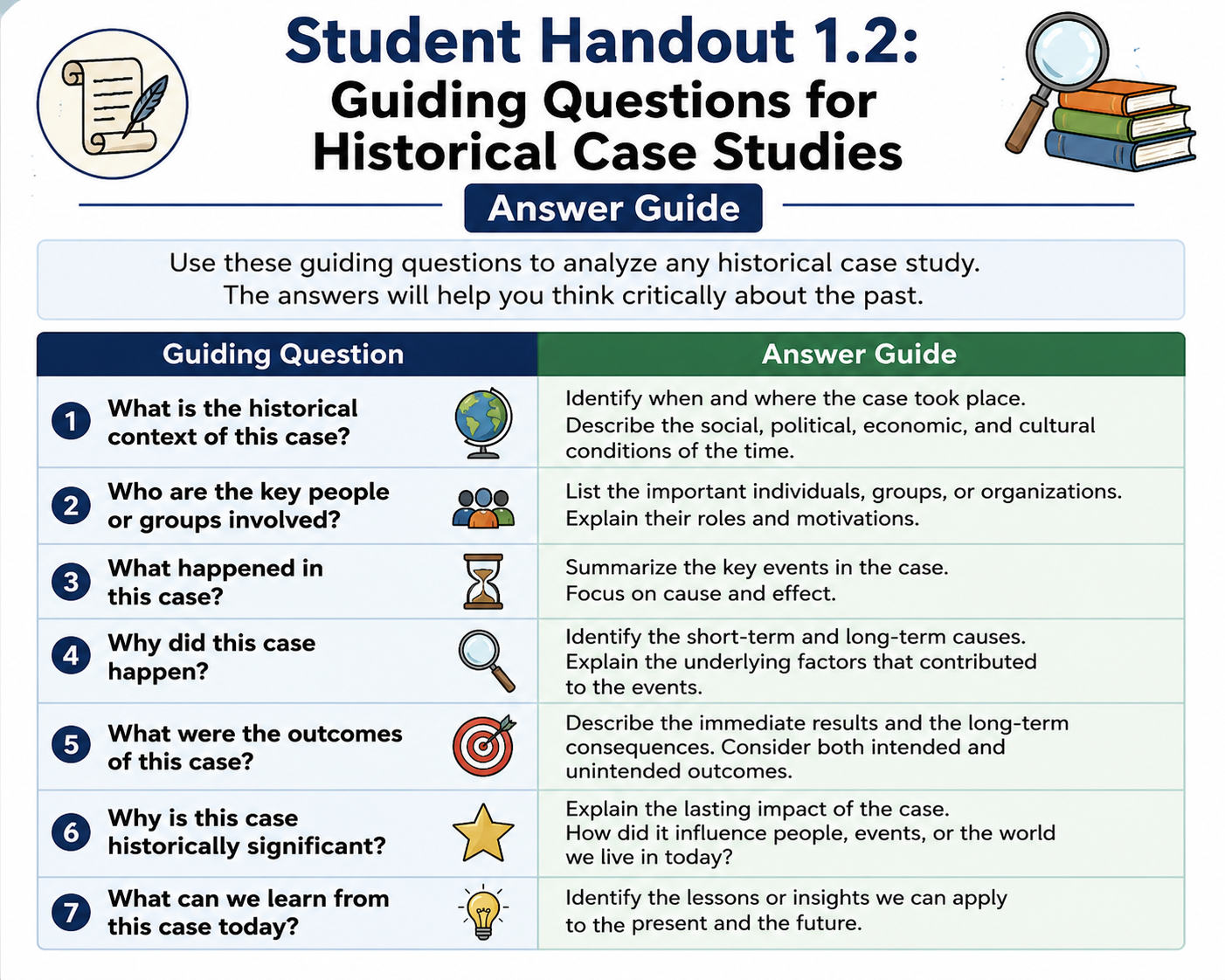
Understanding Historical Case Studies: A Comprehensive Framework
Historical case studies serve as powerful learning tools that help students analyze past events, understand cause-and-effect relationships, and draw meaningful connections to contemporary issues. This guide provides comprehensive answers and frameworks for approaching guiding questions commonly found in historical case study analyses.
General Analytical Framework
When approaching any historical case study, students should consider multiple perspectives, examine primary and secondary sources critically, and understand the broader context in which events occurred. The following sections break down common guiding questions and provide strategies for developing thoughtful, well-supported answers.
What Are the Key Facts and Timeline of Events?
The foundation of any historical case study analysis begins with establishing a clear chronology of events. When answering questions about key facts and timelines, students should identify the who, what, when, where, and why of the historical event or period being studied.
A strong answer includes specific dates, names of important individuals and groups, geographical locations, and a logical sequence of events. Rather than simply listing facts, effective responses show how events connected to one another and built upon previous developments. For example, when studying the American Civil Rights Movement, you would note not just that the Montgomery Bus Boycott occurred in 1955-1956, but also how it followed the Brown v. Board of Education decision and led to the formation of the Southern Christian Leadership Conference.
What Were the Historical Conditions and Context?
Understanding the conditions that existed before and during the events in question is crucial for comprehensive analysis. This question asks students to examine the political, economic, social, and cultural environment of the time period.
Strong answers address the prevailing attitudes, beliefs, and systems that shaped people’s actions and decisions. Consider what was considered normal or acceptable at the time, what challenges or tensions existed in society, and what resources or limitations affected people’s choices. For instance, when examining the Industrial Revolution, you would discuss pre-existing agricultural economies, population growth, technological capabilities, and social class structures that set the stage for industrial transformation.
The context also includes examining what was happening simultaneously in other parts of the world, as historical events rarely occur in isolation. Global trade patterns, international conflicts, scientific discoveries, and cultural movements all contribute to the environment in which specific historical events unfold.
Analyzing Causes and Effects
What Were the Immediate and Long-Term Causes?
Historical events typically result from multiple causes operating at different timescales. Immediate causes are the direct triggers or catalysts that sparked an event, while long-term causes are the underlying conditions and trends that made the event possible or likely.
When answering questions about causes, distinguish between these temporal categories and recognize that historical causation is rarely simple or singular. For example, examining World War I requires discussing immediate causes like the assassination of Archduke Franz Ferdinand, but also long-term causes including nationalism, imperialism, militarism, and the alliance system that had been developing for decades.
Effective answers also categorize causes by type: political, economic, social, cultural, technological, or environmental. This multifaceted approach demonstrates sophisticated historical thinking and acknowledges the complexity of human events. Strong responses provide specific evidence for each cause identified and explain the connection between the cause and the resulting event.
What Were the Short-Term and Long-Term Effects?
Just as events have multiple causes, they also produce multiple effects that ripple through time. Short-term effects are immediate consequences that occurred during or shortly after the event, while long-term effects are lasting changes that continued to influence society for years, decades, or even centuries.
When analyzing effects, consider impacts on different groups of people, as historical events rarely affect everyone equally. Examine political changes (new laws, governments, or power structures), economic changes (shifts in wealth, labor, or trade), social changes (altered relationships between groups, new movements or organizations), and cultural changes (evolving beliefs, values, or practices).
For instance, the effects of the Columbian Exchange included immediate consequences like the rapid spread of diseases that devastated indigenous populations, but also long-term effects such as permanent changes to global agriculture, cuisine, and population distribution that continue to shape our world today.
Examining Perspectives and Stakeholders
Who Were the Key Individuals and Groups Involved?
Historical events involve multiple actors with different roles, motivations, and levels of power or influence. Strong answers to this question identify not only prominent leaders and famous figures but also ordinary people, marginalized groups, and those whose perspectives have been historically overlooked.
When discussing key individuals and groups, provide context about their backgrounds, interests, and what they stood to gain or lose from different outcomes. Consider both those who actively participated in events and those who were affected by them despite having little agency or choice in the matter.
For example, when studying colonization, you would examine European monarchs and explorers, but also indigenous peoples, enslaved Africans, merchants, missionaries, and settlers—each group with distinct experiences, motivations, and impacts on historical outcomes.
What Were the Different Perspectives on These Events?
Historical events look very different depending on one’s position and viewpoint. This question asks students to practice historical empathy by considering how various individuals and groups understood and interpreted the same events based on their circumstances, values, and interests.
Strong answers acknowledge that people in the past held beliefs and values that may differ from contemporary views, and that understanding these perspectives requires setting aside present-day judgments to comprehend how people thought at the time. This doesn’t mean agreeing with or justifying harmful beliefs or actions, but rather understanding the worldview from which they emerged.
When examining perspectives, consider questions like: How did different groups define the problem or opportunity? What solutions did they propose? What did they consider most important? What were their fears and hopes? For instance, the American Revolution appeared quite different to wealthy colonial merchants, struggling farmers, enslaved people, indigenous nations, and British officials—each group perceived different threats and opportunities in independence.
Assessing Decisions and Actions
What Choices Did Historical Actors Face?
Historical actors operated within constraints but also had agency to make choices that shaped outcomes. This question asks students to identify decision points and recognize that history was not inevitable—different choices could have led to different results.
Strong answers describe the actual options available to historical actors, not just the choice they ultimately made. Consider what alternatives existed, what information people had (and didn’t have) at the time, what values or priorities influenced their thinking, and what pressures or incentives affected their decisions.
For example, when examining President Truman’s decision to use atomic bombs on Japan, you would discuss the alternatives that were debated (demonstration of the weapon, continued conventional bombing, invasion, negotiated settlement), the information and advice Truman received, the military and political considerations he weighed, and the context of total war that shaped the decision-making process.
What Were the Consequences of These Decisions?
Every historical decision produces outcomes, some intended and some unintended. This question asks students to trace the results of specific choices and evaluate their impacts.
Strong answers distinguish between what historical actors expected to happen and what actually occurred. They consider both immediate consequences and ripple effects that unfolded over time. They also acknowledge that decisions often produced mixed results, benefiting some people while harming others, or solving some problems while creating new ones.
When discussing consequences, provide specific evidence and avoid vague generalizations. Connect decisions to concrete outcomes with clear causal chains. For instance, discussing the consequences of the Treaty of Versailles would include the immediate political reorganization of Europe, the economic burden on Germany, the rise of resentment that contributed to extremist movements, and ultimately the connection to conditions that enabled World War II.
Making Connections and Drawing Conclusions
How Does This Case Study Connect to Broader Historical Themes?
Individual historical events are part of larger patterns and themes that recur across time and place. This question asks students to move from the specific to the general, identifying how a particular case study illustrates broader concepts or trends.
Strong answers identify relevant themes such as conflict and cooperation, innovation and tradition, freedom and oppression, power and resistance, cultural exchange and isolation, or sustainability and exploitation. They explain how the specific case study demonstrates these themes and provide evidence from the case to support these connections.
For example, the French Revolution illustrates themes of social inequality leading to upheaval, the tension between liberty and order, the role of Enlightenment ideas in political change, and the challenge of translating revolutionary ideals into stable governance—themes that appear in many revolutionary movements across different times and places.
What Lessons or Insights Can We Draw from This Case?
While historians avoid simplistic “lessons of history,” historical case studies do offer insights that can inform our understanding of human behavior, social dynamics, and contemporary challenges. This question asks students to reflect thoughtfully on what can be learned from examining past events.
Strong answers avoid presentism (judging the past by present standards) while still drawing relevant connections to contemporary issues. They recognize both similarities and differences between past and present, acknowledging that while contexts change, certain human patterns and social dynamics recur.
When discussing insights, be specific rather than generic. Instead of vague statements like “we should learn from our mistakes,” explain what specific understanding the case study provides. For instance, studying the Dust Bowl provides insights about the relationship between agricultural practices and environmental sustainability, the importance of scientific understanding in policy-making, and how economic pressures can drive unsustainable resource use—insights relevant to contemporary environmental challenges.
Source Analysis Questions
What Types of Sources Provide Evidence for This Case Study?
Historical understanding depends on sources—the raw materials from which historians construct interpretations. This question asks students to identify and categorize the evidence used in a case study.
Strong answers distinguish between primary sources (created during the time period being studied) and secondary sources (created later by historians and others analyzing the period). They identify different types of sources such as documents, photographs, artifacts, oral histories, newspaper accounts, government records, personal letters, and statistical data.
When discussing sources, note what kinds of information different source types can provide. Official government documents might reveal policies and laws but not necessarily how ordinary people experienced them. Personal letters provide individual perspectives but may not represent broader population views. Recognizing the strengths and limitations of different source types is essential for historical thinking.
How Reliable and Useful Are These Sources?
Not all historical sources are equally reliable or useful, and critical evaluation is essential. This question asks students to assess sources by considering their origin, purpose, limitations, and value for understanding particular aspects of the past.
Strong answers consider questions like: Who created this source and why? What was their perspective or bias? What information does it provide, and what does it omit? How does it compare to other sources? What can it reliably tell us, and what claims would require additional evidence?
For example, a government propaganda poster from World War II is not a reliable source for factual information about enemy nations, but it is extremely valuable for understanding how governments shaped public opinion, what messages they considered persuasive, and what fears or values they appealed to. Understanding this distinction—that unreliability for one purpose doesn’t eliminate usefulness for another—demonstrates sophisticated source analysis.
Comparative Analysis Questions
How Does This Case Compare to Similar Historical Events?
Historical comparison helps identify patterns, understand causes, and recognize both universal themes and unique circumstances. This question asks students to examine similarities and differences between the case study and other historical events.
Strong answers identify specific points of comparison and explain what these similarities or differences reveal. Rather than simply listing parallels, effective responses analyze why similar conditions produced similar outcomes, or why apparently similar situations led to different results.
For instance, comparing the American, French, and Haitian Revolutions reveals common themes of Enlightenment influence and resistance to oppression, but also crucial differences in social structures, the role of slavery, international support, and outcomes. These comparisons deepen understanding of revolutionary processes and the factors that shape their trajectories.
What Makes This Case Unique or Representative?
Every historical event is unique in its specific details but may also represent broader patterns. This question asks students to consider whether a case study is exceptional or typical, and what this tells us about historical processes.
Strong answers balance recognition of distinctive features with identification of representative elements. They explain what about the case is particular to its specific time and place, and what aspects reflect wider trends or common human experiences.
For example, the Holocaust is unique in its specific ideology, mechanisms, and scale, yet it also represents broader patterns of genocide, dehumanization, and the dangers of unchecked state power that appear in other contexts. Understanding both its uniqueness and its connections to other atrocities is essential for both historical understanding and contemporary vigilance.
Evaluation and Judgment Questions
How Have Historians’ Interpretations of This Event Changed Over Time?
Historical interpretation is not static—historians in different eras ask different questions, use different sources, and reach different conclusions about the same events. This question asks students to recognize historiography—the history of historical writing itself.
Strong answers explain how changing social contexts, new methodologies, discovery of new sources, and evolving questions have shaped historical interpretation. They recognize that historical understanding is constructed and reconstructed rather than simply discovered.
For instance, interpretations of Reconstruction after the American Civil War have changed dramatically. Early 20th-century historians often portrayed it as a tragic period of corruption and misrule, while later historians, influenced by the Civil Rights Movement, recognized it as a promising but incomplete attempt at racial justice that was violently overthrown. This shift in interpretation reflects both new evidence and changing perspectives on race and democracy.
What Questions Remain Unanswered or Debated?
Historical knowledge is always incomplete, and honest historical inquiry acknowledges uncertainties and ongoing debates. This question asks students to identify what we don’t know or what historians disagree about regarding the case study.
Strong answers explain why certain questions remain unanswered (perhaps due to lack of sources, destruction of evidence, or inherent limitations in what can be known about the past) and describe the nature of ongoing historiographical debates. They recognize that reasonable people examining the same evidence may reach different conclusions based on different emphases or interpretive frameworks.
For example, debates continue about topics like the decision to drop atomic bombs on Japan, the primary causes of the fall of the Roman Empire, or the extent of agency enslaved people exercised within the institution of slavery. Understanding these debates demonstrates sophisticated historical thinking that recognizes complexity and resists oversimplification.
Application and Reflection Questions
How Does This Historical Case Study Relate to Current Events or Issues?
History provides context for understanding contemporary challenges and opportunities. This question asks students to draw thoughtful connections between past and present while avoiding simplistic parallels.
Strong answers identify genuine similarities in underlying patterns or dynamics while acknowledging important differences in context. They use historical understanding to illuminate present situations without claiming that history simply repeats itself.
For instance, studying historical pandemics like the 1918 influenza provides insights into how societies respond to disease outbreaks, the tension between public health and individual liberty, and the importance of clear communication—all relevant to contemporary pandemic response. However, significant differences in medical knowledge, technology, globalization, and political systems mean that historical responses cannot simply be copied into present contexts.
What Skills or Habits of Mind Does Analyzing This Case Study Develop?
Beyond learning specific historical content, case study analysis develops transferable skills and ways of thinking. This question asks students to reflect on the cognitive and analytical abilities they’re practicing.
Strong answers identify skills such as critical reading, evaluating evidence, recognizing bias and perspective, understanding causation and change over time, making reasoned arguments supported by evidence, and appreciating complexity. They explain how these skills apply beyond history class to informed citizenship, professional work, and personal decision-making.
Analyzing historical case studies develops intellectual humility (recognizing the limits of our knowledge), empathy (understanding perspectives different from our own), and critical thinking (questioning assumptions and evaluating claims). These habits of mind are valuable across all areas of life and learning.
Frequently Asked Questions
What is the purpose of guiding questions in historical case studies?
Guiding questions provide a structured framework for analyzing complex historical events and help students develop critical thinking skills. Rather than simply memorizing facts, students learn to ask meaningful questions, evaluate evidence, consider multiple perspectives, and construct well-supported arguments. These questions guide students toward deeper understanding by focusing attention on causation, context, perspectives, and significance—the elements that transform isolated facts into meaningful historical knowledge.
How detailed should answers to guiding questions be?
The appropriate level of detail depends on your assignment requirements, but effective answers generally include specific evidence (dates, names, places, events) supporting general claims, explanations of how evidence connects to your argument, and acknowledgment of complexity or alternative interpretations. A good rule of thumb is to provide enough detail to demonstrate genuine understanding while maintaining clear organization and focus on answering the specific question asked.
Should I use first-person perspective in my answers?
This depends on your instructor’s preferences and the nature of the question. For analytical questions about causes, effects, and evidence, third-person academic writing is typically appropriate. However, for reflective questions about connections to contemporary issues or lessons learned, first-person may be acceptable and even encouraged. When in doubt, ask your instructor or default to third-person academic style.
How do I avoid presentism when analyzing historical events?
Presentism—judging the past by present-day standards—can distort historical understanding. To avoid it, research the context of the time period including prevailing beliefs, available knowledge, and accepted norms. Explain people’s actions within their historical context rather than simply condemning or praising them by today’s standards. This doesn’t mean accepting harmful ideologies or actions, but rather understanding how people in different contexts thought and why, which actually provides deeper insight into both past and present.
What if I disagree with the historical interpretation presented in the case study?
Disagreement can be intellectually productive if approached thoughtfully. Consider whether your disagreement stems from different evidence, different interpretation of the same evidence, or different values and priorities. If you disagree, articulate your alternative interpretation clearly, support it with evidence, and explain why you find it more convincing than the presented interpretation. Recognize that historical interpretation involves judgment and that reasonable people may reach different conclusions.
How many sources should I reference in my answers?
The number of sources needed depends on the question and assignment requirements. Focus on quality over quantity—a few well-chosen, carefully analyzed sources are more valuable than many superficially referenced ones. For most guiding questions, referencing 2-4 specific pieces of evidence from primary or secondary sources demonstrates solid understanding. More complex questions or formal essays may require more extensive source engagement.
Can I use information from outside the assigned case study materials?
This depends on your assignment guidelines. Generally, demonstrating knowledge beyond assigned materials shows initiative and deeper engagement with the topic. However, ensure you’re accurately answering questions about the specific case study first, and clearly distinguish between information from assigned materials and additional research. Always cite sources for any information that isn’t common knowledge.
How do I organize answers that require addressing multiple aspects?
For complex questions, use clear organizational structures. Consider using topic sentences that preview your main points, organizing chronologically when discussing events over time, or organizing thematically when discussing different types of causes or effects. Transitions between ideas help readers follow your thinking. For longer answers, outlining before writing ensures you address all required elements in a logical order.
What’s the difference between describing and analyzing historical events?
Description tells what happened—recounting events, identifying people, stating facts. Analysis explains why events happened, how they’re connected, what they mean, and what significance they hold. Strong answers to guiding questions move beyond description to analysis. For example, describing the Boston Tea Party means stating that colonists dumped tea into Boston Harbor in 1773. Analyzing it means explaining the context of taxation disputes, the symbolic significance of destroying property, how it escalated tensions, and its role in the movement toward independence.
How do I conclude answers to historical guiding questions?
Effective conclusions briefly synthesize your main points, emphasize the significance of what you’ve discussed, and may connect to broader themes or contemporary relevance when appropriate. Avoid simply restating your introduction or introducing completely new information. Instead, leave readers with a clear understanding of your answer’s main takeaway and why it matters for understanding the historical case study or historical thinking more broadly.
Conclusion
Guiding questions for historical case studies are tools for developing sophisticated historical thinking. They push students beyond memorization toward critical analysis, evidence-based reasoning, perspective-taking, and meaningful connection-making. By engaging thoughtfully with these questions, students learn not just about specific historical events but also how to think like historians—questioning sources, considering context, recognizing complexity, and constructing well-supported interpretations.
The skills developed through answering these guiding questions extend far beyond history class. Evaluating evidence, recognizing bias, understanding causation, appreciating multiple perspectives, and constructing reasoned arguments are essential for informed citizenship, professional success, and thoughtful engagement with the complex world we inhabit.
As you work with historical case studies, remember that history is not a fixed set of facts to be memorized but an ongoing inquiry into human experience across time. The questions you ask shape the understanding you develop, and learning to ask good questions is itself a valuable historical skill. Approach each case study with curiosity, intellectual humility, and a willingness to grapple with complexity, and you’ll find that history offers endless opportunities for learning and insight.