
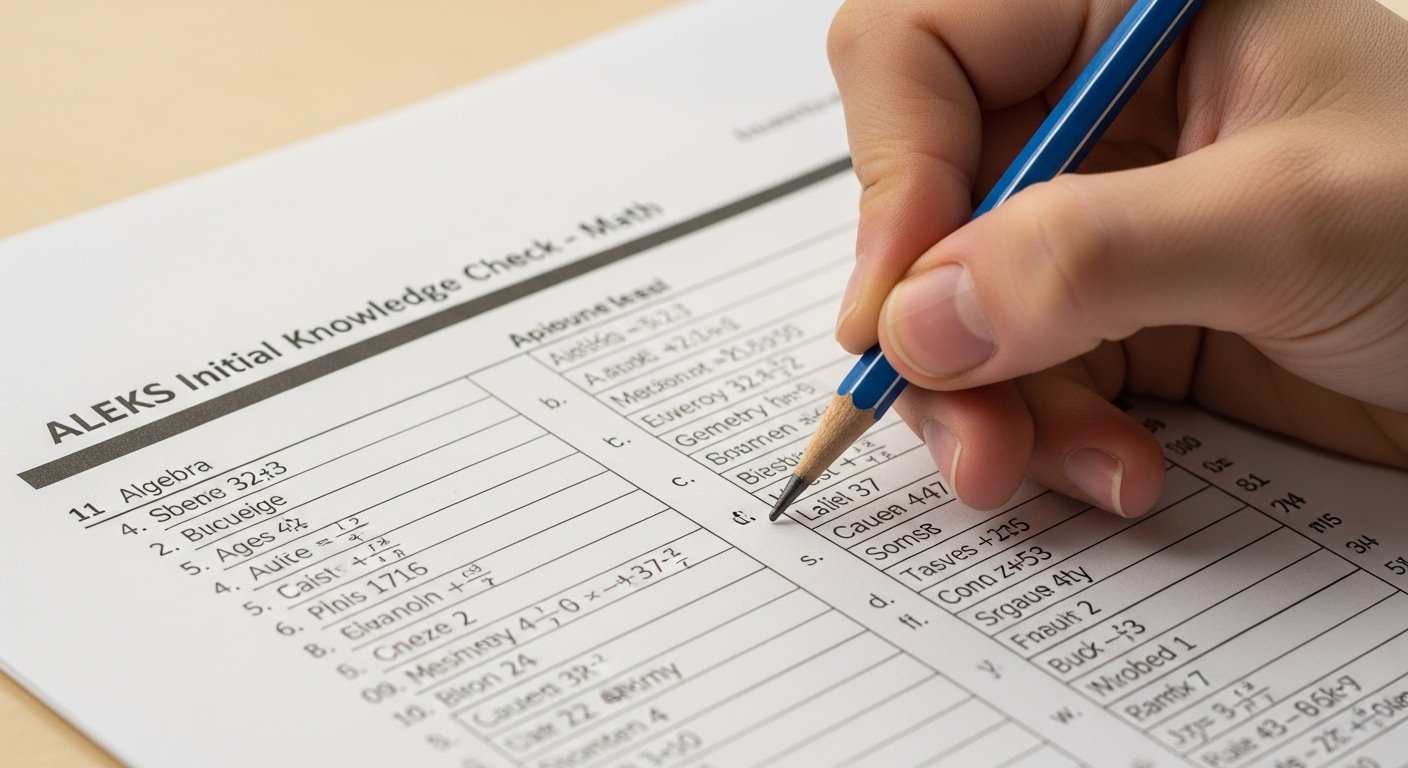
Starting a new math course can feel both exciting and stressful at the same time. For many students, one of the first things they encounter is the ALEKS Initial Knowledge Check. If you have never used ALEKS before, the process may seem confusing or intimidating. However, understanding how the system works can help you feel more confident and prepared.
The ALEKS Initial Knowledge Check is not designed to trick students or make them fail. Instead, it is a smart assessment tool that identifies what you already understand and what topics you still need to improve. The system then creates a personalized learning path based on your current skill level.
In this guide, we’ll explain how the ALEKS Initial Knowledge Check works, what types of questions to expect, important preparation tips, scoring details, and how to use your results to improve your math skills effectively.
What Is the ALEKS Initial Knowledge Check?
The ALEKS Initial Knowledge Check is an adaptive online assessment used by schools and colleges to evaluate a student’s current understanding of mathematics.
Unlike traditional exams, ALEKS does not give every student the same questions. Instead, it uses artificial intelligence to adjust the difficulty level based on your answers.
Typically, the assessment contains around:
- 25 to 30 questions
- Multiple math topics
- Different difficulty levels
The goal is to determine:
- What you already know
- Which skills you have mastered
- What concepts you still need to learn
This information helps ALEKS build a customized learning experience specifically for you.
How the ALEKS System Works
ALEKS stands for:
Assessment and Learning in Knowledge Spaces
The platform uses advanced AI technology to analyze student performance in real time.
Here’s how it works:
- If you answer correctly, ALEKS may provide more challenging questions.
- If you struggle with a concept, the system adjusts and gives easier or related questions.
This adaptive structure allows ALEKS to create a highly accurate picture of your math abilities.
The Assessment Is Not a Traditional Test
One of the biggest misunderstandings students have is thinking the Initial Knowledge Check is a graded exam.
In reality, it is more like a placement and learning tool.
Important Things to Remember:
- It usually does not affect your GPA.
- You are not expected to know every answer.
- It is normal to see unfamiliar questions.
- The purpose is to identify your current skill level honestly.
The system is simply trying to find the point where your understanding ends so it can help you learn efficiently.
Why Honesty Matters During the Assessment
Many students feel tempted to use:
- Online calculators
- Search engines
- Friends for help
- External websites
However, doing this can actually create problems later.
If ALEKS thinks you know advanced concepts that you do not truly understand, it may place you into:
- A harder course
- More advanced topics
- Lessons beyond your actual skill level
This often leads to frustration and confusion during the semester.
The best approach is to answer honestly so ALEKS can create the right learning path for you.
The Importance of the “I Don’t Know” Button
ALEKS includes an “I Don’t Know” option for questions you genuinely cannot solve.
This feature is very helpful when used properly.
When to Use It:
- You have no idea how to start the problem.
- You have never learned the topic before.
- You are completely stuck.
When NOT to Use It:
- When you simply need more time to think.
- If you understand the concept but feel nervous.
- Just to finish the assessment faster.
Using the button too often may lower your placement score unnecessarily.
Common Topics Covered in the ALEKS Knowledge Check
The exact questions vary for every student, but most assessments include a variety of math concepts.
Algebra Topics
Algebra is one of the most common sections.
You may encounter:
- Linear equations
- Systems of equations
- Exponent rules
- Factoring
- Functions
- Inequalities
Example equations may include:
This is the standard form of a linear equation where:
- m = slope
- b = y-intercept
Geometry Topics
Geometry questions often test spatial reasoning and formulas.
Common topics include:
- Surface area
- Volume of cones
- Cylinders
- Angles
- Transformations
For example:
This formula calculates the volume of a cone.
Exponential Functions
Students may also encounter exponential growth and decay problems.
Example:
These equations are commonly used in:
- population growth
- finance
- scientific modeling
Scientific Notation
ALEKS often tests the ability to work with very large or very small numbers using scientific notation.
Students should know how to:
- multiply
- divide
- simplify powers of ten
Systems of Equations
Questions involving multiple variables are also common.
Example:
7x−y=147x – y = 14
You may need to solve using:
- substitution
- elimination
- graphing methods
Tips to Prepare for the ALEKS Initial Knowledge Check
Proper preparation can improve both confidence and performance.
1. Choose a Quiet Environment
Take the assessment in a calm location without distractions.
Avoid:
- loud environments
- multitasking
- interruptions
2. Use Scratch Paper
Keep:
- pencils
- scratch paper
- basic materials nearby
Working through problems manually often improves accuracy.
3. Take Your Time
Do not rush through questions.
ALEKS is designed to measure understanding, not speed.
4. Review Basic Math Concepts
Before starting, it may help to refresh:
- fractions
- algebra
- exponents
- equations
- graphing basics
5. Stay Calm
It is completely normal to encounter difficult questions.
Remember:
- the assessment is adaptive
- everyone receives different problems
- perfection is not expected
Understanding ALEKS Scores
Many students misunderstand their ALEKS score.
The score is not a percentage grade like a school test.
Instead, it represents your current level of math mastery.
For example:
- a score around 50% may qualify students for Pre-Calculus or Calculus placement
- lower scores may place students into foundational math courses
The exact placement depends on your school’s requirements.
The ALEKS Pie Chart
After completing the assessment, ALEKS generates a colorful pie chart.
This chart displays:
- mastered topics
- learning progress
- remaining concepts
Each section represents a different area of mathematics.
As you learn new material, the pie gradually fills in.
Why the Pie Chart Is Helpful
The pie chart acts as a visual roadmap for your learning journey.
It helps students:
- track progress
- stay motivated
- identify weak areas
- focus on unfinished topics
This personalized system makes studying more organized and efficient.
Learning Through ALEKS
Once the assessment is complete, ALEKS begins assigning topics tailored to your skill level.
The platform provides:
- explanations
- practice problems
- guided learning
- progress tracking
Instead of forcing every student through identical lessons, ALEKS focuses on what each individual actually needs.
Common Mistakes Students Make
Here are some common errors students should avoid:
Guessing Randomly
Too much guessing can confuse the system and reduce accuracy.
Using Outside Help
Cheating may lead to incorrect course placement.
Rushing Through Questions
Taking time improves results and reduces careless mistakes.
Panicking Over Difficult Questions
Remember: the system expects some incorrect answers.
Benefits of the ALEKS System
Despite student anxiety, ALEKS offers many advantages.
Personalized Learning
Students focus only on topics they need.
Efficient Progress
No wasted time reviewing concepts already mastered.
Better Placement
Students enter courses that match their skill level.
Improved Confidence
Gradual learning builds stronger understanding over time.
Final Thoughts
The ALEKS Initial Knowledge Check is designed to help students succeed, not to punish them. Its adaptive structure creates a personalized learning experience that identifies strengths and areas for improvement.
The most important thing is to approach the assessment honestly and calmly. By giving your best effort and avoiding shortcuts, ALEKS can accurately place you in the right learning path.
Remember:
- It is okay not to know every answer.
- The assessment is meant to guide your learning.
- Your results are simply the starting point of your math journey.
With patience, practice, and consistent effort, ALEKS can become a powerful tool for improving your math skills and building confidence throughout your course.