
Introduction
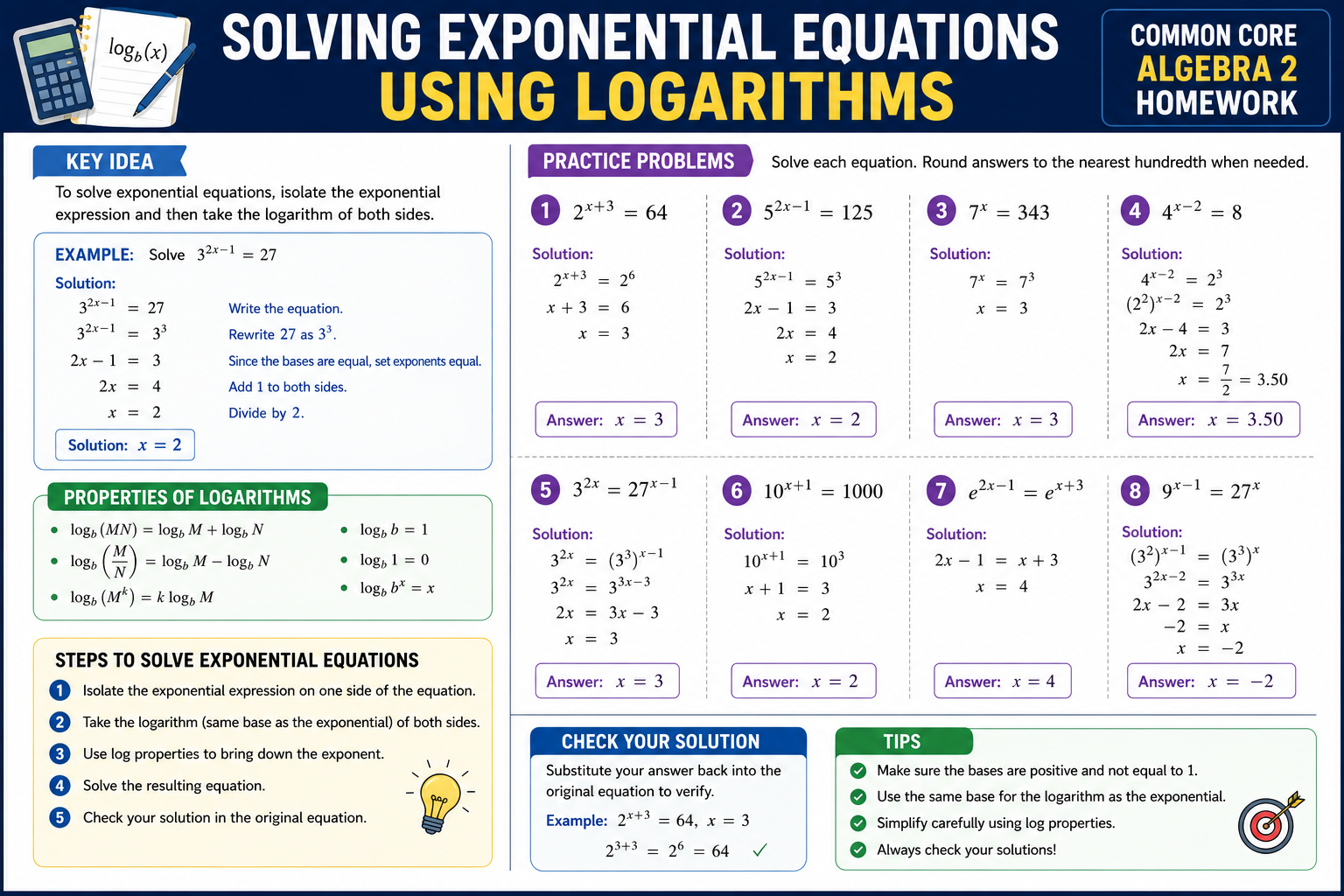
Exponential equations appear throughout algebra, science, and real-world applications—from population growth to radioactive decay to compound interest. While simple exponential equations like 2^x = 8 can be solved by inspection, most real-world problems require logarithms to solve.
Understanding how to use logarithms to solve exponential equations is a critical skill in Common Core Algebra 2. This goes beyond just applying formulas; it requires deep understanding of the relationship between exponential and logarithmic functions and the properties that make solving possible.
This comprehensive guide provides complete solutions to typical exponential equation problems using logarithms, explaining methodology, showing all algebraic steps, and verifying answers. Each solution includes reasoning about why specific approaches work, making this resource valuable for learning, not just answer-checking.
Logarithm Review: Essential Concepts
Before solving exponential equations, reviewing logarithm fundamentals ensures solid foundation.
What Is a Logarithm?
Definition:
log_b(x) = y means b^y = x
In words: The logarithm base b of x equals y if and only if b raised to the power y equals x.
Examples:
- log_2(8) = 3 because 2^3 = 8
- log_10(100) = 2 because 10^2 = 100
- log_5(25) = 2 because 5^2 = 25
Common Logarithms
Base 10 logarithm (Common logarithm):
- Notation: log(x) or log_10(x)
- Used in many scientific and practical applications
- Readily available on calculators
Natural logarithm (Base e):
- Notation: ln(x) or log_e(x)
- Base e ≈ 2.71828…
- Used extensively in calculus and natural growth/decay
- Readily available on calculators
Logarithm Properties
Product property:
log_b(xy) = log_b(x) + log_b(y)
Quotient property:
log_b(x/y) = log_b(x) – log_b(y)
Power property:
log_b(x^n) = n·log_b(x)
Change of base formula:
log_b(x) = log_a(x) / log_a(b)
This allows converting any logarithm to natural logarithm or common logarithm for calculator evaluation.
Inverse Function Relationship
Exponential and logarithmic functions are inverses:
- If f(x) = b^x, then f^(-1)(x) = log_b(x)
- b^(log_b(x)) = x
- log_b(b^x) = x
This inverse relationship is fundamental to solving exponential equations using logarithms.
Basic Exponential Equations
Type 1: Simple Exponential Equations (Single Exponential Term)
Problem 1: Solve 2^x = 16
Solution Method 1: Recognition/Inspection
Notice that 16 = 2^4
So: 2^x = 2^4
Therefore: x = 4
Solution Method 2: Using Logarithms
2^x = 16
log(2^x) = log(16)
x·log(2) = log(16) [Power property]
x = log(16) / log(2)
x = 1.204 / 0.301
x ≈ 4
Answer: x = 4
Verification:
2^4 = 16 ✓
Problem 2: Solve 3^x = 81
Solution:
Recognize that 81 = 3^4
3^x = 3^4
x = 4
Answer: x = 4
Verification: 3^4 = 81 ✓
Problem 3: Solve 5^x = 100
Solution:
This doesn’t have an obvious integer answer, so logarithms are necessary.
5^x = 100
log(5^x) = log(100) [Take log of both sides]
x·log(5) = log(100) [Power property]
x = log(100) / log(5)
x = 2 / 0.699
x ≈ 2.861
Answer: x ≈ 2.861
Alternative solution using natural logarithm:
5^x = 100
ln(5^x) = ln(100)
x·ln(5) = ln(100)
x = ln(100) / ln(5)
x = 4.605 / 1.609
x ≈ 2.861
(Same answer, different logarithm base)
Verification:
5^2.861 ≈ 100 ✓
Type 2: Exponential Equations with Coefficients
Problem 4: Solve 3·2^x = 48
Solution:
Step 1: Isolate the exponential term
3·2^x = 48
2^x = 16 [Divide both sides by 3]
Step 2: Recognize the exponential
2^x = 2^4
x = 4
Answer: x = 4
Verification:
3·2^4 = 3·16 = 48 ✓
Problem 5: Solve 5·3^x = 135
Solution:
Step 1: Isolate exponential
5·3^x = 135
3^x = 27
Step 2: Recognize exponential
3^x = 3^3
x = 3
Answer: x = 3
Verification:
5·3^3 = 5·27 = 135 ✓
Problem 6: Solve 2·4^x = 32
Solution:
Step 1: Isolate exponential
2·4^x = 32
4^x = 16
Step 2: Recognize that 16 = 4^2
4^x = 4^2
x = 2
Answer: x = 2
Verification:
2·4^2 = 2·16 = 32 ✓
Type 3: Exponential Equations with No Recognition
Problem 7: Solve 2^x = 7
Solution:
No integer answer is obvious, so use logarithms.
2^x = 7
log(2^x) = log(7) [Take logarithm of both sides]
x·log(2) = log(7) [Power property]
x = log(7) / log(2)
x = 0.845 / 0.301
x ≈ 2.807
Answer: x ≈ 2.807
Using natural logarithm:
2^x = 7
ln(2^x) = ln(7)
x·ln(2) = ln(7)
x = ln(7) / ln(2)
x = 1.946 / 0.693
x ≈ 2.807
Verification:
2^2.807 ≈ 7 ✓
Problem 8: Solve 10^x = 50
Solution:
10^x = 50
log(10^x) = log(50) [Take log base 10 of both sides]
x = log(50) [Because log_10(10^x) = x]
x ≈ 1.699
Answer: x ≈ 1.699
Why this is simpler:
We can use common logarithm (base 10) directly because the equation base is 10.
Verification:
10^1.699 ≈ 50 ✓
Problem 9: Solve e^x = 15
Solution:
e^x = 15
ln(e^x) = ln(15) [Take natural log of both sides]
x = ln(15) [Because ln(e^x) = x]
x ≈ 2.708
Answer: x ≈ 2.708
Why this works:
When the exponential base is e, the natural logarithm is the appropriate inverse.
Verification:
e^2.708 ≈ 15 ✓
More Complex Exponential Equations
Type 4: Exponential Equations with Multiple Terms
Problem 10: Solve 3^(x+1) = 27
Solution:
Method 1: Recognition
27 = 3^3
3^(x+1) = 3^3
x + 1 = 3 [Equal bases means equal exponents]
x = 2
Answer: x = 2
Verification:
3^(2+1) = 3^3 = 27 ✓
Problem 11: Solve 2^(x-2) = 16
Solution:
Method 1: Recognition
16 = 2^4
2^(x-2) = 2^4
x – 2 = 4
x = 6
Answer: x = 6
Verification:
2^(6-2) = 2^4 = 16 ✓
Problem 12: Solve 5^(2x) = 125
Solution:
Method 1: Recognition
125 = 5^3
5^(2x) = 5^3
2x = 3
x = 1.5 or x = 3/2
Answer: x = 1.5
Verification:
5^(2·1.5) = 5^3 = 125 ✓
Problem 13: Solve 4^(x-1) = 8
Solution:
Express both sides as powers of 2:
- 4 = 2^2, so 4^(x-1) = (2^2)^(x-1) = 2^(2(x-1)) = 2^(2x-2)
- 8 = 2^3
2^(2x-2) = 2^3
2x – 2 = 3 [Equal bases means equal exponents]
2x = 5
x = 2.5 or x = 5/2
Answer: x = 2.5
Verification:
4^(2.5-1) = 4^1.5 = (4^1)(4^0.5) = 4·2 = 8 ✓
Type 5: Exponential Equations Without Obvious Common Base
Problem 14: Solve 2^x = 3^(x-1)
Solution:
This equation has exponentials with different bases, so we can’t equate exponents. Use logarithms.
2^x = 3^(x-1)
log(2^x) = log(3^(x-1)) [Take log of both sides]
x·log(2) = (x-1)·log(3) [Power property]
x·log(2) = x·log(3) – log(3) [Distribute]
x·log(2) – x·log(3) = -log(3) [Collect x terms]
x(log(2) – log(3)) = -log(3) [Factor]
x = -log(3) / (log(2) – log(3))
x = -0.477 / (0.301 – 0.477)
x = -0.477 / (-0.176)
x ≈ 2.710
Answer: x ≈ 2.710
Verification:
- 2^2.710 ≈ 6.54
- 3^(2.710-1) = 3^1.710 ≈ 6.54 ✓
Problem 15: Solve 5^x = 7^(2x)
Solution:
5^x = 7^(2x)
log(5^x) = log(7^(2x)) [Take log of both sides]
x·log(5) = 2x·log(7) [Power property]
x·log(5) – 2x·log(7) = 0 [Move all terms to left]
x(log(5) – 2log(7)) = 0 [Factor]
Either x = 0 or log(5) – 2log(7) = 0
Since log(5) – 2log(7) ≠ 0:
x = 0
Answer: x = 0
Verification:
- 5^0 = 1
- 7^(2·0) = 7^0 = 1 ✓
Exponential Equations with All Terms on One Side
Problem 16: Solve 2^x – 8 = 0
Solution:
Step 1: Isolate exponential
2^x – 8 = 0
2^x = 8
Step 2: Solve
2^x = 2^3
x = 3
Answer: x = 3
Verification:
2^3 – 8 = 8 – 8 = 0 ✓
Problem 17: Solve 3^x + 5 = 32
Solution:
Step 1: Isolate exponential
3^x + 5 = 32
3^x = 27
Step 2: Solve
3^x = 3^3
x = 3
Answer: x = 3
Verification:
3^3 + 5 = 27 + 5 = 32 ✓
Problem 18: Solve 4·2^x – 12 = 20
Solution:
Step 1: Isolate the exponential term
4·2^x – 12 = 20
4·2^x = 32
2^x = 8
Step 2: Solve
2^x = 2^3
x = 3
Answer: x = 3
Verification:
4·2^3 – 12 = 4·8 – 12 = 32 – 12 = 20 ✓
Exponential Growth and Decay Applications
Problem 19: Exponential Growth
Problem Statement:
A bacteria colony starts with 100 bacteria and doubles every hour. How long until there are 6,400 bacteria?
Solution:
Exponential growth formula: A = P·b^t
- P = initial amount = 100
- b = growth factor = 2 (doubling)
- A = final amount = 6,400
- t = time (hours)
6,400 = 100·2^t
64 = 2^t [Divide by 100]
2^6 = 2^t [Recognize 64 = 2^6]
t = 6
Answer: 6 hours
Verification:
After 6 hours: 100·2^6 = 100·64 = 6,400 ✓
Problem 20: Exponential Decay
Problem Statement:
A radioactive substance decays according to A = A₀(0.5)^(t/5), where t is time in years. If you start with 200 grams and want to know when 50 grams remain, solve for t.
Solution:
50 = 200·(0.5)^(t/5)
0.25 = (0.5)^(t/5) [Divide by 200]
Notice that 0.25 = 0.5^2:
0.5^2 = (0.5)^(t/5)
2 = t/5 [Equal bases means equal exponents]
t = 10
Answer: 10 years
Alternative: Using logarithms
50 = 200·(0.5)^(t/5)
0.25 = (0.5)^(t/5)
log(0.25) = log((0.5)^(t/5))
log(0.25) = (t/5)·log(0.5)
t/5 = log(0.25) / log(0.5)
t/5 = -0.602 / -0.301
t/5 = 2
t = 10
Verification:
A = 200·(0.5)^(10/5) = 200·(0.5)^2 = 200·0.25 = 50 ✓
Compound Interest Applications
Problem 21: Compound Interest
Problem Statement:
You invest $1,000 in an account with 5% annual interest compounded annually. How long until you have $1,500?
Formula:
A = P(1 + r)^t
- P = principal = $1,000
- r = rate = 0.05
- A = final amount = $1,500
- t = time (years)
Solution:
1,500 = 1,000(1.05)^t
1.5 = (1.05)^t [Divide by 1,000]
log(1.5) = log((1.05)^t)
log(1.5) = t·log(1.05)
t = log(1.5) / log(1.05)
t = 0.176 / 0.0212
t ≈ 8.31
Answer: Approximately 8.31 years
Verification:
A = 1,000(1.05)^8.31 ≈ 1,500 ✓
Problem 22: Continuous Compound Interest
Problem Statement:
Money is invested with continuous compounding at 4% annual interest. How long until the amount doubles?
Formula:
A = Pe^(rt)
- P = principal
- r = rate = 0.04
- A = 2P (double)
- t = time (years)
Solution:
2P = P·e^(0.04t)
2 = e^(0.04t) [Divide by P]
ln(2) = ln(e^(0.04t))
ln(2) = 0.04t
t = ln(2) / 0.04
t = 0.693 / 0.04
t ≈ 17.33
Answer: Approximately 17.33 years
Verification:
A = P·e^(0.04·17.33) = P·e^0.693 ≈ 2P ✓
Using Change of Base Formula
Problem 23: Solve 7^x = 25 Using Change of Base
Solution:
7^x = 25
log₇(25) = x [By definition of logarithm]
Using change of base formula:
log₇(25) = log(25) / log(7) [Converting to common log]
x = 1.398 / 0.845
x ≈ 1.655
Alternative with natural log:
log₇(25) = ln(25) / ln(7)
x = 3.219 / 1.946
x ≈ 1.655
Answer: x ≈ 1.655
Verification:
7^1.655 ≈ 25 ✓
Common Mistakes and How to Avoid Them
Mistake 1: Forgetting to Isolate the Exponential
Common error:
Solve: 3·2^x + 5 = 29
2^x = 8 (didn’t isolate first)
x = 3 (wrong)
Correct approach:
3·2^x + 5 = 29
3·2^x = 24 (subtract 5 first)
2^x = 8 (divide by 3)
x = 3 (correct)
Mistake 2: Incorrectly Applying Logarithm Properties
Common error:
log(a + b) ≠ log(a) + log(b)
Only the product property works:
log(a·b) = log(a) + log(b)
Mistake 3: Forgetting Both Cases When Taking Logarithms
Common error:
Solve: 2^x = 3^(x-1)
log(2^x) = log(3^x – 1) (WRONG—can’t distribute into addition)
Correct:
log(2^x) = log(3^(x-1)) (Take log of entire side, not separate terms)
Mistake 4: Rounding Too Early
Common error:
x = log(50) / log(2)
x = 1.7 / 0.3 = 5.67 (rounded too early)
Correct:
Use full precision in calculator:
x = 1.699 / 0.301 = 5.645
Mistake 5: Not Verifying Answers
Best practice:
Always substitute answer back into original equation to verify.
Step-by-Step Problem-Solving Guide
For ANY exponential equation:
Step 1: Isolate the exponential expression
- Perform algebraic operations to get exponential alone
- Example: 3·2^x – 5 = 19 → 2^x = 8
Step 2: Determine if bases can be made equal
- Can you write both sides as powers of the same base?
- Example: 2^x = 8 → 2^x = 2^3 → x = 3
Step 3: If bases can be equal, equate exponents
- If b^x = b^y, then x = y
Step 4: If bases cannot be equal, use logarithms
- Apply logarithm to both sides: log(b^x) = log(a)
- Use power property: x·log(b) = log(a)
- Solve for x: x = log(a) / log(b)
Step 5: Calculate numerical answer
- Use calculator for logarithm values
- Maintain precision throughout
Step 6: Verify the answer
- Substitute back into original equation
- Check that both sides are equal
Practice Problems With Solutions
Set A: Simple Exponential Equations
1. Solve 4^x = 64
64 = 4^3
4^x = 4^3
x = 3
2. Solve 6^x = 36
36 = 6^2
x = 2
3. Solve 10^x = 1,000
1,000 = 10^3
x = 3
Set B: Requiring Logarithms
4. Solve 2^x = 15
x = log(15) / log(2) = 1.176 / 0.301
x ≈ 3.907
5. Solve 5^x = 40
x = log(40) / log(5) = 1.602 / 0.699
x ≈ 2.291
6. Solve e^x = 20
x = ln(20) ≈ 2.996
x ≈ 2.996
Set C: With Coefficients and Constants
7. Solve 2·3^x = 54
3^x = 27 = 3^3
x = 3
8. Solve 5·2^x – 10 = 150
2^x = 32 = 2^5
x = 5
9. Solve 4·10^x = 400
10^x = 100 = 10^2
x = 2
Set D: Complex Exponents
10. Solve 2^(3x) = 64
64 = 2^6
3x = 6
x = 2
11. Solve 3^(x-1) = 27
27 = 3^3
x – 1 = 3
x = 4
12. Solve 5^(2x-1) = 125
125 = 5^3
2x – 1 = 3
2x = 4
x = 2
Conclusion
Solving exponential equations using logarithms is essential for Common Core Algebra 2 and beyond. The methodology is consistent:
- Isolate the exponential
- Check if bases can be equal (if so, equate exponents)
- If not, apply logarithms to both sides
- Use logarithm properties to solve for the variable
- Calculate and verify your answer
Key concepts to remember:
- Logarithms are the inverse of exponential functions
- The power property allows exponents to become coefficients
- Common (base 10) and natural (base e) logarithms are most useful
- Change of base formula converts between logarithm bases
- Always verify answers by substitution
Mastery develops through:
- Practicing each problem type multiple times
- Understanding WHY specific steps work
- Checking all answers thoroughly
- Creating your own similar problems
- Applying these techniques to real-world scenarios
With consistent practice using this systematic approach, solving exponential equations becomes straightforward and intuitive.