
English grammar can sometimes feel confusing, especially when it comes to irregular verbs. One common example is the verb “bite.” Many learners often wonder about the correct past tense of “bitten” and when to use words like bite, bit, and bitten properly.
If you’ve ever asked yourself whether “bitten” is past tense or past participle, this guide will help you understand everything clearly with simple explanations and examples.
What Is the Past Tense of Bite?
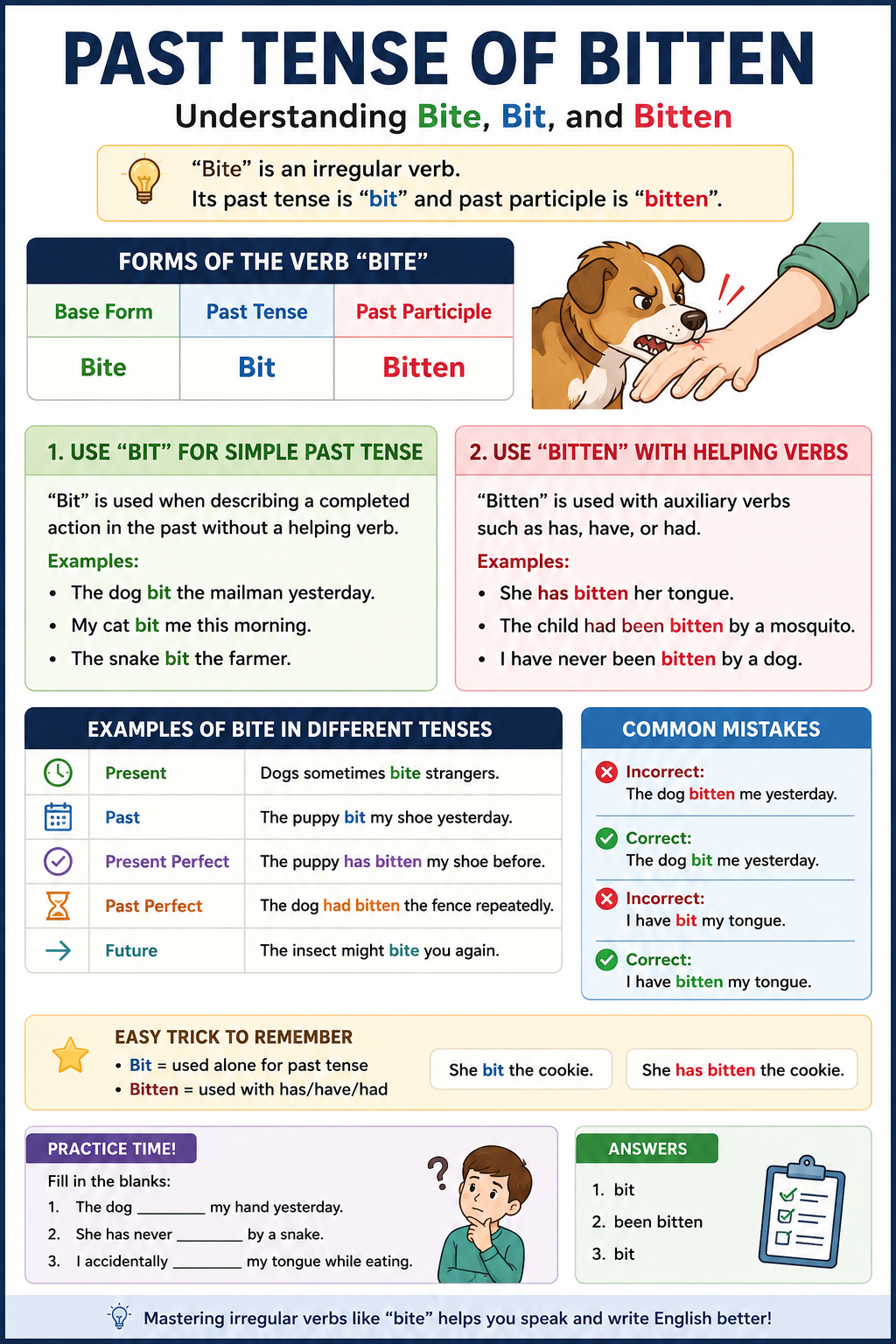
The verb “bite” is an irregular verb, which means it does not follow the regular “-ed” pattern used by most English verbs.
Here are its forms:
| Verb Form | Word |
|---|---|
| Base Form | Bite |
| Simple Past Tense | Bit |
| Past Participle | Bitten |
So, the correct simple past tense of bite is:
Bit
Example:
- The dog bit the mailman yesterday.
Is “Bitten” the Past Tense?
No, “bitten” is not the simple past tense.
“Bitten” is the past participle form of the verb. It is usually used with helping verbs such as:
- has
- have
- had
- was
- were
Examples:
- She has bitten her tongue.
- The child had been bitten by a mosquito.
This is one of the most common grammar mistakes English learners make.
Understanding the Difference Between “Bit” and “Bitten”
Many people confuse these two forms because both refer to actions in the past. However, they are used differently.
Use “Bit” for Simple Past Tense
“Bit” is used when describing a completed action in the past without a helping verb.
Examples:
- My cat bit me this morning.
- He accidentally bit his lip while eating.
- The snake bit the farmer.
Use “Bitten” With Helping Verbs
“Bitten” is used with auxiliary verbs in perfect tenses or passive voice.
Examples:
- She has bitten into the apple.
- They had been bitten by insects during the trip.
- I have never been bitten by a dog.
Why “Bite” Is an Irregular Verb
Most English verbs form the past tense by adding “-ed.”
For example:
- Walk → Walked
- Play → Played
However, irregular verbs change differently:
- Bite → Bit → Bitten
- Go → Went → Gone
- Write → Wrote → Written
These irregular patterns must usually be memorized through practice and reading.
Examples of Bite in Different Tenses
Understanding examples can make grammar much easier.
| Tense | Example Sentence |
|---|---|
| Present | Dogs sometimes bite strangers. |
| Past | The puppy bit my shoe yesterday. |
| Present Perfect | The puppy has bitten my shoe before. |
| Past Perfect | The dog had bitten the fence repeatedly. |
| Future | The insect might bite you again. |
Common Situations Where “Bite” Is Used
The verb “bite” is commonly used in both literal and figurative ways.
Literal Meaning
This refers to physically using teeth.
Examples:
- The dog bit the boy.
- Mosquitoes bite at night.
Figurative Meaning
Sometimes “bite” is used symbolically.
Examples:
- The cold weather really bites.
- His joke had a sarcastic bite.
Common Grammar Mistakes
Here are some mistakes learners often make when using “bite.”
Incorrect:
- The dog bitten me yesterday.
Correct:
- The dog bit me yesterday.
Incorrect:
- I have bit my tongue.
Correct:
- I have bitten my tongue.
Easy Trick to Remember
A simple way to remember the forms is:
- Bit = used alone for past tense
- Bitten = used with has/have/had
Examples:
- She bit the cookie.
- She has bitten the cookie.
Importance of Learning Verb Forms
Learning irregular verbs improves:
- Grammar accuracy
- Speaking confidence
- Writing quality
- Reading comprehension
Since verbs like “bite” are frequently used in everyday English, understanding their correct forms is very important for learners.
Practice Sentences
Try filling in the blanks:
- The dog ______ my hand yesterday.
- She has never ______ by a snake.
- I accidentally ______ my tongue while eating.
Answers:
- bit
- been bitten
- bit
Bite in Everyday Communication
You may hear these forms commonly in:
- Conversations
- Movies and TV shows
- News reports
- School assignments
- Storytelling
Mastering irregular verbs helps you sound more natural and fluent in English.
Final Thoughts
The verb “bite” can be confusing because it changes form differently from regular verbs.
To remember:
- Bite = present tense
- Bit = simple past tense
- Bitten = past participle
Using the correct form helps improve both spoken and written English. With practice, these irregular verbs become easier to recognize and use naturally.
Understanding grammar rules like these is an important step toward becoming a more confident English speaker and writer.
FAQs
What is the past tense of bite?
The simple past tense of “bite” is bit.
Is bitten a past tense verb?
No. “Bitten” is the past participle form of the verb “bite.”
How do you use bitten in a sentence?
Example:
- She has bitten into the sandwich.
What is the difference between bit and bitten?
“Bit” is used for simple past tense, while “bitten” is used with helping verbs like has, have, or had.
Is bite a regular or irregular verb?
“Bite” is an irregular verb because it does not follow the normal “-ed” rule.