
Introduction
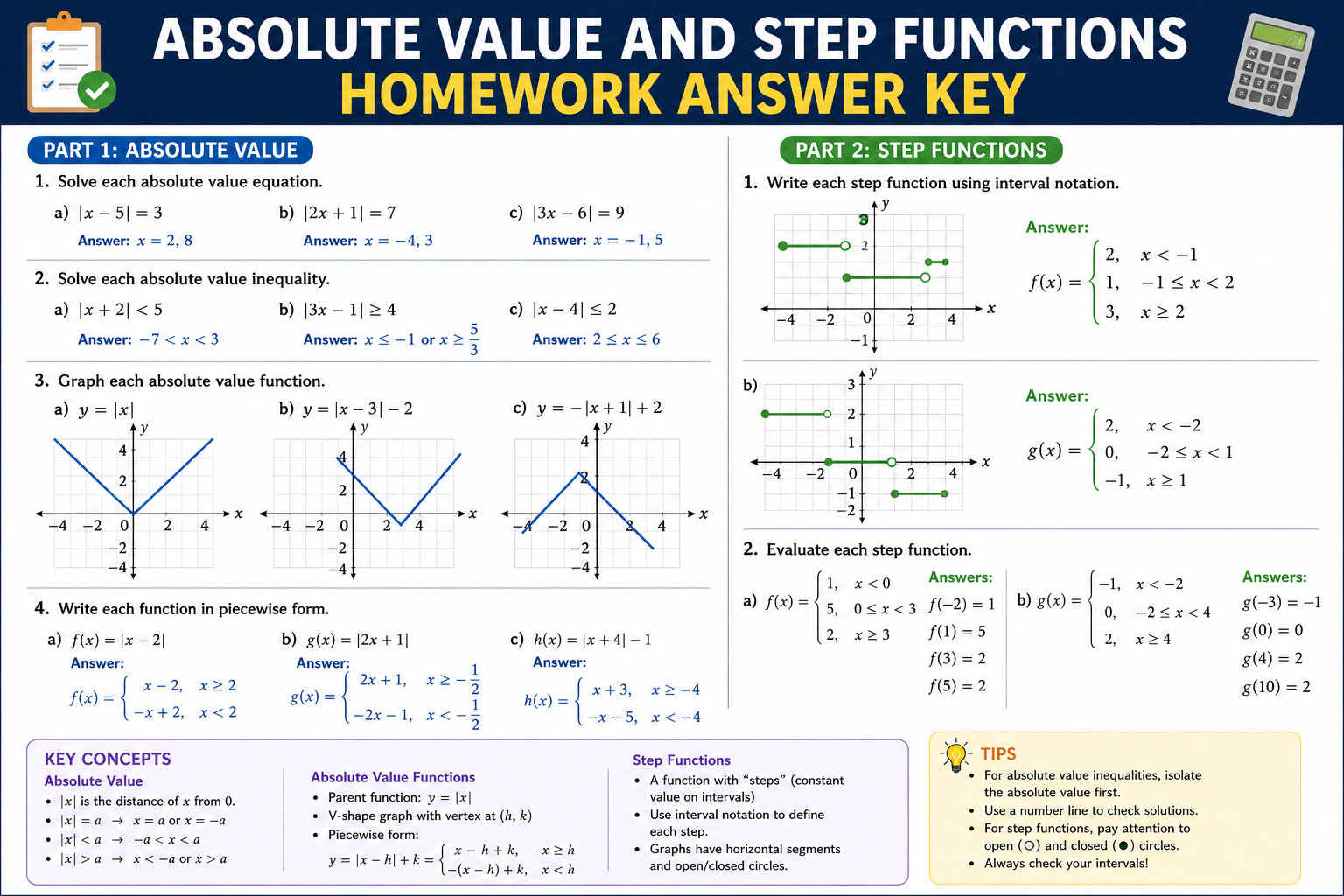
Absolute value and step functions represent important function families in algebra, yet many students struggle with their unique properties and graphing characteristics. Absolute value functions create distinctive V-shaped graphs, while step functions produce the characteristic staircase pattern.
Working through homework problems with detailed solutions helps understanding deepen. This comprehensive answer key provides complete solutions for typical absolute value and step functions problems, showing methodology, algebraic steps, and graphing approaches.
Whether you’re checking your work, seeking to understand methodology, or studying for tests, this answer key provides the guidance needed. Each solution includes explanation of the concept, step-by-step work, and verification of results.
Note on Using This Answer Key
This answer key is a learning tool:
- Use to check your work
- Study the methodology shown
- Understand reasoning behind steps
- Practice similar problems independently
- Don’t simply copy answers
Best practices:
- Attempt problems first
- Compare your work to solutions
- Understand where differences occur
- Identify concept gaps
- Redo problems independently after studying
Absolute Value Function Basics
What Is Absolute Value?
Definition: The absolute value of a number is its distance from zero on the number line, always non-negative.
Notation: |x| represents absolute value of x
Properties:
- |x| ≥ 0 (always non-negative)
- |-x| = |x| (positive and negative versions equal)
- |x| = x when x ≥ 0
- |x| = -x when x < 0
Basic Absolute Value Equation Solutions
Problem 1: Solve |x| = 5
Solution:
|x| = 5 means distance from zero is 5
Two solutions:
- x = 5 (five units to the right of zero)
- x = -5 (five units to the left of zero)
Answer: x = 5 or x = -5
Verification: |5| = 5 ✓ and |-5| = 5 ✓
Problem 2: Solve |x – 3| = 7
Solution:
|x – 3| = 7 means distance from 3 is 7
Case 1: x – 3 = 7
x = 10
Case 2: x – 3 = -7
x = -4
Answer: x = 10 or x = -4
Verification: |10 – 3| = |7| = 7 ✓ and |-4 – 3| = |-7| = 7 ✓
Problem 3: Solve |2x + 1| = 9
Solution:
Case 1: 2x + 1 = 9
2x = 8
x = 4
Case 2: 2x + 1 = -9
2x = -10
x = -5
Answer: x = 4 or x = -5
Verification: |2(4) + 1| = |9| = 9 ✓ and |2(-5) + 1| = |-9| = 9 ✓
Graphing Absolute Value Functions
Understanding the Parent Function
Parent function: f(x) = |x|
Key characteristics:
- V-shaped graph
- Vertex at origin (0, 0)
- Opens upward
- Symmetric about y-axis
- Domain: all real numbers
- Range: y ≥ 0
Key points:
- f(0) = 0
- f(1) = 1
- f(-1) = 1
- f(2) = 2
- f(-2) = 2
Graphing Problem 1: f(x) = |x| + 2
Analysis:
- Vertex at (0, 2) [moved up 2 units]
- Opens upward
- V-shape
Key points:
- (0, 2) vertex
- (1, 3) [right 1, up 2]
- (-1, 3) [left 1, up 2]
- (2, 4)
- (-2, 4)
Graph:
      y
      |
    4 |    ●   ●
      |   /     \
    3 |  ●       ●
      | /         \
    2 |●-----------●  (vertex)
      |/           \
    1 |
      |________________ x
Domain: All real numbers
Range: y ≥ 2
Graphing Problem 2: f(x) = |x – 3|
Analysis:
- Vertex at (3, 0) [moved right 3 units]
- Opens upward
- V-shape
Key points:
- (3, 0) vertex
- (4, 1)
- (2, 1)
- (5, 2)
- (1, 2)
Method for finding points:
- At x = 3: f(3) = |3 – 3| = 0
- At x = 4: f(4) = |4 – 3| = 1
- At x = 2: f(2) = |2 – 3| = 1
- At x = 5: f(5) = |5 – 3| = 2
- At x = 1: f(1) = |1 – 3| = 2
Graph:
      y
      |
    2 |●         ●
      | \       /
    1 |  ●     ●
      |   \   /
    0 |    ●------- (vertex at (3,0))
      |   /   \
   -1 |________________ x
      1   3   5
Domain: All real numbers
Range: y ≥ 0
Graphing Problem 3: f(x) = -|x| + 4
Analysis:
- Vertex at (0, 4) [opens downward, shifted up 4]
- Opens downward (negative coefficient)
- Inverted V-shape
- Maximum at vertex
Key points:
- (0, 4) vertex
- (1, 3) [right 1, down 1]
- (-1, 3) [left 1, down 1]
- (2, 2)
- (-2, 2)
Calculations:
- f(0) = -|0| + 4 = 4
- f(1) = -|1| + 4 = -1 + 4 = 3
- f(-1) = -|-1| + 4 = -1 + 4 = 3
- f(2) = -|2| + 4 = -2 + 4 = 2
- f(-2) = -|-2| + 4 = -2 + 4 = 2
Graph:
      y
    4 |    ●-------●  (vertex)
      |   / \     / \
    3 |  ●   \   /   ●
      | /     \ /     \
    2 |●       V       ●
      |
    1 |________________ x
Domain: All real numbers
Range: y ≤ 4
Graphing Problem 4: f(x) = 2|x – 1| – 3
Analysis:
- Vertex at (1, -3)
- Moved right 1 unit
- Moved down 3 units
- Opens upward
- Stretched by factor of 2 (steeper sides)
Finding vertex:
- x-coordinate: Set x – 1 = 0, so x = 1
- y-coordinate: f(1) = 2|1 – 1| – 3 = -3
- Vertex: (1, -3)
Key points:
- (1, -3) vertex
- (2, -1) [right 1: 2|2-1| – 3 = 2(1) – 3 = -1]
- (0, -1) [left 1: 2|0-1| – 3 = 2(1) – 3 = -1]
- (3, 1) [right 2: 2|3-1| – 3 = 2(2) – 3 = 1]
- (-1, 1) [left 2: 2|-1-1| – 3 = 2(2) – 3 = 1]
Graph:
      y
    1 |●         ●
      | \       /
    0 |  \     /
      |   \   /
   -1 |    ●●
      |    / \
   -3 |   ●---● (vertex)
      |________________ x
     -1   1   3
Domain: All real numbers
Range: y ≥ -3
Step Functions
Understanding Step Functions
What is a step function:
A function that remains constant over an interval, then jumps to a different constant value for the next interval.
Common form: Greatest Integer Function (Floor Function)
Notation: f(x) = ⌊x⌋ (greatest integer less than or equal to x)
Examples:
- ⌊2.3⌋ = 2
- ⌊5⌋ = 5
- ⌊-1.7⌋ = -2 (greatest integer ≤ -1.7)
Step Function Evaluation
Problem 5: Evaluate ⌊x⌋ for given x values
Given:
- x = 2.9
- x = -0.5
- x = 4
- x = -2.3
Solutions:
⌊2.9⌋ = 2 (greatest integer ≤ 2.9)
⌊-0.5⌋ = -1 (greatest integer ≤ -0.5)
⌊4⌋ = 4 (greatest integer ≤ 4, which is 4 itself)
⌊-2.3⌋ = -3 (greatest integer ≤ -2.3)
Graphing Step Functions
Problem 6: Graph f(x) = ⌊x⌋
Function behavior:
- For 0 ≤ x < 1: f(x) = 0
- For 1 ≤ x < 2: f(x) = 1
- For 2 ≤ x < 3: f(x) = 2
- For -1 ≤ x < 0: f(x) = -1
- For -2 ≤ x < -1: f(x) = -2
Key characteristics:
- Horizontal line segments (steps)
- Filled dot at left endpoint (included)
- Open circle at right endpoint (excluded)
- Jump discontinuities at integers
Graph:
      y
    3 |
      |     ●───
    2 |   ●───
      | ●───
    1 |───
      |●───
    0 |───●───
      |     ●───
   -1 |───●───
      | ●───
   -2 |───
      |_______________ x
     -2  -1  0  1  2  3
Domain: All real numbers
Range: All integers (…, -2, -1, 0, 1, 2, …)
Graphing Problem 7: f(x) = ⌊x⌋ + 1
Analysis:
- Shifts parent step function up 1 unit
- Same step pattern as ⌊x⌋, just shifted
Function behavior:
- For 0 ≤ x < 1: f(x) = 1
- For 1 ≤ x < 2: f(x) = 2
- For 2 ≤ x < 3: f(x) = 3
- For -1 ≤ x < 0: f(x) = 0
- For -2 ≤ x < -1: f(x) = -1
Key values:
- f(0) = ⌊0⌋ + 1 = 0 + 1 = 1
- f(1.5) = ⌊1.5⌋ + 1 = 1 + 1 = 2
- f(-0.5) = ⌊-0.5⌋ + 1 = -1 + 1 = 0
- f(2) = ⌊2⌋ + 1 = 2 + 1 = 3
Graph:
      y
    4 |
      |         ●───
    3 |       ●───
      |     ●───
    2 |   ●───
      | ●───
    1 |───●───
      |     ●───
    0 |───●───
      | ●───
   -1 |───
      |_______________ x
     -2  -1  0  1  2  3
Domain: All real numbers
Range: All integers
Graphing Problem 8: f(x) = 2⌊x⌋
Analysis:
- Stretches parent function vertically by factor of 2
- Steps are twice as tall
Function behavior:
- For 0 ≤ x < 1: f(x) = 0
- For 1 ≤ x < 2: f(x) = 2
- For 2 ≤ x < 3: f(x) = 4
- For -1 ≤ x < 0: f(x) = -2
- For -2 ≤ x < -1: f(x) = -4
Key values:
- f(0.5) = 2⌊0.5⌋ = 2(0) = 0
- f(1.5) = 2⌊1.5⌋ = 2(1) = 2
- f(2.5) = 2⌊2.5⌋ = 2(2) = 4
- f(-0.5) = 2⌊-0.5⌋ = 2(-1) = -2
Graph:
      y
    4 |     ●───
      |
    2 |   ●───
      | ●───
    0 |───●───
      |     ●───
   -2 |───●───
      | ●───
   -4 |───
      |_______________ x
     -2  -1  0  1  2  3
Domain: All real numbers
Range: All even integers (…, -4, -2, 0, 2, 4, …)
Mixed Absolute Value and Step Functions Problems
Problem 9: Solve |x – 2| = 4
Solution:
Case 1: x – 2 = 4
x = 6
Case 2: x – 2 = -4
x = -2
Answer: x = 6 or x = -2
Verification:
- |6 – 2| = |4| = 4 ✓
- |-2 – 2| = |-4| = 4 ✓
Problem 10: Solve |3x – 6| = 12
Solution:
Case 1: 3x – 6 = 12
3x = 18
x = 6
Case 2: 3x – 6 = -12
3x = -6
x = -2
Answer: x = 6 or x = -2
Verification:
- |3(6) – 6| = |18 – 6| = |12| = 12 ✓
- |3(-2) – 6| = |-6 – 6| = |-12| = 12 ✓
Problem 11: Graph f(x) = |2x – 4| + 1
Step 1: Find the vertex
- 2x – 4 = 0
- 2x = 4
- x = 2
- f(2) = |2(2) – 4| + 1 = 0 + 1 = 1
- Vertex: (2, 1)
Step 2: Find key points
- f(0) = |2(0) – 4| + 1 = |-4| + 1 = 4 + 1 = 5
- f(1) = |2(1) – 4| + 1 = |-2| + 1 = 2 + 1 = 3
- f(3) = |2(3) – 4| + 1 = |2| + 1 = 2 + 1 = 3
- f(4) = |2(4) – 4| + 1 = |4| + 1 = 4 + 1 = 5
Step 3: Characteristics
- Vertex: (2, 1)
- Opens upward
- Steeper than standard absolute value (coefficient 2)
- Shifted right 2, up 1
Graph:
      y
    5 |●         ●
      | \       /
    3 |  ●     ●
      |   \   /
    1 |    ●------- (vertex)
      |   /   \
   -1 |________________ x
      0   2   4
Domain: All real numbers
Range: y ≥ 1
Problem 12: Solve |x| < 3
Analysis:
|x| < 3 means distance from 0 is less than 3
Solution:
-3 < x < 3
Verification:
- x = 0: |0| = 0 < 3 ✓
- x = 2: |2| = 2 < 3 ✓
- x = -2: |-2| = 2 < 3 ✓
- x = 3: |3| = 3, not less than 3 ✗
- x = -3: |-3| = 3, not less than 3 ✗
Answer: -3 < x < 3 or x ∈ (-3, 3)
Problem 13: Solve |x – 1| ≥ 2
Analysis:
|x – 1| ≥ 2 means distance from 1 is at least 2
Case 1: x – 1 ≥ 2
x ≥ 3
Case 2: x – 1 ≤ -2
x ≤ -1
Answer: x ≤ -1 or x ≥ 3
Verification:
- x = -1: |-1 – 1| = 2 ≥ 2 ✓
- x = 3: |3 – 1| = 2 ≥ 2 ✓
- x = 0: |0 – 1| = 1, not ≥ 2 ✗
- x = 4: |4 – 1| = 3 ≥ 2 ✓
Answer: x ∈ (-∞, -1] ∪ [3, ∞)
Word Problems
Problem 14: Absolute Value Application
Problem Statement:
The actual temperature was 72°F, but a weather instrument has an error of at most 2°F. Write and solve an absolute value equation to find the range of possible readings.
Solution:
Let x = instrument reading
|x – 72| ≤ 2
Solving:
-2 ≤ x – 72 ≤ 2
-2 + 72 ≤ x ≤ 2 + 72
70 ≤ x ≤ 74
Answer: The instrument could read between 70°F and 74°F, inclusive.
Verification:
- Reading 70: |70 – 72| = 2 ✓
- Reading 72: |72 – 72| = 0 ✓
- Reading 74: |74 – 72| = 2 ✓
- Reading 69: |69 – 72| = 3 > 2 ✗
Problem 15: Step Function Application
Problem Statement:
Parking costs $5 for the first hour and $3 for each additional hour (charged per whole hour). Write a step function for the cost and find the cost for parking 3.5 hours.
Solution:
Let f(x) = cost for parking x hours
f(x) = 5 + 3⌊x – 1⌋ for x > 0
(or alternative: f(x) = 5 + 3⌈x – 1⌉ depending on rounding rules)
For x = 3.5 hours:
f(3.5) = 5 + 3⌊3.5 – 1⌋
= 5 + 3⌊2.5⌋
= 5 + 3(2)
= 5 + 6
= $11
Alternative interpretation:
If we charge for each full or partial hour after the first:
- First hour: $5
- Additional hours: ⌈3.5 – 1⌉ = ⌈2.5⌉ = 3 hours
- Additional cost: 3 × $3 = $9
- Total: $5 + $9 = $14
Answer: $11 or $14 depending on rounding interpretation
Typical interpretation: $14 (charging full hour rate for partial hours)
Troubleshooting Common Mistakes
Mistake 1: Sign Errors with Absolute Value
Common error: |x – 3| = 7 solved as:
- x – 3 = 7 → x = 10 ✓
- x – 3 = 7 → x = 4 ✗ (forgot negative case)
Correct approach:
Remember to solve BOTH cases:
- x – 3 = 7 → x = 10
- x – 3 = -7 → x = -4
Mistake 2: Vertex Location Errors
Common error: f(x) = |x – 3| has vertex at (-3, 0)
Correct answer: Vertex at (3, 0)
Remember: |x – h| has vertex at x = h (where the expression inside equals zero)
Mistake 3: Step Function Direction
Common error: ⌊2.7⌋ = 3 (rounding up)
Correct answer: ⌊2.7⌋ = 2 (greatest integer LESS THAN OR EQUAL to 2.7)
Ceiling vs. Floor:
- ⌊x⌋ = greatest integer ≤ x (floor, rounds down)
- ⌈x⌉ = smallest integer ≥ x (ceiling, rounds up)
Mistake 4: Inequality Direction
Common error: |x – 2| > 3 becomes -3 > x – 2 > 3
Correct approach:
- Case 1: x – 2 > 3 → x > 5
- Case 2: x – 2 < -3 → x < -1
- Answer: x < -1 or x > 5 (two separate regions)
Practice Problem Set With Solutions
Set A: Solving Absolute Value Equations
1. Solve |x + 5| = 12
Solution:
Case 1: x + 5 = 12 → x = 7
Case 2: x + 5 = -12 → x = -17
Answer: x = 7 or x = -17
2. Solve |2x – 8| = 6
Solution:
Case 1: 2x – 8 = 6 → 2x = 14 → x = 7
Case 2: 2x – 8 = -6 → 2x = 2 → x = 1
Answer: x = 1 or x = 7
3. Solve 2|x – 3| + 4 = 12
Solution:
2|x – 3| = 8
|x – 3| = 4
Case 1: x – 3 = 4 → x = 7
Case 2: x – 3 = -4 → x = -1
Answer: x = -1 or x = 7
Set B: Solving Absolute Value Inequalities
4. Solve |x| ≤ 5
Solution:
-5 ≤ x ≤ 5
Answer: x ∈ [-5, 5]
5. Solve |x – 4| > 2
Solution:
Case 1: x – 4 > 2 → x > 6
Case 2: x – 4 < -2 → x < 2
Answer: x < 2 or x > 6; x ∈ (-∞, 2) ∪ (6, ∞)
6. Solve 3|x + 1| ≤ 9
Solution:
|x + 1| ≤ 3
-3 ≤ x + 1 ≤ 3
-4 ≤ x ≤ 2
Answer: x ∈ [-4, 2]
Set C: Graphing Absolute Value Functions
7. Graph f(x) = |x + 2| – 1
Vertex: x + 2 = 0 → x = -2, f(-2) = -1
Vertex: (-2, -1)
Key points:
- (-1, 0): |(-1) + 2| – 1 = 1 – 1 = 0
- (-3, 0): |(-3) + 2| – 1 = 1 – 1 = 0
- (0, 1): |0 + 2| – 1 = 2 – 1 = 1
- (-4, 1): |(-4) + 2| – 1 = 2 – 1 = 1
Domain: All real numbers
Range: y ≥ -1
Set D: Step Functions
8. Evaluate ⌊-3.2⌋
Answer: -4 (greatest integer ≤ -3.2)
9. Graph f(x) = ⌊x⌋ – 2
Shift parent step function down 2 units
Key points:
- For 0 ≤ x < 1: f(x) = -2
- For 1 ≤ x < 2: f(x) = -1
- For -1 ≤ x < 0: f(x) = -3
- For -2 ≤ x < -1: f(x) = -4
Domain: All real numbers
Range: All integers
10. Solve ⌊x⌋ = 3
Solution:
3 ≤ x < 4
Answer: x ∈ [3, 4)
Conclusion
Absolute value and step functions present unique characteristics requiring specific problem-solving approaches:
Key concepts to master:
- Absolute value equations: Remember both positive and negative cases
- Absolute value inequalities: Create compound inequalities
- Graphing absolute values: Find vertex, identify transformations, plot key points
- Step functions: Understand greatest integer function, identify step pattern, note discontinuities
- Real-world applications: Model situations with appropriate functions
Study strategies:
- Practice each problem type multiple times
- Understand underlying concepts, not just memorize procedures
- Check answers by substitution
- Use graphing to verify algebraic solutions
- Create your own similar problems
This answer key provides frameworks for solving problems. Use it to verify your work, understand methodology, and practice similar problems independently. Mastery comes through consistent practice and deep understanding of underlying concepts.