
Introduction
Whether you’re conducting research, running a survey, creating a questionnaire, or designing an exam, you need effective questions that elicit clear, usable responses.
Dichotomous questions are among the most straightforward yet powerful tools in data collection. Combined with clear accompanying instructions, they become invaluable for gathering reliable information.
This comprehensive guide explains exactly how to formulate a dichotomous question with accompanying instruction. You’ll learn the theory, see practical examples, discover best practices, and gain skills to create questions that work for your specific needs.
Whether you’re a researcher, student, business professional, or educator, mastering this skill will improve your data collection and decision-making.
Let’s explore how to create effective dichotomous questions with clear, helpful instructions.
What Is a Dichotomous Question?
Definition
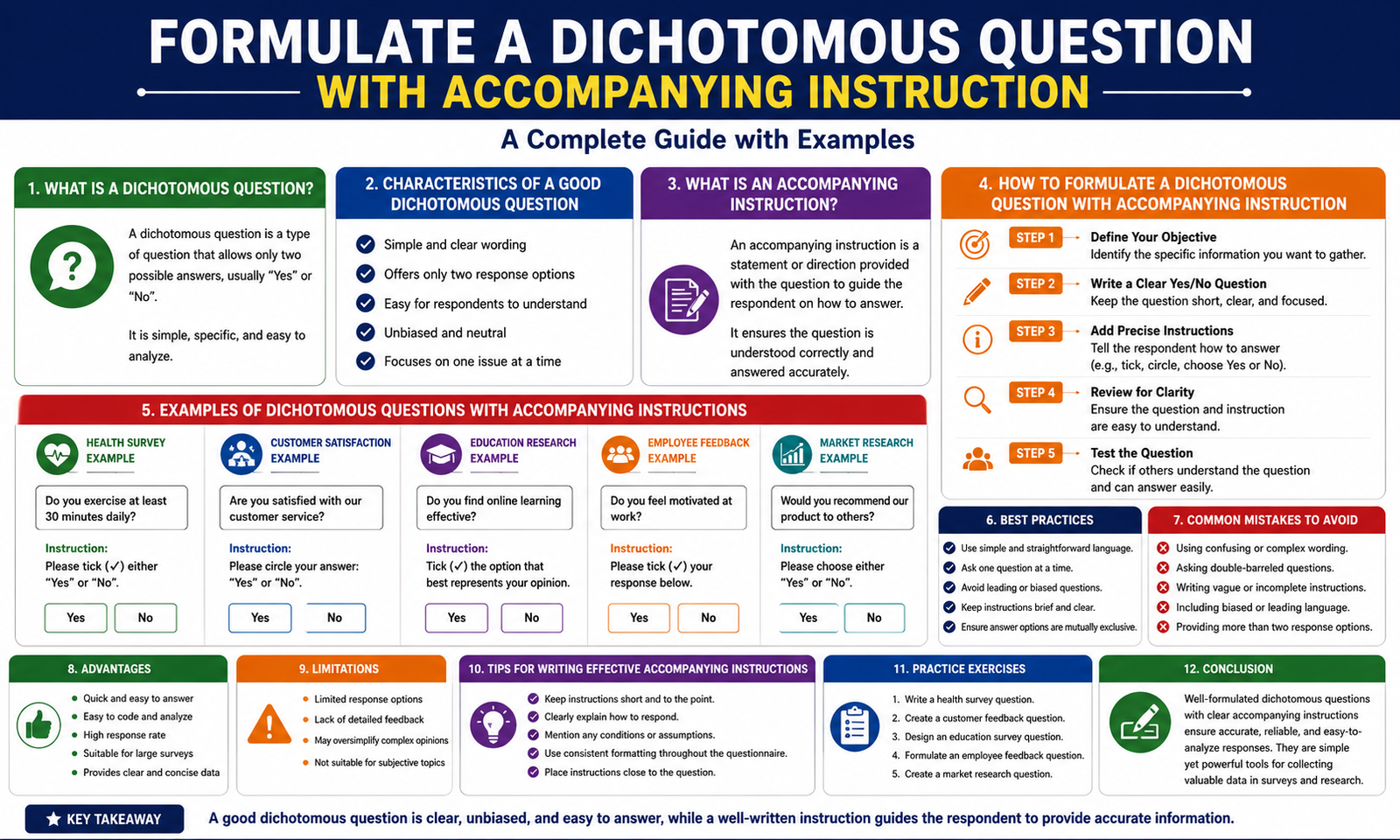
A dichotomous question is a closed-ended question that offers exactly two mutually exclusive response options.
Most commonly: Yes/No questions
Other formats:
- True/False
- Agree/Disagree
- Male/Female
- Present/Absent
- Correct/Incorrect
Key characteristic: Respondents must choose one of two options. No middle ground or additional choices exist.
Purpose of Dichotomous Questions
Dichotomous questions serve to:
- Collect binary information: Determine presence or absence of something
- Simplify responses: Limit choices to make answering quick
- Facilitate analysis: Easy to quantify and compare responses
- Screen respondents: Determine eligibility for further questions
- Clarify positions: Force respondents to take a stance
- Measure agreement: Determine if respondent agrees or disagrees with statement
Where Dichotomous Questions Are Commonly Used
Healthcare and Medical Research:
- Patient satisfaction surveys
- Symptom screening questionnaires
- Treatment effectiveness studies
- Medical history forms
Market Research and Business:
- Customer satisfaction surveys
- Product preference studies
- Brand awareness research
- Employee feedback questionnaires
Education:
- Comprehension assessments
- Knowledge tests
- Student surveys
- Exam questions
Social Research:
- Opinion polls
- Demographic surveys
- Behavioral studies
- Preference assessments
Quality Control:
- Pass/fail testing
- Defect identification
- Compliance checking
- Standard verification
Characteristics of a Good Dichotomous Question
Simple and Clear
Essential quality: The question must be immediately understandable.
Good example: “Do you have a driver’s license?”
Poor example: “Have you ever possessed or currently possess documentation authorizing operation of motorized vehicles on public roadways?”
Why clarity matters:
- Reduces confusion
- Increases accurate responses
- Saves respondent time
- Prevents need for clarification
Two Response Options
Mandatory requirement: Exactly two mutually exclusive choices.
Good format:
- Yes / No
- True / False
- Agree / Disagree
- Present / Absent
Poor format (offering more):
- “Do you like coffee? Yes / No / Sometimes / Rarely”
This is no longer truly dichotomous.
Mutual exclusivity: Respondent cannot choose both options. Choosing one automatically excludes the other.
Easy to Understand
Characteristics of understandable questions:
- Uses simple vocabulary
- Avoids jargon
- Asks about one concept
- Doesn’t require specialized knowledge
- Grammatically correct
- Concise (usually under 20 words)
Test for clarity: Read aloud to someone unfamiliar with your research. They should understand immediately.
Unbiased Wording
Neutral language: Question shouldn’t suggest preferred answer.
Biased example: “Don’t you agree that our excellent product is the best choice?”
Neutral example: “Would you choose this product again?”
Bias can appear through:
- Emotionally charged words
- Leading phrases
- Judgmental language
- Assumptions about the respondent
- Presuppositions
What Is an Accompanying Instruction?
Definition
Accompanying instructions are clear, concise directions that tell respondents how to answer the dichotomous question.
Components typically include:
- How to mark or record response
- Any definitions needed
- Conditions or context
- Time frame (if relevant)
- What “yes” or “no” means in this context
- Any special considerations
Importance in Questionnaires and Exams
Instructions serve critical functions:
- Clarify expectations: Tell respondent exactly what you want
- Prevent misinterpretation: Explain what question means
- Standardize responses: Ensure all respondents answer same question
- Improve accuracy: Clear instructions mean more accurate data
- Build confidence: Respondents know what’s expected
- Reduce errors: Clear instructions decrease mistakes
How Instructions Improve Response Accuracy
Example showing importance:
Question without instruction: “Have you visited our website?”
Possible interpretations:
- In the last month?
- Ever in your lifetime?
- Recently?
- Regularly?
Same question with instruction: “Have you visited our website in the past 30 days? (Mark Yes or No)”
Now clear: Respondent knows exact timeframe and format.
How to Formulate a Dichotomous Question with Accompanying Instruction
Step 1: Define Your Objective
Before writing anything, answer:
- What information do I need?
- Who will answer this question?
- How will I use the response?
- What decision depends on this answer?
- Do I need yes/no, or would another format work better?
Example objective: “Determine if customers would recommend our product to others.”
Step 2: Write a Clear Yes/No Question
Transform your objective into simple question:
From objective “Determine if customers would recommend our product to others”
First draft: “Would you recommend our product to a friend or family member?”
Check the question:
- Single concept? ✓ (recommendation to others)
- Yes/no format? ✓
- Clear language? ✓
- Unbiased? ✓
- Specific timeframe? ✗ (Need to add)
Revised: “Would you recommend our product to a friend or family member within the next month?”
Step 3: Add Precise Instructions
Instructions should explain:
- How to answer (mark, circle, type, etc.)
- What yes/no specifically means
- Any timeframe
- Any conditions
- Whether explanation is needed
Example instruction (accompanying the question above):
“Please mark Yes or No. Yes means you would definitely recommend our product to someone you know in the next 30 days. No means you would not recommend it or are unsure.”
Another example instruction:
“Circle your response: Yes if you would recommend to others, No if you would not.”
Step 4: Review for Clarity
Checklist for review:
□ Is question grammatically correct?
□ Does it use simple language?
□ Is it one question (not double-barreled)?
□ Are exactly two response options offered?
□ Is instruction concise?
□ Does instruction explain what to do?
□ Would someone unfamiliar with research understand it?
□ Are there any assumptions in the question?
□ Could the question be misinterpreted?
□ Is wording neutral and unbiased?
If any answer is “no,” revise.
Step 5: Test the Question
Before using in actual survey/exam:
- Ask pilot group (5-10 people): Do they understand the question? What does yes/no mean to them?
- Record feedback: Did they interpret correctly?
- Watch for confusion: Did anyone hesitate or ask for clarification?
- Analyze responses: Do answers make sense given the question?
- Revise if needed: Adjust based on pilot feedback
Testing prevents costly mistakes in your actual data collection.
Examples of Dichotomous Questions with Accompanying Instructions
Health Survey Example
Question: “Have you been vaccinated against influenza in the past 12 months?”
Accompanying Instruction: “Please answer Yes or No. Yes means you received a flu vaccine at any time during the past 12 months. No means you have not received a flu vaccine in the past 12 months. (Do not count vaccines received more than 12 months ago.)”
Why this works:
- Clear timeframe (past 12 months)
- Definition of what “vaccinated” means
- Excludes older vaccines
- Specific response format
Customer Satisfaction Example
Question: “Would you purchase from us again?”
Accompanying Instruction: “Mark Yes if you would definitely or probably buy from us again. Mark No if you would not buy from us again or are unsure. Please consider all your experiences with our company.”
Why this works:
- Clarifies what yes/no mean
- Provides context (all experiences)
- Specific response method
- Addresses possible uncertainty
Education Research Example
Question: “True or False: The capital of France is Paris.”
Accompanying Instruction: “Write T for True or F for False. This question tests knowledge of world capitals. Do not guess if unsure. Base your answer only on facts you know.”
Why this works:
- Specific response format (T or F)
- States what’s being tested
- Discourages guessing
- Clear answer recording method
Employee Feedback Example
Question: “Do you feel supported by your direct manager?”
Accompanying Instruction: “Please respond Yes or No. Yes means your manager regularly provides support, guidance, and assistance. No means you do not feel consistently supported by your manager. Consider the past 6 months of your working relationship.”
Why this works:
- Defines “supported” specifically
- Timeframe included (6 months)
- Explains what each answer means
- Clear response requirement
Market Research Example
Question: “Have you heard of Brand X before this survey?”
Accompanying Instruction: “Please answer Yes or No. Yes means you have previously encountered, heard about, or seen advertising for Brand X at any time. No means this is your first time hearing about Brand X. Mark your answer clearly in the box provided.”
Why this works:
- Defines what counts as “heard of”
- Includes any form of awareness
- Specific answer location
- Clear format requirement
Best Practices for Writing Dichotomous Questions
Use Simple Language
Avoid technical jargon, acronyms, and complex vocabulary.
Complex: “Do you experience somatic manifestations of psychological distress?”
Simple: “Does stress cause physical symptoms in your body?”
Why it matters: Surveys reach diverse audiences. Simple language ensures understanding.
Ask One Question at a Time
Never use double-barreled questions (asking two things at once).
Bad: “Do you like the quality and price of our product?”
(Respondent might like quality but not price—how do they answer?)
Good: “Do you think the quality of our product is excellent?”
(Ask about price separately)
Why it matters: You need to know specifically what yes/no refers to.
Avoid Leading Questions
Don’t suggest which answer is preferred.
Leading: “Don’t you agree that our service is exceptional?”
Neutral: “How would you rate our service?”
Leading: “We have an amazing team, don’t you think?”
Neutral: “Do you feel our team is effective?”
Why it matters: Leading questions get inaccurate data reflecting respondent bias toward preferred answer.
Keep Instructions Brief
Comprehensive but concise:
Too long: “In response to the above inquiry regarding your personal consumption patterns and behaviors relative to our particular product offering, in the context of your typical purchasing decisions and lifestyle considerations, please indicate whether you would or would not consider utilizing this product…”
Concise: “Mark Yes if you would buy this product. Mark No if you would not.”
Why it matters: Long instructions confuse rather than clarify. Respondents skip them.
Ensure Answer Options Are Mutually Exclusive
Choices cannot overlap.
Not mutually exclusive:
- “Are you single or young?” (Someone can be young and single—overlap)
- “Do you like tea or hot beverages?” (Tea is a hot beverage—overlap)
Mutually exclusive:
- “Are you single or married?”
- “Do you like tea or coffee?”
Why it matters: Respondent should have exactly one correct answer option.
Common Mistakes to Avoid When Formulating Questions
Using Confusing Wording
Problem: Words with multiple meanings or unclear references.
Confusing: “Do you frequently utilize digital platforms for socialization?”
Clear: “Do you use social media like Facebook or Instagram?”
Fix: Test with someone unfamiliar with your topic.
Asking Double-Barreled Questions
Problem: Asking two things in one question.
Double-barreled: “Do you think our customer service is friendly and helpful?”
Single question: “Do you think our customer service is friendly?” (Ask helpfulness separately)
Fix: Split into separate questions.
Writing Vague Instructions
Problem: Unclear how to respond.
Vague: “Please indicate your response appropriately.”
Clear: “Write Yes or No on the line provided.”
Fix: Specify exact response method and format.
Including Biased Language
Problem: Words that suggest preferred answer.
Biased: “Would you agree that our outstanding product is the best choice?”
Unbiased: “Would you choose this product?”
Words that bias:
- “outstanding,” “excellent,” “best”
- “Don’t you agree that…”
- “As everyone knows…”
- Emotionally charged descriptors
Fix: Use neutral, objective language.
Offering More Than Two Response Options
Problem: Defeats purpose of dichotomous question.
Wrong: “Do you like our product? Yes / No / Sometimes / Unsure”
Correct: “Do you like our product? Yes / No”
Fix: Limit to exactly two options.
Advantages of Dichotomous Questions
Quick to Answer
Why this matters:
- Respondents answer in seconds
- Reduces survey fatigue
- Encourages completion
- Increases response rate
Easy to Analyze
Why this matters:
- Count yes and no responses
- Calculate percentages
- Create simple charts and graphs
- Compare groups easily
- No need for complex coding
Example: 60% answered Yes, 40% answered No.
High Response Rate
Why this matters:
- Simple format encourages participation
- People willing to answer quick questions
- More people complete entire survey
- More reliable data from larger sample
- Better representation of population
Suitable for Surveys and Questionnaires
Why this matters:
- Perfect for quick polls
- Works for long questionnaires
- Can screen respondents
- Covers lots of ground quickly
- Popular in market research and healthcare
Limitations of Dichotomous Questions
Limited Response Choices
The problem:
- Forces choice between only two options
- Real opinions often more complex
- May not capture full picture
Example: “Do you like this book? Yes/No”
What if you like it, but with reservations?
Lack of Detailed Feedback
The problem:
- No explanation of why respondent answered yes or no
- No depth of information
- Can’t understand reasoning
Example: Yes, someone would buy again—but why?
May Oversimplify Complex Opinions
The problem:
- Complex issues reduced to yes/no
- Nuance lost
- Full perspective not captured
Example: Political opinions rarely fit yes/no format
Solution: Combine dichotomous questions with open-ended questions for deeper understanding.
Tips for Creating Effective Accompanying Instructions
Keep Instructions Concise
Good: “Mark Yes or No.”
Poor: “In the space provided below, please mark the option that most accurately represents your response to the above question, considering all relevant factors…”
Rule: Instructions should take 10 seconds to read.
Explain How to Respond
Include:
- What format to use (circle, check, write, mark)
- Where to put answer (box, line, space)
- Whether to write out answer or use shorthand
Example: “Circle Yes or No. Do not write out the words.”
Mention Any Conditions or Assumptions
Include relevant context:
- Timeframe (past month, ever, last year)
- Conditions (if applicable, only for employees, etc.)
- What yes/no specifically means in this context
Example: “Yes means you have purchased from us in the past 6 months. No means you have not purchased from us in the past 6 months.”
Use Consistent Formatting
Consistency across all questions:
- Same instruction style
- Same answer format
- Same spacing
- Same font/size
- Professional appearance
Why it matters: Consistency helps respondents develop rhythm and complete survey more quickly.
Practice Exercises for Writing Dichotomous Questions with Instructions
Exercise 1: Write a Health Survey Question
Objective: Determine if people exercise regularly.
Your task:
- Write a clear dichotomous question
- Add accompanying instructions
- Define what “regularly” means
- Specify timeframe
Sample answer:
Question: “Do you exercise at least 30 minutes, three times per week or more?”
Accompanying Instruction: “Mark Yes if you exercise at least 30 minutes in duration, three or more times per week on average. Mark No if you exercise less frequently than this. Include any form of exercise (walking, sports, gym, etc.). Consider your activity level over the past month.”
Exercise 2: Create a Customer Feedback Question
Objective: Determine if customers would recommend your business.
Your task:
- Write a clear recommendation question
- Add specific instructions
- Define recommendation
- Include timeframe
Sample answer:
Question: “Would you recommend our restaurant to a friend?”
Accompanying Instruction: “Mark Yes if you would definitely or probably recommend our restaurant to someone you know. Mark No if you would not recommend it or are unsure. Consider your overall dining experience, including food quality, service, and atmosphere.”
Exercise 3: Design an Education Survey Question
Objective: Determine if students found a course helpful.
Your task:
- Create a course helpfulness question
- Add clear instructions
- Specify what “helpful” means
- Explain response method
Sample answer:
Question: “Did this course help you understand the material?”
Accompanying Instruction: “Answer Yes or No. Yes means the course helped you learn and understand the subject matter. No means the course did not help you learn this material. Consider whether the course content, teaching method, and resources supported your learning.”
Frequently Asked Questions About Dichotomous Questions and Instructions
What exactly is a dichotomous question?
A dichotomous question is a closed-ended question offering exactly two mutually exclusive response options. The most common format is yes/no questions, but can also be true/false, agree/disagree, or any two opposite choices. Dichotomous questions are used in surveys, questionnaires, tests, and research to collect binary data. The key is that respondents must choose one option—there’s no middle ground or third choice.
What are examples of dichotomous questions?
Common examples:
- “Do you have a college degree?” (Yes/No)
- “Have you visited our website?” (Yes/No)
- “True or False: The Earth is round.” (True/False)
- “Do you agree that exercise is important?” (Agree/Disagree)
- “Are you employed?” (Yes/No)
- “Did you receive training?” (Yes/No)
- “Is this product defective?” (Yes/No)
Each offers exactly two options.
Why are accompanying instructions important?
Instructions matter because they:
- Clarify what the question means
- Explain how to record response
- Define timeframes or conditions
- Reduce misinterpretation
- Ensure consistent responses
- Improve data accuracy
- Help respondents answer correctly
- Prevent confusion
Without clear instructions, respondents might interpret the same question differently.
Where are dichotomous questions used?
Common places:
- Healthcare: Patient surveys, symptom screening, medical histories
- Business: Customer satisfaction, employee feedback, market research
- Education: Tests, knowledge checks, student surveys
- Research: Opinion polls, behavioral studies, demographic surveys
- Quality control: Pass/fail testing, compliance checking
- Government: Census data, voter preferences, policy feedback
Anywhere you need simple yes/no or true/false responses.
What are the advantages and disadvantages of dichotomous questions?
Advantages:
- Quick to answer
- Easy to analyze
- High response rates
- Encourages survey completion
- Simple to score
- Good for screening
- Produces clean data
Disadvantages:
- Limited response choices
- Oversimplifies complex topics
- Lacks detail and explanation
- May force incorrect answers
- Doesn’t capture nuance
- Can’t understand reasoning
- Sometimes doesn’t fit the issue
Best use: Combine with other question types for complete understanding.
How do I know if my question is well-written?
Check these:
- Can someone unfamiliar understand it immediately?
- Does it ask one thing, not two?
- Does it offer exactly two options?
- Is language simple and clear?
- Is wording neutral and unbiased?
- Would different people interpret it the same way?
- Do instructions explain everything clearly?
- Would a pilot group understand it?
If you answer yes to all, your question is well-written.
Conclusion
Dichotomous questions with clear accompanying instructions are powerful tools for data collection. They simplify complex information into clear yes/no choices, making surveys, questionnaires, and exams more effective.
Key Takeaways
✓ Dichotomous questions offer exactly two mutually exclusive response options
✓ Clear instructions prevent misinterpretation and improve accuracy
✓ Simple language matters more than complex vocabulary
✓ Testing your questions prevents problems in real surveys
✓ Best practices include avoiding leading questions and double-barreled questions
✓ Accompanying instructions should be brief but comprehensive
✓ Advantages include ease of analysis and high response rates
✓ Limitations include oversimplification of complex issues
Why This Matters
Whether you’re conducting medical research, customer surveys, employee feedback, education assessments, or market studies, knowing how to formulate a dichotomous question with accompanying instruction improves your results. Better questions mean better data. Better data means better decisions.
Next Steps
Start practicing:
- Identify what information you need
- Write a simple yes/no question
- Create clear, brief instructions
- Test with 3-5 people
- Revise based on feedback
- Use in your survey or questionnaire
Remember: The best questions seem simple because they’re well-crafted. The poorly written questions are the ones that confuse people.
Master this skill, and your surveys, questionnaires, and assessments will be more effective. Your respondents will understand exactly what you’re asking. Your data will be more accurate and useful.
Start formulating better dichotomous questions today. Your research—and your data—will be better for it.