
Introduction
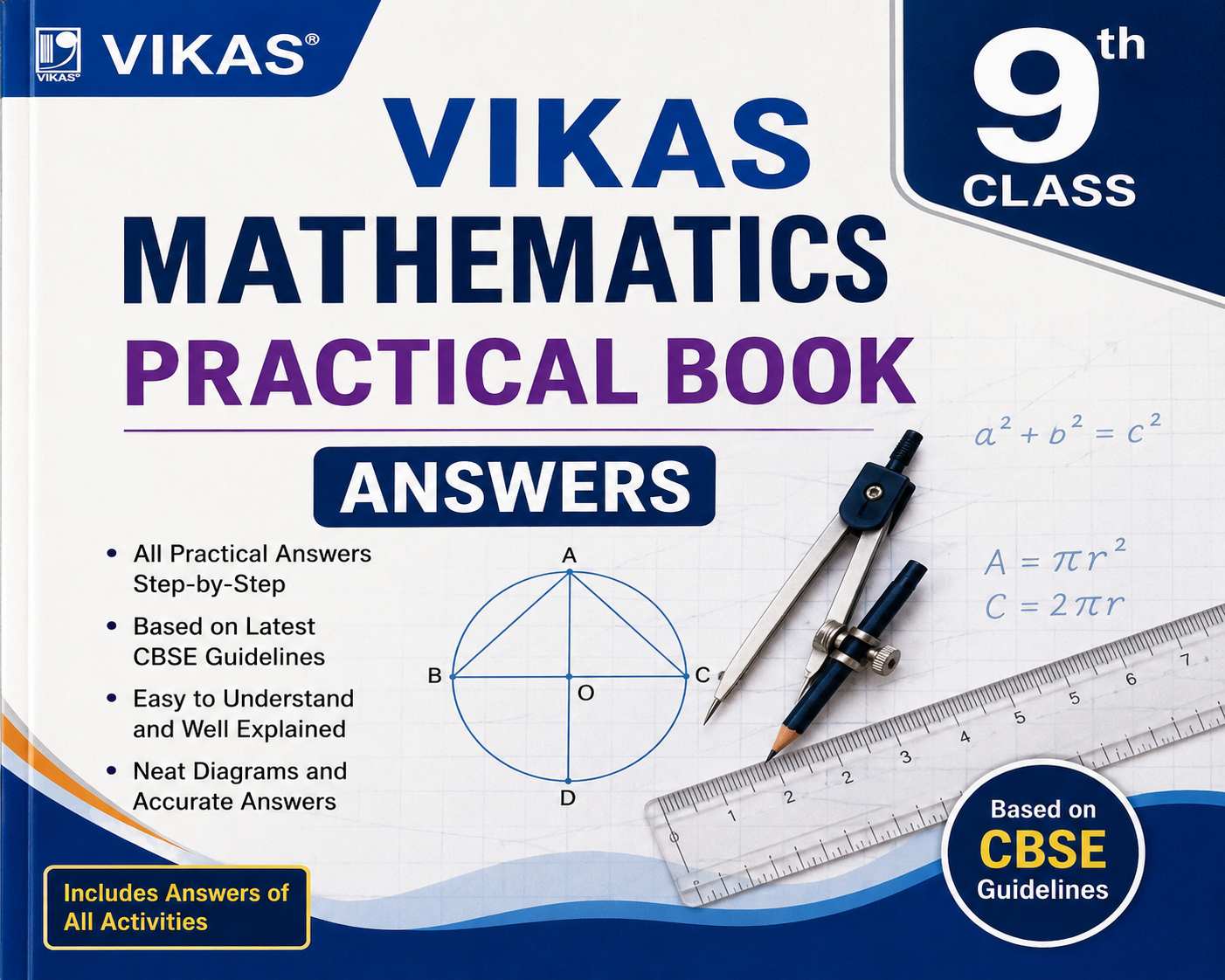
Mathematics is not just about solving equations on paper—it’s about understanding concepts through practical application. The Vikas Mathematics Practical Book Class 9 is designed specifically to bridge this gap between theoretical knowledge and hands-on learning. This comprehensive guide serves as a companion book that helps students visualize mathematical concepts through activities, diagrams, and practical exercises.
Purpose of the Practical Book
The primary purpose of this practical book is to make mathematics more engaging and easier to understand. Traditional textbooks often focus on formulas and theorems, but the Vikas Practical Book takes a different approach by encouraging students to:
- Perform hands-on activities to understand abstract concepts
- Visualize geometric shapes and their properties
- Apply mathematical principles to real-life situations
- Develop problem-solving skills through practical exercises
- Build a strong foundation for higher-level mathematics
Benefits Students Will Gain from This Guide
By following this Class 9 Maths Practical Guide, students can expect several advantages:
- Better Conceptual Clarity – Practical activities help solidify theoretical concepts learned in the classroom.
- Improved Retention – Visual and hands-on learning improves memory retention compared to rote learning.
- Exam Readiness – Many CBSE and state board exams include practical-based questions, and this guide prepares students effectively.
- Confidence Building – Regular practice with real questions boosts confidence before exams.
- Time-Saving Revision – A well-structured guide allows for quick and efficient revision.
Chapter Overview
The Class 9 Mathematics syllabus covers several important topics, each requiring a different approach for practical understanding. Let’s explore the key chapters covered in the Vikas Mathematics Practical Book.
1. Sets
The chapter on Sets introduces students to the basic language of mathematics. Practical activities in this chapter include:
- Representing sets using Venn diagrams
- Performing set operations (union, intersection, difference) practically
- Real-life examples of sets (like classroom groups, number collections)
2. Algebra
Algebra forms the backbone of higher mathematics. The practical exercises focus on:
- Verifying algebraic identities through paper folding and cutting activities
- Using algebra tiles to understand polynomial expressions
- Graphical representation of algebraic equations
3. Geometry
Geometry is perhaps the most activity-rich chapter in the entire syllabus. Practical work includes:
- Constructing triangles, angles, and quadrilaterals using a compass and ruler
- Verifying geometric theorems through paper folding
- Understanding congruence and similarity through cut-outs
4. Linear Equations
This chapter emphasizes the practical application of equations in daily life. Activities include:
- Plotting linear equations on a graph
- Solving real-world problems using linear equations
- Understanding the relationship between algebraic and graphical representation
5. Statistics
Statistics is all about data interpretation, and the practical book helps students:
- Collect and organize real-life data
- Create bar graphs, histograms, and pie charts
- Calculate mean, median, and mode using classroom data
6. Coordinate Geometry
This chapter introduces the Cartesian plane and its applications. Practical activities cover:
- Plotting points on a graph paper
- Understanding quadrants and coordinates
- Distance and midpoint calculations through visual methods
How to Solve Practical Activities
Solving practical mathematics activities requires a systematic approach. Here’s how students can effectively tackle these exercises.
Method for Drawing Diagrams
Accurate diagrams are essential for practical mathematics. Follow these tips:
- Use proper tools: Always use a sharp pencil, ruler, compass, and protractor for accuracy.
- Follow scale properly: When diagrams require specific measurements, maintain the correct scale throughout.
- Label everything: Clearly label all points, lines, and angles for easy reference.
- Practice neatness: A clean diagram is easier to understand and evaluate.
Step-by-Step Approach
To solve any practical activity systematically, follow these steps:
- Read the activity carefully – Understand what is being asked before starting.
- Gather required materials – Keep your geometry box, graph paper, and other tools ready.
- Plan your approach – Decide the sequence of steps needed to complete the activity.
- Execute step-by-step – Perform each step carefully, especially in construction-based activities.
- Verify your results – Cross-check your findings with theoretical concepts.
- Write observations clearly – Document your conclusions in simple language.
Common Mistakes to Avoid
Students often make these errors while working on practical activities:
- Inaccurate measurements – Using a damaged or incorrect ruler/compass leads to errors.
- Skipping steps – Rushing through construction steps often results in incorrect diagrams.
- Poor labeling – Diagrams without proper labels are hard to evaluate and understand.
- Ignoring units – Forgetting to mention units (cm, degrees, etc.) is a common mistake.
- Not verifying answers – Failing to cross-check results with theory leads to incorrect conclusions.
Original Practice Questions
Here are some original practice questions designed to strengthen your understanding of Class 9 Mathematics practical concepts.Question 1: Sets
Draw a Venn diagram to represent two sets A = {2, 4, 6, 8} and B = {4, 8, 12, 16}. Find A ∩ B and A ∪ B.
Explanation: Draw two overlapping circles. Place common elements (4, 8) in the overlapping region. A ∪ B = {2, 4, 6, 8, 12, 16}, A ∩ B = {4, 8}.
Question 2: Algebra
Verify the identity (a + b)² = a² + 2ab + b² using a square paper cutting activity.
Explanation: Cut a square paper of side (a+b). Divide it into four parts: two squares of sides a and b, and two rectangles of dimensions a×b. This visually proves the identity.
Question 3: Geometry
Construct a triangle with sides 5 cm, 6 cm, and 7 cm using a compass and ruler.
Explanation: Draw a base of 7 cm. Using a compass, mark arcs of 5 cm and 6 cm from each endpoint. Their intersection gives the third vertex.
Question 4: Linear Equations
Plot the graph of the equation 2x + 3y = 6 on graph paper.
Explanation: Find two points by substituting x = 0 (y = 2) and y = 0 (x = 3). Plot these points and draw a straight line connecting them.
Question 5: Statistics
Collect the marks of 20 students in a class test and represent the data using a bar graph.
Explanation: Organize data into groups (e.g., 0-10, 10-20, etc.), calculate frequency, and represent it using bars of proportional height.
Question 6: Coordinate Geometry
Plot the points A(2,3), B(-2,3), C(-2,-3), and D(2,-3) on a graph. Identify the shape formed.
Explanation: These points form a rectangle when connected in order.
Question 7: Geometry
Verify that the sum of angles in a triangle is 180° using a paper cutting method.
Explanation: Cut a triangle, tear off its three angles, and arrange them together to form a straight line (180°).
Question 8: Algebra
Factorize x² + 5x + 6 using the algebra tiles method.
Explanation: Use rectangular tiles to represent x² and x, and unit squares for constants. Arrange them into a rectangle to find factors (x+2)(x+3).
Question 9: Statistics
Find the mean, median, and mode of the following data set: 12, 15, 12, 18, 20, 15, 12.
Explanation: Mean = sum/count, Median = middle value when arranged in order, Mode = most frequently occurring value (12).
Question 10: Linear Equations
Solve the system of equations x + y = 10 and x – y = 2 graphically.
Explanation: Plot both lines on the same graph. Their intersection point gives the solution (x=6, y=4).
Question 11: Coordinate Geometry
Find the distance between points P(3,4) and Q(7,1) using the distance formula.
Explanation: Distance = √[(7-3)² + (1-4)²] = √[16+9] = √25 = 5 units.
Question 12: Sets
If Set A has 5 elements and Set B has 3 elements with 2 common elements, find n(A∪B).
Explanation: n(A∪B) = n(A) + n(B) – n(A∩B) = 5 + 3 – 2 = 6.
Exam Preparation Tips
Proper exam preparation requires more than just solving questions—it requires strategy and consistency.
Revision Strategy
- Chapter-wise revision: Complete one chapter thoroughly before moving to the next.
- Practice regularly: Solve at least 5-10 practical questions daily.
- Use flashcards: Create flashcards for important formulas and theorems.
- Group study: Discussing problems with classmates can clarify doubts quickly.
- Mock tests: Attempt full-length practice tests under timed conditions.
Formula List
Keep these essential formulas handy for quick revision:
- Algebra: (a+b)² = a² + 2ab + b², (a-b)² = a² – 2ab + b², a² – b² = (a+b)(a-b)
- Geometry: Area of triangle = ½ × base × height, Perimeter of rectangle = 2(l+b)
- Statistics: Mean = Σx/n, Median = middle value, Mode = most frequent value
- Coordinate Geometry: Distance formula = √[(x2-x1)² + (y2-y1)²]
Time Management
- Create a study timetable: Allocate specific time slots for each subject and chapter.
- Prioritize weak areas: Spend more time on topics you find challenging.
- Take regular breaks: Short breaks between study sessions improve focus.
- Practice with a timer: This helps develop speed and accuracy for exams.
- Avoid last-minute cramming: Start revision at least 2-3 weeks before exams.
FAQs
Q1: What is the Vikas Mathematics Practical Book Class 9 used for?
A: It is used to help students understand mathematical concepts through practical activities, diagrams, and hands-on exercises, complementing the theoretical textbook.
Q2: Is this practical book aligned with the CBSE syllabus?
A: Yes, the Vikas Mathematics Practical Book Class 9 is designed according to the CBSE curriculum and covers all essential topics required for board examinations.
Q3: How can I improve my scores in Class 9 Mathematics practical exams?
A: Regular practice, accurate diagram construction, understanding step-by-step methods, and reviewing common mistakes can significantly improve your practical exam scores.
Q4: Are practical activities important for the final exam?
A: Yes, many schools include practical-based questions in internal assessments and exams. Understanding these concepts also helps in solving theoretical problems more effectively.
Q5: How many hours should I dedicate to practical mathematics daily?
A: Ideally, students should spend 30-45 minutes daily on practical activities, gradually increasing practice time as exams approach.
Q6: Can I find additional Class 9 Mathematics practical questions online?
A: Yes, apart from the practical book, various educational websites and NCERT resources offer additional practice questions and solutions.
This comprehensive Class 9 Maths Study Guide aims to make your learning journey smoother and more effective. By combining theoretical knowledge with practical application, students can develop a deeper understanding of mathematics while boosting their confidence for exams. Regular practice, along with the tips and questions provided in this guide, will help you excel in your Class 9 Mathematics curriculum.