
Introduction
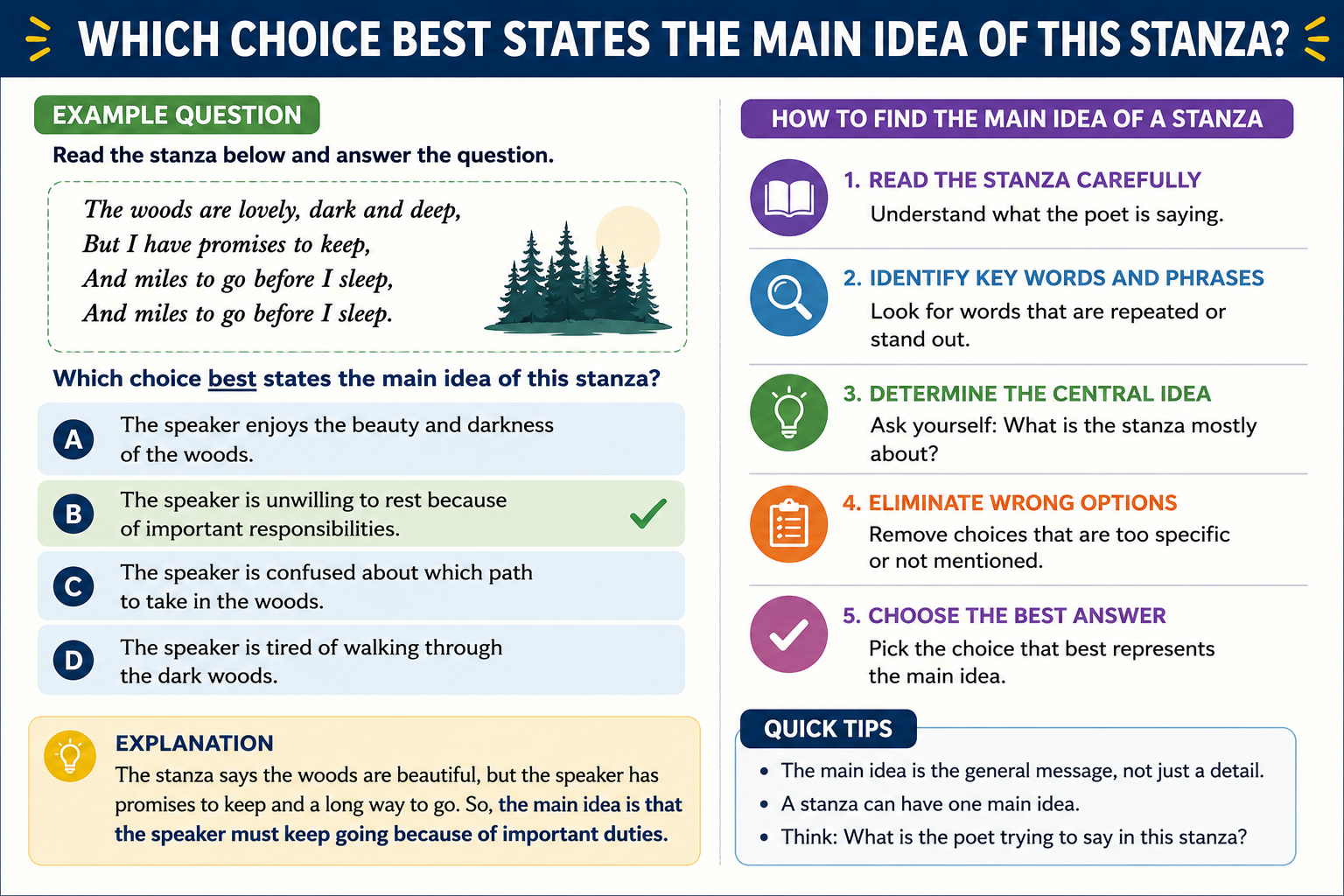
“Which choice best states the main idea of this stanza?” appears constantly on standardized tests, literature exams, and reading comprehension assignments. Yet many students struggle with this question type, uncertain how to identify the main idea in poetic language filled with metaphors, imagery, and figurative language.
The challenge: poetry often expresses main ideas indirectly. Unlike prose stating ideas plainly, poems weave central meanings through imagery, symbolism, and emotion. A stanza might describe a sunset without explicitly stating what the sunset represents. You must interpret to find the deeper meaning.
This comprehensive guide teaches you how to systematically identify main ideas in poetry stanzas and choose the best answer from multiple choices. You’ll learn the thinking process, common wrong answer traps, and strategies for tackling any stanza analysis question.
What Is a Main Idea in a Stanza?
Definition
The main idea of a stanza is the central point, message, or meaning the poet is communicating. It’s the “big picture” takeaway—what the stanza is really about when you look beyond surface-level descriptions.
Key distinction:
- Topic: What the stanza is literally about (a sunset, a person, nature)
- Main idea: What the stanza is saying about that topic; what message or meaning it conveys
Example:
- Topic: A sunset
- Main idea: Beauty fades quickly, and we should appreciate fleeting moments
Main Ideas vs. Details
Main ideas:
- Broader, more general
- Encompass multiple details
- Directly related to stanza’s purpose
- What the poet ultimately wants to communicate
Details:
- Specific observations or descriptions
- Support the main idea
- Often concrete images or facts
- Help develop and illustrate the main idea
Step-by-Step Strategy for Finding Main Ideas
Step 1: Read the Stanza Carefully (Multiple Times)
First reading:
Read for general impression and emotion. Don’t worry about every word yet.
Second reading:
Read aloud to hear rhythm, tone, and emphasis. Poetry is meant to be spoken.
Third reading:
Read slowly, pausing at punctuation. Notice where sentences begin and end (not necessarily where lines end).
Why multiple readings matter:
- First reading misses nuance
- Rereading reveals details initially missed
- Hearing the words (even mentally) accesses emotional content
- Understanding poetry requires immersion, not quick skimming
Step 2: Identify the Literal Content (What’s Happening)
Ask yourself: What is literally described in this stanza?
Example stanza:
“The autumn leaves drift slowly down,
Each one a different shade of gold,
Covering the ground without a sound,
The summer’s warmth has grown cold.”
Literal content: Autumn leaves are falling and covering the ground; summer has ended and weather is growing cold.
Step 3: Look for Figurative Language and Symbolism
Types of figurative language to identify:
- Metaphor: Direct comparison (“Winter is death”)
- Simile: Comparison using “like” or “as” (“Leaves fall like tears”)
- Personification: Human qualities given to non-human things (“The wind whispers secrets”)
- Symbolism: Objects representing larger ideas (autumn = change, mortality)
- Alliteration/Repetition: Sound patterns emphasizing certain words
- Imagery: Vivid descriptions appealing to senses
Example from above stanza:
- “Each one a different shade of gold” – poetic description, suggests beauty and value
- “Covering the ground without a sound” – quiet, peaceful imagery; perhaps suggests inevitability or loss
- “Summer’s warmth has grown cold” – metaphorical shift from warmth to cold; suggests loss, aging
Step 4: Consider Tone and Mood
Tone: The poet’s attitude toward the subject (sad, joyful, angry, reflective, bitter, etc.)
Mood: The emotional atmosphere created (the feeling the stanza evokes in reader)
How tone/mood reveals main idea:
A stanza describing autumn might convey:
- Melancholy tone (loss, decline) vs. peaceful tone (acceptance, change) vs. ominous tone (death, decay)
- Same topic (autumn) but different main ideas based on tone
Identifying tone:
- Word choice: “withered” vs. “mature” vs. “golden” (same thing, different connotations)
- Imagery: Dark, cold imagery vs. warm, colorful imagery
- Rhythm: Fast, energetic vs. slow, heavy
- Sentence structure: Exclamations (emotional) vs. statements (calm)
Step 5: Consider Context
Within the poem:
- What stanzas come before and after?
- How does this stanza relate to the overall poem?
- Does the main idea connect to the poem’s central theme?
About the poet:
- What was the historical/biographical context?
- What are the poet’s typical themes?
- What was happening when the poem was written?
Note: For test questions, context is usually provided in the passage itself. Use what’s given.
Step 6: Articulate the Main Idea in Your Own Words
Before looking at answer choices, state what you think the main idea is:
“This stanza is saying that _____________”
Or: “The poet is expressing the idea that _____________”
Use complete sentences. Be specific, not vague.
Example:
Poor: “The stanza is about autumn.”
Better: “The stanza expresses the idea that change is inevitable and beautiful, but tinged with sadness as summer fades.”
Step 7: Evaluate Answer Choices
Once you’ve identified what you think the main idea is, examine each choice:
For each option, ask:
- Does this accurately capture the main idea?
- Or is it too narrow (only captures one detail)?
- Or too broad (overly general, not specific to this stanza)?
- Or wrong (contradicts or misses the point)?
Common Wrong Answer Traps
Test makers deliberately include incorrect answers that seem plausible. Recognizing these traps helps you avoid them.
Trap 1: Literal vs. Metaphorical Answers
Example:
Stanza: “My heart is a caged bird, beating against walls”
Wrong answer: “The speaker has a bird as a pet”
Correct answer: “The speaker feels trapped and unable to express themselves”
Why it’s a trap: The wrong answer takes metaphor literally. Choose answers understanding figurative language.
Trap 2: Too Specific (Detail, Not Main Idea)
Example stanza:
“The old man walked slowly down the street,
His cane tapped rhythmically on stone,
Children played nearby but left him alone,
He existed in solitude, even among the crowd.”
Wrong answer: “An old man walks down the street with a cane”
Correct answer: “Loneliness and isolation persist even in the presence of others”
Why it’s a trap: The wrong answer restates details, not the main idea. Main idea = deeper meaning.
Trap 3: Too Broad/Overly General
Example stanza:
(Same as above about the old man)
Wrong answer: “Life is difficult”
Correct answer: “Loneliness and isolation persist even in the presence of others”
Why it’s a trap: “Life is difficult” is too vague, applies to countless situations, doesn’t capture what this specific stanza expresses.
Trap 4: Opposite or Contradictory Meaning
Example stanza:
“Her laughter rang out like bells,
Joy painted colors on her face,
The room brightened with her presence,
Life danced in her every motion.”
Wrong answer: “The speaker describes sadness and despair”
Correct answer: “The speaker celebrates the transformative power of genuine joy”
Why it’s a trap: Opposite meanings trick students who aren’t careful. Re-read to verify correct understanding.
Trap 5: Plausible But Not Supported by Text
Example stanza:
“The rain fell heavy on the roof,
Each drop a tiny voice,
Speaking secrets to the night,
The earth drank deeply and was satisfied.”
Wrong answer: “The speaker is angry about the rain” (Plausible but text doesn’t support this tone)
Correct answer: “The speaker finds beauty and meaning in natural processes” (Supported by language and tone)
Why it’s a trap: Answer might be true in general, but not supported by this specific stanza. Choose answers grounded in textual evidence.
How to Use Textual Evidence
The best answer choice will be supported by specific language in the stanza.
Finding Supporting Evidence
Step 1: Identify key words and phrases in the stanza
Underline or mark powerful words, especially:
- Words with strong connotations
- Figurative language
- Repeated words
- Words that carry emotional weight
Step 2: Connect these to answer choices
For each answer choice, ask: “Does the text specifically support this?”
Example:
Stanza with words: “withered,” “dark,” “lost,” “yearning,” “forgotten”
Good answer: “The poem expresses longing for something lost” (supported by “yearning” and “lost”)
Poor answer: “The poem celebrates nature’s beauty” (contradicted by words like “withered” and “dark”)
Avoiding Inference Overreach
Good inference: Based directly on what’s stated
Bad inference: Requires too many assumptions
Example stanza:
“She walked away without looking back,
Her footsteps echoed then faded to silence.”
Good inference: “The speaker is describing a final separation or goodbye” (directly supported)
Bad inference: “The speaker is angry at the woman for leaving” (assumes emotion not stated)
Different Stanza Types and Their Main Ideas
Narrative Stanzas (Telling a Story)
Main idea: What is the significance or meaning of the event described?
Not: “This event happened”
But: “This event demonstrates/reveals/shows that ___”
Descriptive Stanzas (Painting a Picture)
Main idea: What larger meaning does this description suggest?
Not: “The place looks like ___”
But: “This description conveys a feeling/message of ___”
Reflective/Philosophical Stanzas (Thinking About Life)
Main idea: Often explicitly stated; look for the universal truth the poet expresses
Not: “The speaker is thinking about ___”
But: “The stanza expresses the idea that ___”
Emotional/Expressive Stanzas (Expressing Feelings)
Main idea: What emotion is being expressed and what does it reveal?
Not: “The speaker feels ___”
But: “By expressing this emotion, the poet conveys that ___”
Worked Examples
Example 1: Sad/Loss Stanza
Stanza:
“The photographs grow yellow at the edges,
Faces I once knew smile from cardboard and glass,
Their voices silent now, years between us,
I hold these fragments of a life I’ve lived.”
Step-by-step analysis:
- Literal content: Someone is looking at old photographs of people they once knew.
- Figurative language: “Photographs grow yellow” = passage of time; “fragments” = broken pieces; “voices silent” = death/separation
- Tone/mood: Reflective, nostalgic, bittersweet, melancholic
- Main idea in own words: “The passage of time causes us to lose touch with people and experiences once meaningful to us.”
- Best answer would be:
✓ “The speaker reflects on how time separates us from people and moments we cherish”
✗ “The speaker enjoys looking at old photographs”
✗ “Photographs turn yellow as they age”
✗ “The speaker is angry at the people in the photos”
Example 2: Celebratory/Joyful Stanza
Stanza:
“The mountain peak pierces the sky,
Snow gleaming white like a crown of light,
From this height, the world spreads below in endless possibility,
Standing here, I feel I could touch the stars.”
Step-by-step analysis:
- Literal content: Speaker is on a mountain peak looking at the view.
- Figurative language: “Crown of light” = majesty; “endless possibility” = hope, opportunity; “could touch the stars” = feeling of transcendence
- Tone/mood: Awe, exhilaration, triumph, wonder
- Main idea in own words: “Reaching a high place (literally and metaphorically) fills the speaker with a sense of possibility, achievement, and transcendence.”
- Best answer would be:
✓ “The speaker celebrates a moment of achievement and transcendent possibility”
✗ “Mountains are higher than other landforms”
✗ “Snow is white and gleaming”
✗ “The speaker is afraid of heights”
Example 3: Conflicted Stanza
Stanza:
“Part of me wants to stay, rooted deep,
Familiar ground beneath my feet,
But another part yearns to fly, to seek,
To abandon safety for the unknown sky.”
Step-by-step analysis:
- Literal content: Speaker expresses conflicting desires—to stay or to go.
- Figurative language: “Rooted deep” = stability, tradition; “fly, seek” = change, adventure; “safety” vs. “unknown sky” = security vs. risk
- Tone/mood: Contemplative, torn, yearning, uncertain
- Main idea in own words: “The speaker expresses the universal human tension between the security of the known and the desire for new experiences and growth.”
- Best answer would be:
✓ “The speaker describes internal conflict between comfort and the desire for change”
✗ “The speaker enjoys nature and flying”
✗ “Staying in one place is better than leaving”
✗ “Unknown situations are always dangerous”
Practice Questions
Practice 1
Stanza:
“The clock ticks loud in the quiet room,
Each second a heartbeat of time passing,
I count them, hoping the moment will freeze,
But still they slip away like water through my fingers.”
Which choice best states the main idea?
A) The speaker dislikes the sound of clocks
B) Time cannot be stopped or controlled despite our desire to hold onto moments
C) Quiet rooms are good places to think about time
D) Water flows through fingers when held
Answer: B – The metaphor comparing seconds to heartbeats, the imagery of water slipping through fingers, and the overall tone convey that time is unstoppable despite desire to hold moments. A focuses on an irrelevant detail; C misses the deeper meaning; D is too literal.
Practice 2
Stanza:
“The garden blooms in spite of weeds,
Roses thrust through rocky ground,
Stubborn, brilliant, reaching for the sun,
Beauty born from struggle and pain.”
Which choice best states the main idea?
A) Gardens require careful weeding to bloom properly
B) Roses are more beautiful than other flowers
C) Beauty and resilience emerge from difficult circumstances
D) Rocky ground prevents most plants from growing
Answer: C – The language of “despite weeds,” “thrust through rocky ground,” “stubborn,” and especially “beauty born from struggle and pain” all support the idea that resilience and beauty emerge from adversity. A, B, and D focus on literal details or unsupported claims.
Practice 3
Stanza:
“She speaks in colors I cannot name,
Her words paint pictures in the air,
I listen, though understanding eludes me,
Captivated by mystery.”
Which choice best states the main idea?
A) The speaker is confused by what the woman says
B) Colors and words are the same thing
C) The speaker is fascinated by something beautiful yet not fully understood
D) The woman is painting pictures with paint and brushes
Answer: C – “Mystery” and “captivated,” combined with “colors I cannot name” and “understanding eludes me,” convey the idea of being drawn to something beautiful and mysterious. A is partially true but incomplete; B is too literal; D misunderstands the figurative language.
Tips for Test Day
Before Answering
- Read the entire stanza at least twice
- Mark/highlight key language
- Identify tone
- State main idea in own words before looking at choices
When Evaluating Choices
- Eliminate obviously wrong answers first
- Look for answer supported by specific language
- Avoid answers that are too specific (just details) or too broad
- Verify answer reflects the tone and mood
- Make sure answer isn’t contradicted by the text
Red Flags
- Answer that takes metaphor literally
- Answer that focuses on one small detail
- Answer that’s too obvious or surface-level
- Answer that contradicts the tone
- Answer that requires assumptions not supported by text
Double-Checking
- Reread relevant sections of stanza
- Verify your answer choice matches your analysis
- Ensure answer is specific to this stanza, not general
- If torn between two answers, pick the one with strongest textual support
FAQ: Main Idea Questions
Q1: How is main idea different from theme?
A: Main idea = the central point of one stanza; Theme = the broader message of the entire poem. A poem may have multiple stanzas developing one theme; each stanza has its own main idea contributing to the overall theme.
Q2: What if I don’t understand what the figurative language means?
A: Look at context clues. How does the figurative language relate to other words in the stanza? What mood/emotion does it seem to create? What might it logically represent?
Q3: Should I consider what comes before and after the stanza?
A: For standardized tests, focus on the specific stanza asked about. However, context from surrounding stanzas can help confirm your interpretation.
Q4: What if two answer choices seem correct?
A: Look for the one more supported by specific language. The “best” answer is most directly supported by textual evidence.
Q5: Can the main idea be something not explicitly stated?
A: Yes. Poetry often implies meaning through imagery and figurative language. However, your interpretation must be logical and supported by the text, not guesswork.
Conclusion
Finding the main idea of a stanza requires systematic analysis, not guessing. The process—reading carefully, identifying figurative language, considering tone, articulating the idea in your own words, then evaluating choices—works consistently.
Remember:
- Read multiple times – Poetry requires immersion
- Look beyond literal meaning – Consider metaphors, symbols, and implications
- Identify tone and mood – These reveal the main idea’s emotional content
- Use textual evidence – Every answer should be supported by specific language
- Avoid common traps – Watch for too specific, too broad, literal, or contradictory choices
- State main idea first – Know what you think before looking at choices
Main idea questions appear on virtually every literature test because identifying main ideas is fundamental to understanding any text. The strategies in this guide apply to any stanza, any poet, any style.
Practice these techniques with different poems until the process becomes automatic. Soon, identifying main ideas will feel intuitive—and that “Which choice best states the main idea?” question that once stumped you will become straightforward.