

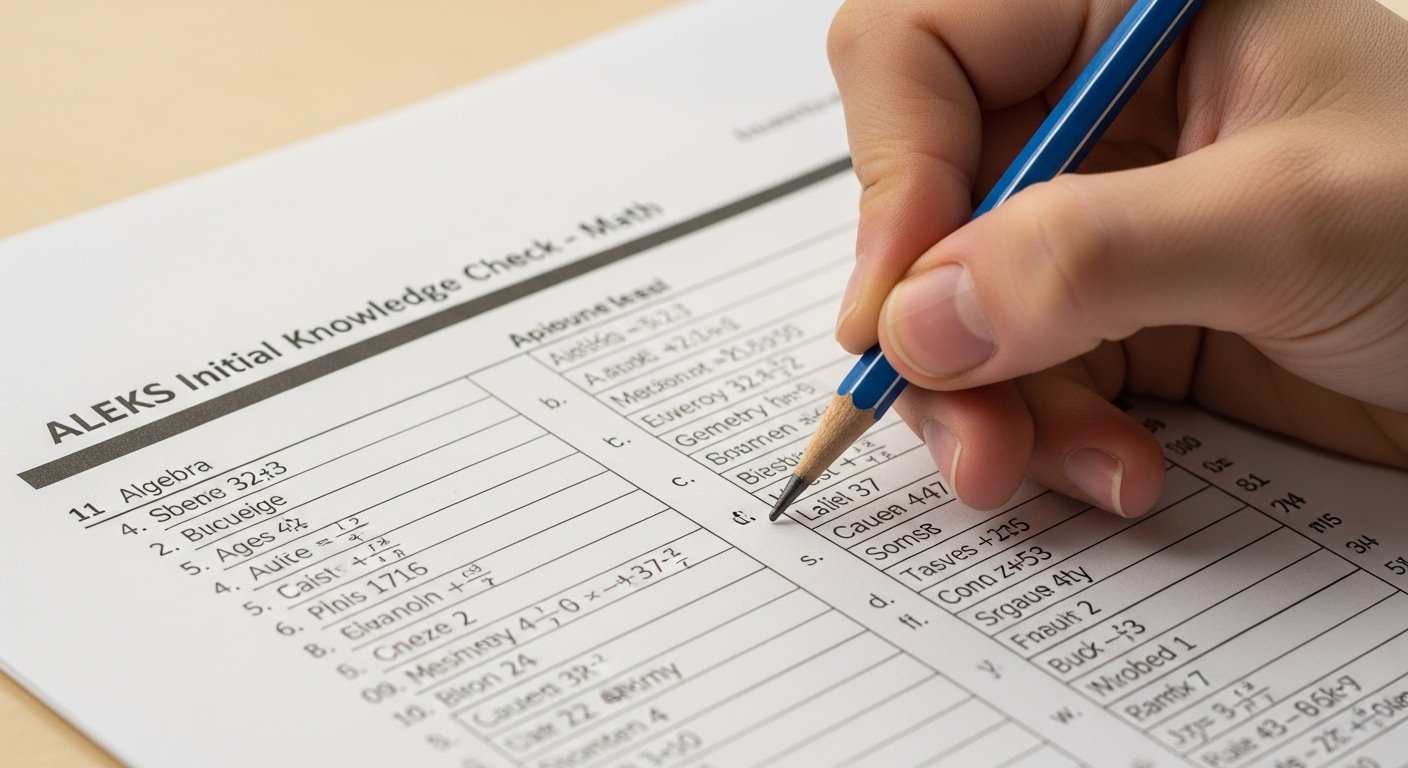
Starting a new math course often brings a mix of excitement and anxiety. If your school uses ALEKS (Assessment and Learning in Knowledge Spaces), your very first step will be the Initial Knowledge Check. This tool figures out exactly what you already know and what you still need to learn, setting the foundation for your entire semester.
What is the Initial Knowledge Check?
The main goal of the ALEKS Initial Knowledge Check is to build a personalized learning path just for you. Instead of forcing everyone in the class through the exact same lessons, ALEKS uses advanced artificial intelligence to map your unique understanding of math.
When you answer questions, the system adapts in real time. If you get a question right, it might give you a slightly harder one. If you struggle, it dials the difficulty back. By the end of the session, ALEKS pinpoints your current math skills and charts a direct course toward mastering the rest of your curriculum.
A Tool, Not a Test
Many students panic when they see unfamiliar math problems. Let us clear up a major misconception right now: the Initial Knowledge Check is not a test. You do not get a grade that impacts your GPA, and you are not expected to get everything right.
It is simply a learning tool. Seeing a question you have never learned how to solve is completely normal. The system just wants to find the outer boundaries of your current knowledge.
How to Approach the Knowledge Check
To get the most out of ALEKS, you need to approach the initial assessment with the right mindset. Keep these tips in mind:
- Be honest: Do not search for answers online, use unauthorized calculators, or ask a friend for help. If you fake your way through the assessment, ALEKS will think you know the material. It will then give you much harder topics during the course, leaving you frustrated and lost.
- Give it your best effort: Try to solve each problem on your own. Grab some scratch paper and a pencil, and treat the session seriously.
- Use the “I don’t know” button wisely: If you genuinely do not know how to approach a problem, click the “I don’t know” button. However, only use this if you are truly stuck. Giving up too easily will force you to spend hours reviewing basic math concepts you actually already understand.
Using Your Results to Grow
Once you finish the assessment, ALEKS generates a colorful pie chart showing your unique knowledge profile. Each slice represents a different math topic, filling up based on what you have mastered.
Use this chart as your daily roadmap. The system will naturally guide you toward the topics you are most ready to learn next. By trusting your personalized path, you will save time, avoid unnecessary busywork, and build genuine confidence in your math skills as you fill your pie.