
Unit conversion is one of the most important skills in mathematics, physics, chemistry, and everyday problem solving. Students often face questions where a conversion equation is already partially written, but one section is missing. The goal is to complete it correctly so that all unwanted units cancel out and only the required unit remains.
This article explains, in a simple and practical way, how to identify and fill in missing conversion factors step by step.
What Is a Unit Conversion Equation?
A unit conversion equation is a mathematical setup used to change a value from one unit to another without changing its actual quantity.
For example:
- meters to centimeters
- kilograms to grams
- cubic centimeters to cubic meters
The main idea is always the same:
👉 Multiply by a fraction (conversion factor) that equals 1, so the value stays the same but the unit changes.
The Core Idea: Canceling Units
The most important principle in unit conversion is unit cancellation.
When setting up an equation:
- Units on the top and bottom should cancel each other out
- The final answer should only have the target unit
If cancellation does not happen correctly, the equation is wrong.
How Missing Parts in Equations Work
Sometimes a teacher or exam question gives a partially completed equation like:
“Fill in the missing conversion factor”
This missing part is usually a ratio that helps connect two units.
Example idea:
If you are converting meters into centimeters, you need a relationship like:
- 1 meter = 100 centimeters
So the missing part could be written as a fraction:
- 100 cm / 1 m OR 1 m / 100 cm
The correct direction depends on which unit you want to remove.
Step-by-Step Method to Solve Missing Conversion Factors
Step 1: Identify starting and ending units
First, clearly see what unit you are given and what unit you need.
Example:
- Given: meters
- Required: centimeters
Step 2: Find the relationship between units
Look for a known equivalence.
Example:
- 1 m = 100 cm
Step 3: Arrange the conversion factor correctly
This is where most students make mistakes.
You must place units so they cancel out.
If meters are on top, put meters on bottom in the conversion factor.
Step 4: Check unit cancellation
Before solving, cancel units like algebraic terms.
If everything cancels correctly, your setup is correct.
Common Types of Missing Conversion Factors
Let’s explore different situations where students are asked to complete missing parts.
1. Length Conversions (Basic Level)
These are the simplest conversions used in early math and science.
Example relationships:
- 1 m = 100 cm
- 1 km = 1000 m
Missing factor example:
If converting km to m:
You may need:
- 1000 m / 1 km
or reversed depending on direction.
👉 The goal is to make km disappear from the equation.
2. Mass Conversions (kg to g and beyond)
Mass conversions are very common in physics and chemistry problems.
Key relation:
- 1 kilogram = 1000 grams
Typical missing section:
If converting from kilograms to grams:
You might insert:
- 1000 g / 1 kg
This ensures kilograms cancel and grams remain.
3. Area and Volume Conversions (Squared and Cubed Units)
This is where many students get confused.
Because units are squared or cubed, the conversion is also raised to a power.
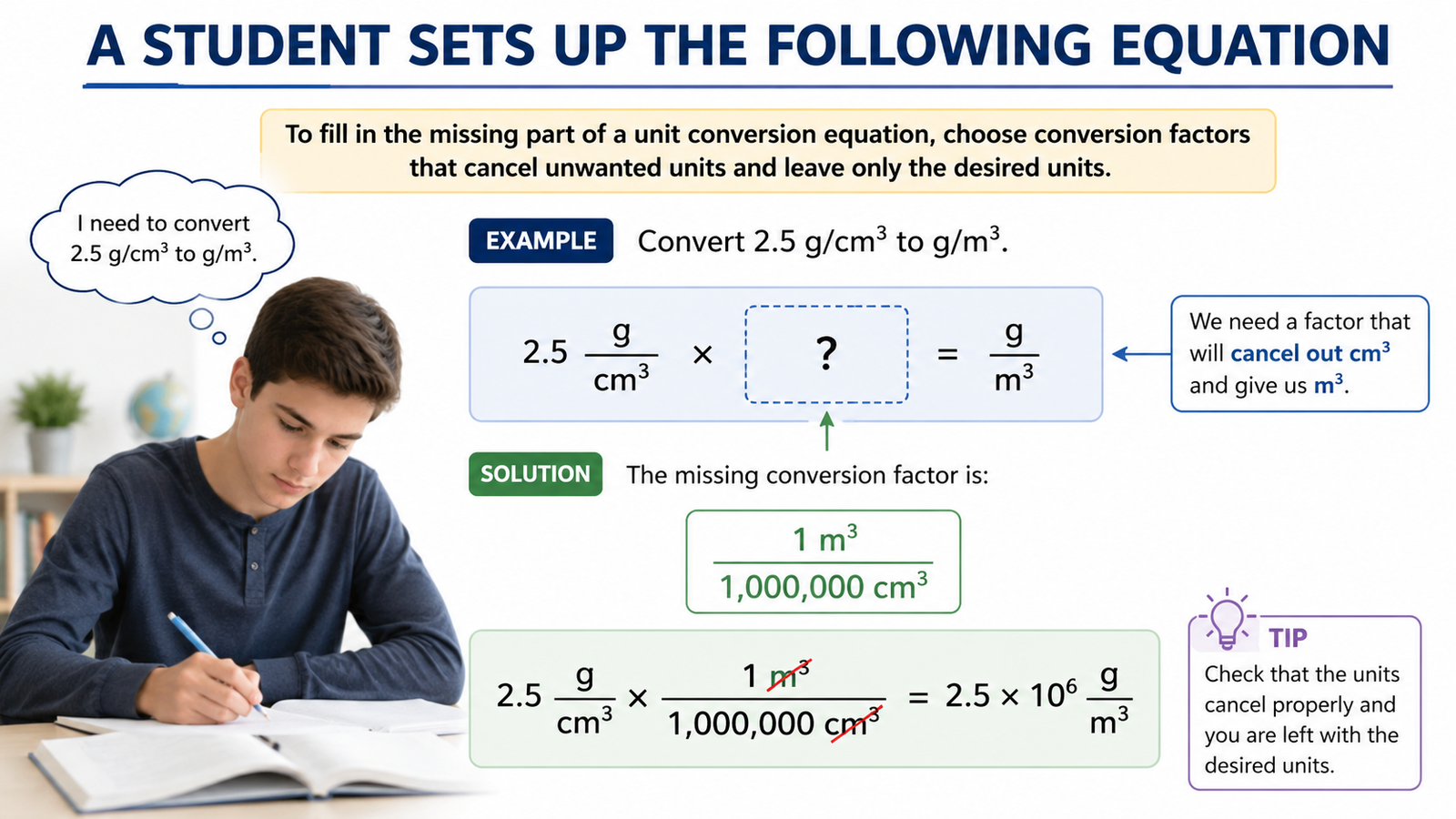
Example: Volume conversion
- 1 m³ = 1,000,000 cm³
So the missing factor may be:
- 1,000,000 cm³ / 1 m³
Important idea:
When converting:
- cm → m is ×100
- but cm³ → m³ becomes ×1,000,000
Because dimensions multiply in all directions.
4. Density and Compound Units
Density involves both mass and volume, which makes it slightly more complex.
Typical unit:
- g/cm³ or kg/m³
Example situation:
Converting between systems like g/cm³ and g/m³ requires adjusting both:
- mass units
- volume units
So students often need a combination of factors such as:
- gram to kilogram conversion
- cubic centimeter to cubic meter conversion
The missing part usually includes multiple ratios multiplied together to ensure full cancellation.
5. Mixed Unit Conversions (Speed, Force, etc.)
Some problems involve combined units like:
- m/s
- kg·m/s²
In these cases, each unit must be handled separately.
Key idea:
Treat numerator and denominator independently.
Example:
- convert seconds and meters separately
- ensure each unit cancels correctly
Common Mistakes Students Make
Wrong orientation of fractions
Placing units in the wrong position causes incorrect cancellation.
Forgetting squared or cubed units
Not adjusting powers leads to wrong answers.
Skipping unit checking
Students often calculate without confirming cancellation.
Mixing unrelated conversion factors
Using wrong relationships (e.g., cm to kg) breaks the equation.
Smart Tips to Solve Faster
✔ Always write units clearly before numbers
✔ Treat units like algebra variables
✔ Cancel units before doing multiplication
✔ Memorize basic conversion facts (m–cm, kg–g, etc.)
✔ Double-check final unit matches the question
Why Unit Conversion Is Important
Unit conversion is not just a classroom topic. It is used in:
- Engineering calculations
- Scientific experiments
- Medical dosage measurements
- Construction and architecture
- Daily life measurements
Understanding it properly builds strong logical and analytical thinking skills.
Final Thoughts
Filling missing parts in unit conversion equations is not about memorization—it is about understanding structure and logic. Once students learn how units cancel and how conversion factors work, even complex problems become simple.
The key is always the same:
👉 Make unwanted units disappear
👉 Leave only the required unit behind
With practice, students can quickly identify missing factors and solve conversion problems confidently and accurately.