

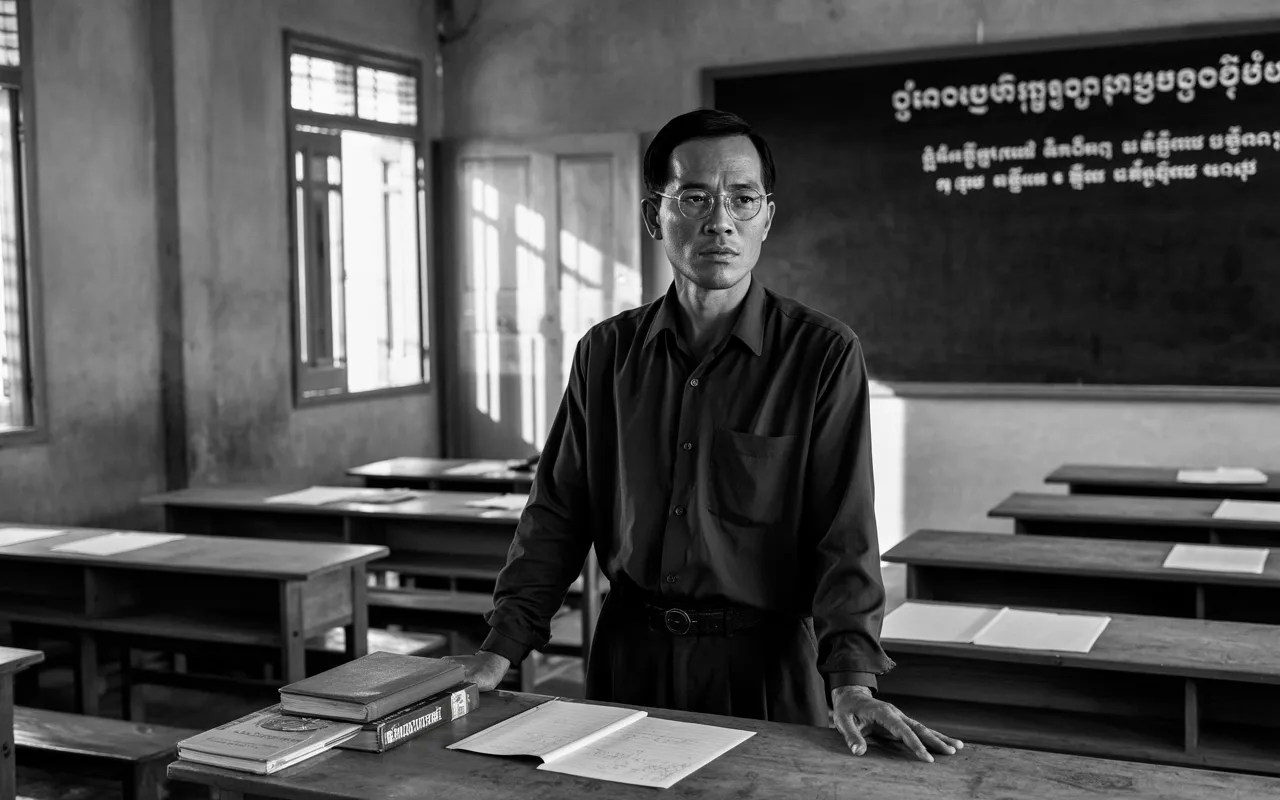
Long before he became known to the world as the architect of the Khmer Rouge, Pol Pot was a soft-spoken schoolteacher in Phnom Penh named Saloth Sar. While history remembers him for the devastating Cambodian genocide of the 1970s, his formative years offer a stark contrast to his later actions. Understanding his time in the classroom provides important insight into how he developed and spread the radical ideology that would eventually tear his country apart.
Cambodia in the Mid-20th Century
To understand Saloth Sar’s path, we must look at the Cambodia of his youth. During the 1950s and early 1960s, the country was undergoing massive shifts. Cambodia was transitioning out of decades of French colonial rule and navigating its newly won independence under King Norodom Sihanouk. The political climate was tense and heavily polarized. While the royal government maintained strict control, underground communist and anti-imperialist movements began to gain traction, particularly among young intellectuals who had studied abroad.
Education and Radicalization in France
Saloth Sar grew up in a relatively prosperous farming family with ties to the Cambodian royal court. He received a traditional education, including time at a Catholic school, before earning a scholarship to study radio electronics in Paris in 1949.
France proved to be an ideological turning point. Rather than focusing on electronics, he spent most of his time reading Marxist texts and associating with the French Communist Party. He joined a tight-knit circle of Cambodian students who discussed anti-colonialism and communist theory. Because he devoted his energy to political organizing rather than his coursework, he failed his exams repeatedly. His scholarship was revoked, forcing him to return to Cambodia in 1953 without a degree.
The Gentle Teacher of Chamraon Vichea
Upon returning to Phnom Penh, Saloth Sar needed a steady income to support his underground political work. In 1956, he took a job teaching history, geography, and French literature at Chamraon Vichea, a private college in the capital.
Accounts from former students and colleagues paint a surprising picture of the man who would later dismantle the country’s education system. As a teacher, he was well-liked, charismatic, and unfailingly polite. He spoke softly, dressed neatly, and showed a deep knowledge of French poetry. Students respected him for his calm demeanor and his ability to explain complex historical events in simple, engaging terms. He never displayed anger in the classroom, earning a reputation as a patient and accessible mentor.
Shaping Minds and Building a Movement
The classroom served as more than just a workplace for Saloth Sar; it became a quiet incubator for his political ambitions. His role as a teacher gave him a captive audience of young, impressionable minds.
While he rarely spoke openly about communism in class, he subtly wove anti-establishment themes into his lessons. When teaching history or literature, he highlighted the struggles of the peasantry, the injustices of colonial rule, and the corruption of the wealthy elite. He paid close attention to his students, identifying those who showed a strong sense of social justice or frustration with the government.
Outside of school hours, he invited these select students to private study groups. Here, he slowly introduced them to radical political literature and recruited them into the underground communist movement. Many of his students from Chamraon Vichea went on to become high-ranking cadres within the Khmer Rouge. They trusted him implicitly, viewing him as an intellectual father figure who understood their frustrations and offered a clear vision for a more equal society.
From the Classroom to the Jungle
Saloth Sar continued teaching until 1963. As the Cambodian government began to crack down heavily on suspected leftists, his position in Phnom Penh became too dangerous. He fled the capital for the jungle to join the armed resistance full-time, fully adopting his revolutionary pseudonym, Pol Pot.
His years as a teacher played a crucial role in his rise to power. The skills he honed at Chamraon Vichea—speaking persuasively, breaking down complex ideas into simple slogans, and inspiring deep loyalty in young people—became the same tools he used to build the Khmer Rouge. The gentle educator persona allowed him to build a devoted following, laying the groundwork for the brutal agrarian revolution that would follow just a decade later.